What Does Rembrandt's The Jewish Bride Mean?

A man's hand rests on a woman's chest, and nobody agrees on who they are. Even the painting's title was never Rembrandt's own choice.

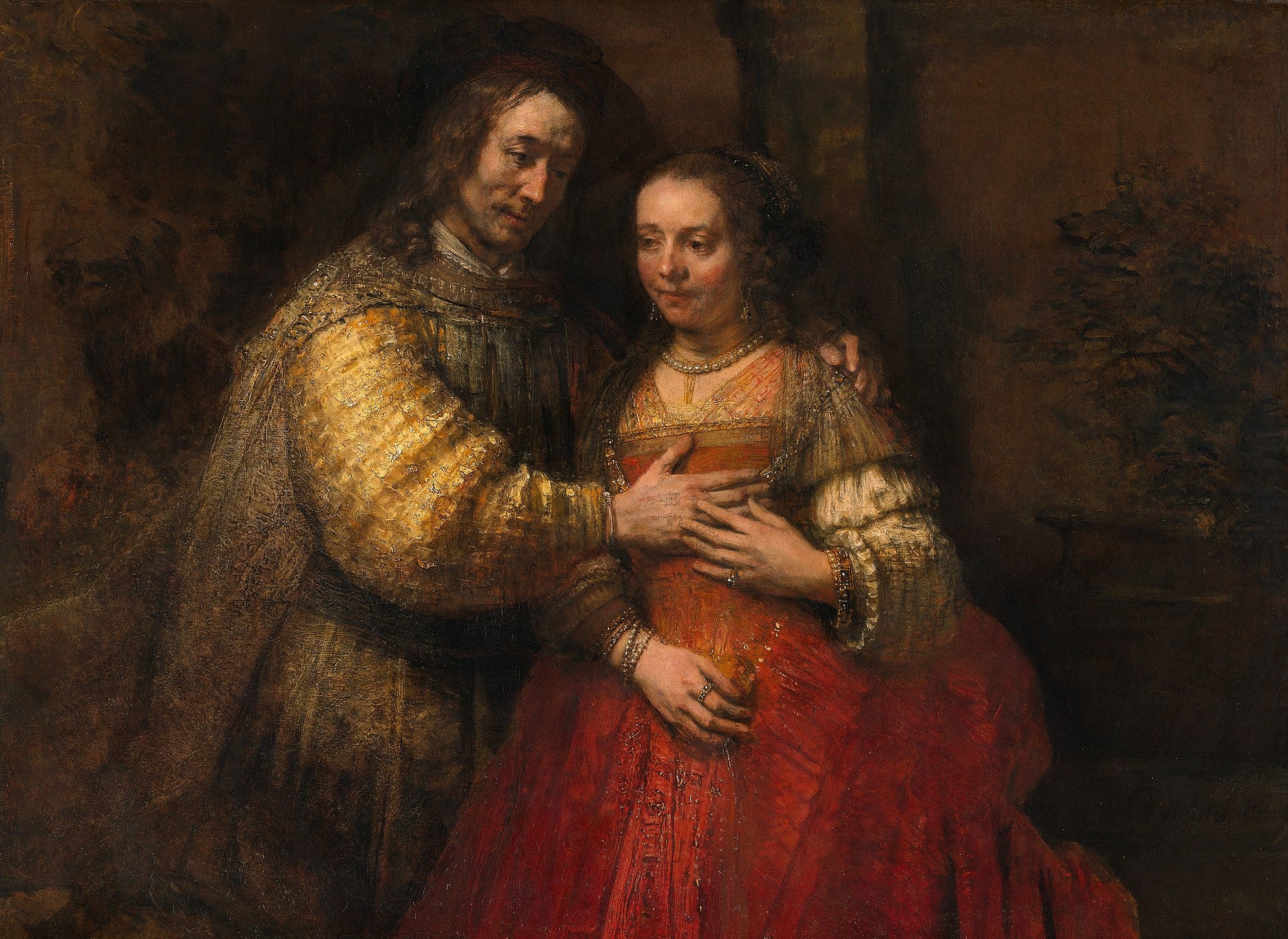
Rembrandt's The Jewish Bride shows a man resting his hand on a woman's chest while she covers it with her own. Painted around 1665, the couple's true identity is still debated, and even the title is a nickname nobody asked for.

Rembrandt couple tender embrace
Rembrandt, The Jewish Bride, circa 1665.

I find this one of the most tender paintings Rembrandt ever made, and also one of his strangest mysteries. Nobody agrees on who these two people actually are.

  • Date: Rembrandt painted The Jewish Bride sometime between 1665 and 1669, near the end of his life.

  • Medium: The work is oil on canvas and hangs today in the Rijksmuseum in Amsterdam.

  • Location: The title Het Joodse Bruidje, or The Jewish Bride, was given by a later owner and was never Rembrandt's own name for the painting.


Never miss a story like this one. Join 170,000 readers discovering the stories behind the world's greatest paintings.


More stories worth your time

If painted couples and hidden identities interest you, these dig into similar ground.


A gesture nobody has fully explained

The man's hand rests flat on the woman's chest, just above her heart. She doesn't push it away; her own hand settles gently over his. Art historians keep returning to that gesture because it reads as real tenderness rather than the formal poses common in portraits of the period, and nobody knows whether Rembrandt was recording an actual couple's affection or painting an idea of married love.

Isaac and Rebecca, or somebody else entirely

The most repeated theory ties the painting to Genesis: Isaac and his wife Rebecca, travelling in a foreign land, pretend to be brother and sister until a king catches them showing affection through a window. Other historians think Rembrandt simply painted a real Amsterdam couple in costume, possibly even his own son Titus and his bride Magdalena van Loo, who married in 1668.

Genesis 26 tells the story in a single tense scene: the king Abimelech looks out a window and sees Isaac caressing Rebecca, realizing they lied about being siblings. Rembrandt kept the tenderness of that private moment but stripped away any narrative clue that would tie it firmly to the text. To me, that stripping away is the whole decision. Rembrandt keeps the feeling and drops the plot, so the picture works even if you never learn the story behind it.

Other historians think Rembrandt simply painted a real couple from Amsterdam, dressed in costume, and that the biblical reading came later.

Older Rembrandt self portrait
Rembrandt, Self Portrait, circa 1665.

Rembrandt painted this scene near the end of his own life, around the same years he painted himself looking older and heavier, in the self portrait above.

Rembrandt son Titus portrait
Rembrandt, Titus, the Artist's Son, circa 1660.

Rembrandt painted the people close to him often. His son Titus, shown above, appears in several works from the same late period.

Titus died within the year of his marriage, and Rembrandt followed him the year after. If the theory holds, the painting shows a marriage that barely outlasted the canvas itself. Most historians treat it as one reading among others, not a settled fact.

A title Rembrandt never chose

For most of its history this painting had no fixed name. A nineteenth century owner started calling it Het Joodse Bruidje, The Jewish Bride, apparently guessing the couple was a Jewish father giving away his daughter. The name stuck even though most historians now doubt that reading entirely.


The story doesn't end with the gesture. Join 170,000 readers discovering the stories behind the world's greatest paintings.


Why Van Gogh wanted to sit in front of it

Vincent van Gogh saw The Jewish Bride at the Rijksmuseum and reportedly said he would give ten years of his life for two weeks in front of it, with only dry bread to eat. Part of the pull is technical: Rembrandt built up the man's sleeve and the woman's dress with thick ridges of paint, applied partly with a palette knife rather than a brush alone.

Rembrandt was in his late fifties by the time he painted this, working without wealthy patrons and largely outside fashion. He kept painting the way he wanted to paint, not the way buyers of the 1660s wanted him to. What strikes me is that stubbornness. He was not chasing fashion at that point in his life, he was painting exactly what he wanted.

Van Gogh self portrait grey hat
Vincent van Gogh, Self Portrait with Grey Felt Hat, 1886 to 1887.

Rembrandt returned to tender and difficult love stories throughout his career. Bathsheba at Her Bath, painted a decade earlier, shows the same interest in intimacy and consequence.

Rembrandt Bathsheba biblical scene
Rembrandt, Bathsheba at Her Bath, 1654.

The texture is so raw in places that some later restorers assumed sections were unfinished. Most historians now read it as a deliberate late style choice, not an accident.

I think that raw texture is exactly what Van Gogh responded to. It looks less like paint describing skin and more like paint becoming skin.

Keep exploring


From a private collection to the Rijksmuseum

Amsterdam collector Adriaan van der Hoop owned the painting by the middle of the nineteenth century. When he died in 1854, he left his entire art collection to the city of Amsterdam, a bequest that became one of the founding blocks of what later grew into the Rijksmuseum, where the painting has hung since 1885.

Van der Hoop's bequest included more than 200 paintings, and this one was already recognized as a highlight among them, long before the modern title existed.

The Rijksmuseum has changed buildings and gone through a decade long renovation since acquiring the painting, finishing major restoration work in 2013. The Jewish Bride made the move each time without significant damage, unlike some Rembrandts that show old cracking from earlier transport or poor storage.

What technical examination reveals

Technical examination of the canvas has revealed pentimenti, earlier positions Rembrandt painted over before settling on the final composition, a kind of reworking common in his late paintings. Comparing the composition to related sketches, some scholars also believe the canvas was reduced from a larger scene, possibly a garden setting that once included more of the couple's surroundings.

Infrared reflectography, the standard tool for this kind of study, lets conservators see beneath the visible paint layer without removing a speck of pigment.

If that reading holds, the tight, close framing viewers see today was not entirely Rembrandt's original choice. It may be the result of a later owner trimming the canvas to fit a smaller wall.

A canvas built for close viewing

The painting measures close to 121 by 166 centimeters, life size enough that a viewer standing near it feels close to the couple rather than looking at them from a formal distance. That scale is part of why the Rijksmuseum keeps the painting at eye level in a room built around it, rather than hanging it high on a crowded wall.

FAQ

  • Who are the two people in Rembrandt's Jewish Bride?

    Their exact identity is unknown. The most common theory links them to Isaac and Rebecca from the Book of Genesis, but some historians believe Rembrandt painted a real Amsterdam couple instead.

  • Why is the painting called The Jewish Bride if nobody is sure who they are?

    The title came from a nineteenth century collector who assumed the scene showed a Jewish father giving away his daughter. Rembrandt never gave the painting that name himself.

  • Where can I see The Jewish Bride today?

    The painting hangs in the Rijksmuseum in Amsterdam, where it has been part of the collection since 1885.

  • Did Van Gogh really admire this painting?

    Yes. Van Gogh is reported to have said he would give ten years of his life to sit in front of the painting for two weeks with just dry bread to eat.

  • When did Rembrandt paint The Jewish Bride?

    Most historians date the work to sometime between 1665 and 1669, placing it among the last paintings Rembrandt completed before his death in 1669.

  • Could the canvas have looked different originally?

    Possibly. Some scholars believe the composition was cut down from a larger scene, based on comparison with related sketches, which would mean the tight framing seen today was not entirely Rembrandt's own choice.


Real mysteries, real paintings, every week. Join 170,000 readers discovering the stories behind the world's greatest paintings.