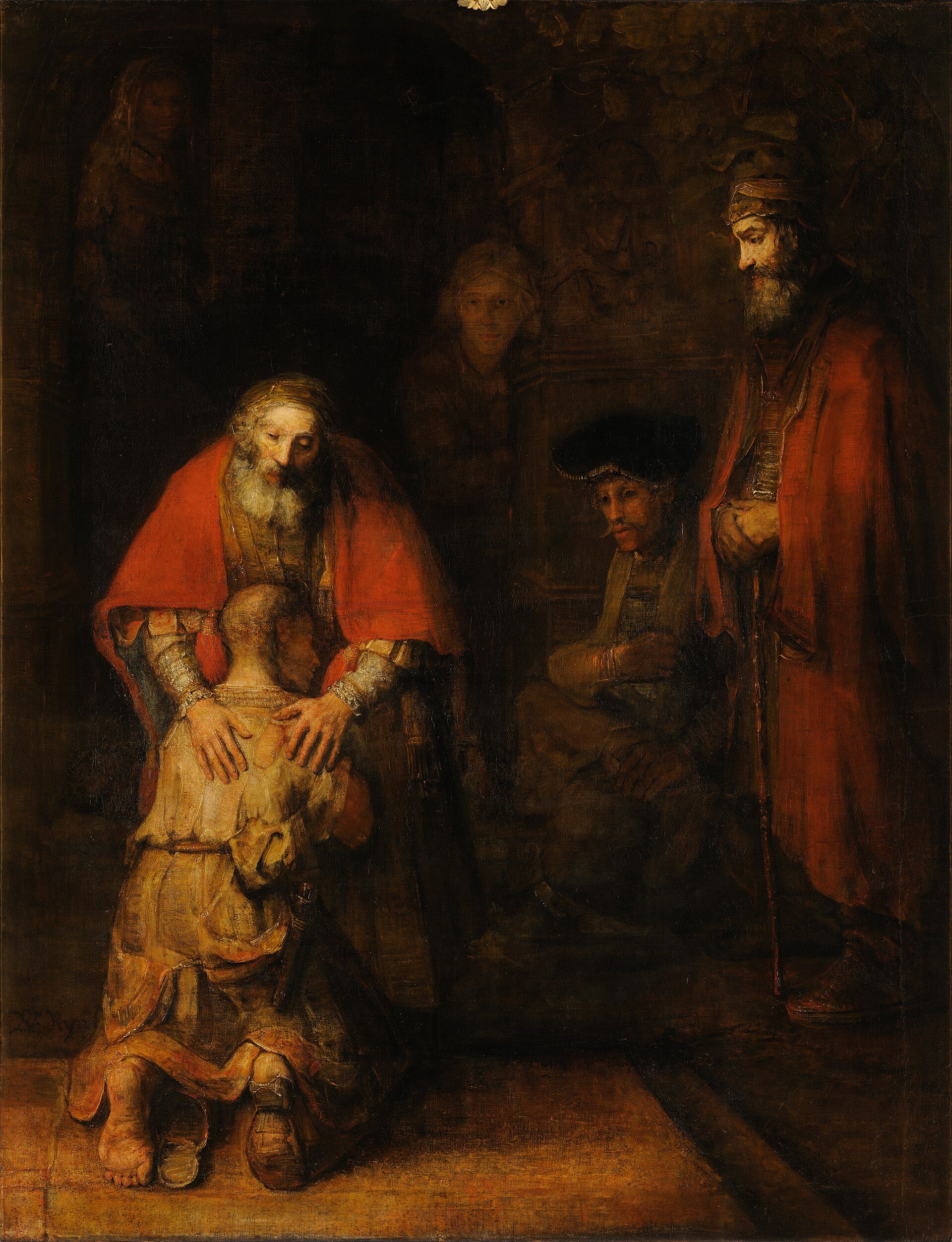
Rembrandt's The Return of the Prodigal Son shows the exact moment a father forgives a son who wasted everything and came home broken. He painted it around 1668, near the end of his own life, after bankruptcy and burying nearly everyone he loved.
It illustrates the parable in Luke 15, where a young man demands his inheritance early, squanders it in a foreign country, and returns starving and ashamed, expecting nothing more than a servant's job.
Artist: Rembrandt van Rijn, Dutch, 1606 to 1669
Painted: circa 1668, near the end of his life
Housed at: The State Hermitage Museum, Saint Petersburg
More Paintings About Family, Guilt, and Grace
The ones I would send you to next.
The Parable Rembrandt Kept Coming Back To
The story comes from the Gospel of Luke, chapter 15. A younger son asks his father to hand over his share of the inheritance while the father is still alive, which in that world was close to wishing him dead.
He takes the money, leaves home, and burns through it in what the text calls dissolute living. When a famine hits, he ends up feeding pigs for a living, which for a Jewish audience was about as low as a person could fall.
Starving, he decides to go home and beg to be taken on as a hired servant, since even his father's servants eat better than he does. In the parable, the father sees him from a distance and runs to him. Rembrandt does not paint the running.
He paints the second after, when the son is already on his knees and the father's hands have already landed on his back.
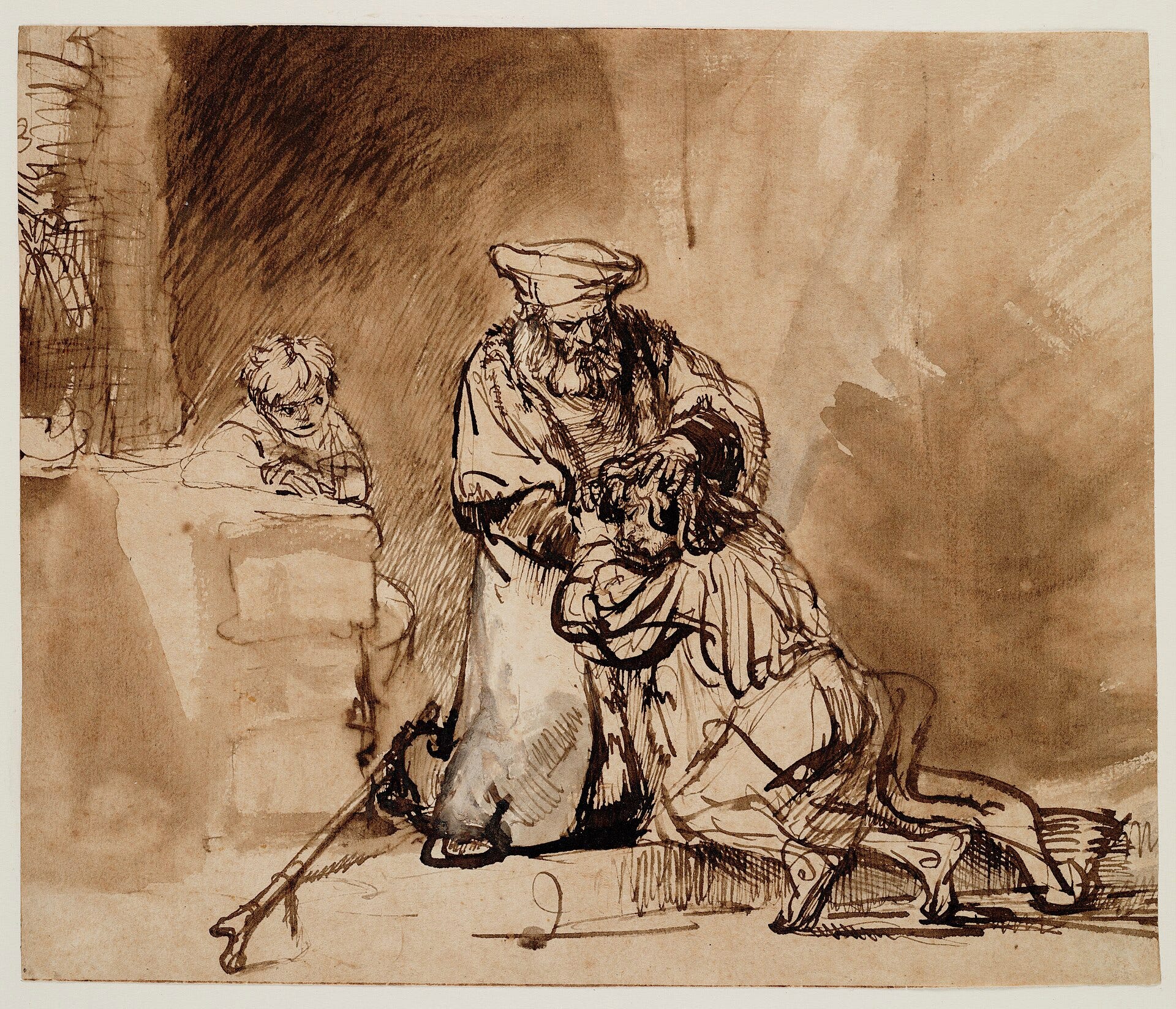
This is the choice that makes the painting work. Rembrandt had drawn and etched this same story for more than thirty years, going back to a 1636 etching, but every earlier version showed movement, gesture, an event happening.
Here, at the end of his own life, he paints stillness instead, and that stillness is the whole point.
The Son Who Never Left, Standing to the Side
Off to the right, half in shadow, stands another man in dark, expensive robes. Arms crossed, face closed. This is the elder brother, and in the parable he refuses to celebrate.
In his own words in the text, he tells his father he has slaved for him for years without so much as a goat to celebrate with his friends, while this other son, who blew the family's money on prostitutes, gets a feast the day he walks back in.
It is one of the most honest complaints in the whole Bible.
There are two more figures further back, a woman barely visible in the upper left, likely meant to be the mother, and a seated man dressed like someone with money, possibly a steward or a tax collector.
Historians still argue about exactly who they are supposed to be. Rembrandt never wrote it down, and nobody who knew him left an answer either.
The Dutch priest and writer Henri Nouwen spent hours alone in front of this painting at the Hermitage in 1986 and later wrote an entire book about it. His observation stuck with me: Rembrandt was not just the father in this picture.
By the end of his life he had been the reckless younger son and the resentful older one too.
Two Hands That Do Not Match
Look closely at the father's hands on his son's back, and something is off in a way that took art historians years to fully articulate. The hand on the left is bigger, rougher, clearly a man's hand, pressing down with some force.
The hand on the right is smaller, softer, the fingers close together in a gentler, almost cradling gesture. Several scholars have read this as deliberate. One hand fathers. The other mothers.
I do not think that is a stretch. Rembrandt was in complete control of his brush at this stage of his career, not fumbling around by accident. If he wanted two identical hands, he was more than capable of painting two identical hands.
What he gives instead is a single figure carrying both kinds of love at once, the kind that holds firm and the kind that simply comforts. That is a strange thing for one man to paint after losing basically every woman who ever mothered anyone in his own life.
It reads less like theology and more like a wish.
This same tenderness is a world away from the Rembrandt most people meet first, the confident young painter who made his name with crowded, dramatic group portraits.
A Man Who Had Buried Everyone He Loved
In 1632, a twenty six year old Rembrandt made his name in Amsterdam with The Anatomy Lesson of Doctor Nicolaes Tulp, a group portrait so sharp and alive that commissions started pouring in almost overnight.
Ten years later he painted The Night Watch, the enormous militia portrait that became his most famous work and, by most accounts, the high point of his public career.
None of that early success protected him. In 1656, he was forced into a form of bankruptcy, and his house on the Jodenbreestraat and nearly everything he owned, his art collection, his furniture, his prints, was auctioned off to pay his debts.
That was not even his worst decade. His wife Saskia died in 1642, after the couple had already lost three infant children and only their son Titus survived. His later companion, Hendrickje Stoffels, died in the early 1660s.
Then Titus, his one surviving child, married in February 1668 and was dead by September that same year, most likely while Rembrandt was still working on this canvas. Rembrandt himself would be gone within a year of finishing it.
This is one of the reasons the painting reads less like religious duty and more like something Rembrandt actually needed to paint.
So when Rembrandt painted a father forgiving a son who wasted everything, he was not guessing at either role from the outside. He had been financially reckless himself. He had also spent years waiting for people who were never coming back.
More Secrets to Unlock
A few more stories worth your time.
The Late Rembrandt Style: Shadow Doing the Work of Light
Rembrandt's early work is crisp, detailed, almost showing off. This painting is the opposite. The background dissolves into near black, and there is barely any defined space behind the figures.
All the paint, thick and built up almost like plaster in places, sits on the father's robe and the son's tattered back. Everything else gets left in the dark on purpose. Your eye has nowhere else to go.
That deep shadow around a single lit passage is chiaroscuro, a technique Rembrandt had spent forty years mastering by the time he painted this.
This restraint is what separates late Rembrandt from the younger painter who built a career on flashy self portraits and society commissions.
By 1668 he was not interested in impressing anyone. He was interested in one gesture, lit correctly, and he stripped away everything that competed with it.
That same tenderness turns up again in The Jewish Bride, painted only a few years before this canvas, another late picture built entirely around one quiet, unshowy gesture of affection.
The Detail Most Retellings Leave Out
Most articles about this painting mention the two hands and stop there. What gets skipped is that Rembrandt did not paint the prodigal son once.
He returned to this exact story across four decades, in a 1636 etching, in drawings from the early 1640s, and in at least one earlier painting of the son wasting his money in a brothel.
That matters because it means this was not a one off religious commission. It was closer to an obsession, a story he kept rewriting as his own life gave him more reasons to understand it.
I trace that fuller arc, from his apprentice years to this final canvas, in the complete story of Rembrandt.
The second thing that gets flattened into certainty online is the identity of the two background figures. Plenty of sites will tell you flatly who the woman and the seated man are.
The honest answer, based on the actual scholarship, is that nobody knows for sure, and Rembrandt left no notes explaining his own painting.
The third thing worth noticing is what he left out. Luke's parable has the father running to his son. Rembrandt paints an old man standing still, bent forward, feet planted. He slowed down the most dramatic verb in the whole story on purpose.
From a Paris Town House to a Room in the Hermitage
The painting is enormous, close to nine feet tall, which is not something you get a real sense of from a photo on a screen.
It was bought out of the Paris collection of the Duke d'Ancezune in 1766, arranged through the philosopher Denis Diderot and Prince Dmitry Golitsyn, acting as agents for Catherine the Great of Russia.
It has been part of the Hermitage Museum in St. Petersburg ever since, and as far as the museum's own records show, it has never once been lent out for a traveling exhibition. If you want to see it, you go to St. Petersburg.
The art historian Kenneth Clark once called it a picture that anyone who has stood in front of the original in St. Petersburg could be forgiven for calling the greatest picture ever painted.
That is a big claim, and I do not throw around superlatives like that lightly when I write about painters. But standing in front of thick, dark, quiet paint that a bankrupt, grieving seventy year old man made about being forgiven, I get why he said it.
Rembrandt is routinely ranked among the handful of painters who mattered most in the entire history of the medium, and he is never far from the top of that conversation.
FAQ
What does Rembrandt's Return of the Prodigal Son mean?
It shows a father forgiving his son without conditions, the moment repentance meets mercy rather than judgment. Rembrandt painted it near the end of his own life, after bankruptcy and the loss of nearly everyone close to him, which gives the forgiveness in the picture a weight that goes beyond the Bible story alone.
What Bible story is the painting based on?
It is based on the parable of the prodigal son in Luke 15:11 to 32, where a younger son demands his inheritance, wastes it, and returns home in poverty to a father who forgives him instantly.
Why does the father have two different hands in the painting?
One hand is larger and rougher, read as masculine, and the other is smaller and softer, read as feminine. Many scholars believe Rembrandt combined a father's and a mother's touch into a single gesture of complete, unconditional love.
When did Rembrandt paint the Return of the Prodigal Son?
Most historians date it to around 1668, roughly one to two years before Rembrandt died in October 1669, making it one of his final major works.
Where can you see the Return of the Prodigal Son today?
It hangs in the State Hermitage Museum in St. Petersburg, Russia, where it has been part of the collection since it was acquired for Catherine the Great in 1766. The museum does not lend it out for traveling shows.
Who is the man standing on the right side of the painting?
He is the elder brother from the parable, the son who stayed home and worked while his brother spent the family's money. He stands apart with his arms crossed, unwilling to join the celebration.
Was Rembrandt going through hardship when he painted this?
Yes. He had been through a public bankruptcy in 1656 that cost him his house and his art collection, and by the time he painted this picture he had lost his wife, his companion, and his only surviving son.
How big is the Return of the Prodigal Son?
The canvas measures roughly 262 by 205 centimeters, close to nine feet tall, which makes the figures close to life size when you stand in front of it.