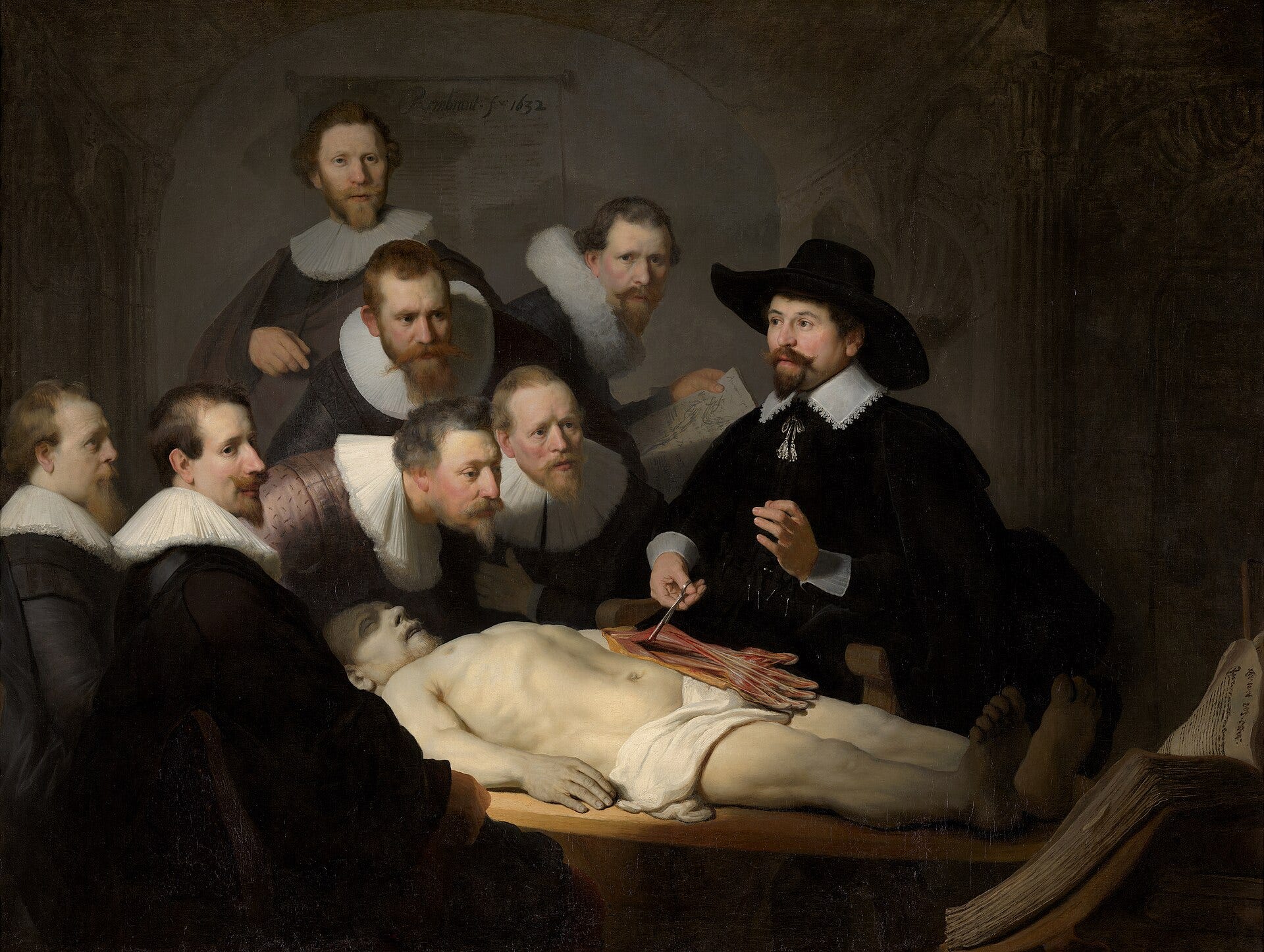
The Anatomy Lesson of Dr Nicolaes Tulp is a 1632 group portrait, not a science record. Rembrandt painted seven paying Amsterdam surgeons around Dr Tulp, who dissects the forearm of executed criminal Aris Kindt.
The Vesalius text at his feet signals method over superstition, tying medical status to printed science and public display.
What gets me about this painting is that everyone remembers it as a science image, when really it is a payment structure with a body in the middle. Tulp is not mid genius insight, he is mid job, demonstrating tendons for men who bought their spot in the composition. The mismatch in the forearm, right hand shown on a left arm, is not some coded riddle either, most likely it is Rembrandt correcting his own sketch and running out of room to fully undo it. I find that more interesting than any hidden message theory. It means the most famous science painting in art history has an ordinary studio mistake sitting in plain view, and nobody has managed to erase it in almost four hundred years.
A Portrait Dressed Up As A Dissection
The Anatomy Lesson of Dr Nicolaes Tulp looks like a science demonstration. It is actually a group portrait. Seven paying members of the Amsterdam Guild of Surgeons commissioned Rembrandt to paint them witnessing a public dissection led by their praelector, Dr Nicolaes Tulp.
Rembrandt was twenty five years old. This was his first major commission in Amsterdam, and it set the pattern for the rest of Rembrandt's career, from crowded group portraits to the quiet self portraits of his final years.
The painting hangs in the Mauritshuis in The Hague. It has stayed there since 1828.
Who Was On The Table
The corpse belongs to Aris Kindt, born Adriaan Adriaanszoon. He was hanged on 31 January 1632 for armed robbery, having stolen a coat.
Public dissections only used the bodies of executed criminals. It was both a legal source of cadavers and a form of punishment that continued after death, since there was no proper burial and the body was opened in front of a paying crowd.
Kindt's low status is part of the point. He is the only figure without a name recognized by history until much later, stretched flat while eight guild members in starched collars look poised above him.
What Tulp Is Actually Showing
Tulp is not opening the chest, which is where dissections usually began before decomposition made deeper work impossible. He has moved to the left forearm, using forceps to lift the flexor tendons that curl the fingers.
Some viewers have noted a detail: the exposed arm matches the position of a right arm rather than a left one. Historians reading Rembrandt's early sketches think he adjusted the final canvas from an earlier study, and the mismatch may be a working error rather than deliberate symbolism.
Tulp is demonstrating the mechanics of grip, the muscles and tendons working together, the practical curiosity that made Dutch medicine confident and public facing.

More Rembrandt And Group Portrait Stories
The Book At The Feet
At Kindt's feet sits a large anatomy textbook, most likely Andreas Vesalius's De Humani Corporis Fabrica, the 1543 text that reorganized how European doctors understood the body by insisting on direct observation over inherited theory.
Its presence in the painting works as a credential. It says this is not superstition, this is method, backed by printed authority.
Eight Faces, One Bill
Group portraits like this one followed a simple system in the Dutch Republic: each sitter paid to be included, and the price usually depended on visibility. That is why the men are staggered instead of lined up, and why more than one looks straight at the viewer instead of at Tulp.
The man at the top, Frans van Loenen, points at the corpse while looking out of the canvas, connecting the viewer to the scene. It reads less like commissioned formality and more like a direct address.
Light As Argument
A single source of light falls across the seated men and the body, leaving the ceiling, Tulp's raised hand, and the pale corpse in near shadow.
Rembrandt used the same lighting instinct through the years: put the light where the meaning is. Here it lands first on knowledge changing hands, and second on the body that made the demonstration possible.
How Accurate Is The Scene
The painting is not a snapshot of an actual afternoon. Records show only seven or eight surgeons in the guild in 1632, and historians believe some were added to the composition after the real dissection, included for the fee rather than for attendance.
Hidden details like this show up across art history, in paintings far more famous than this one. Historians treat the scene as staged for effect and payment, a common practice for Golden Age group portraits, not a documentary record of one January dissection.
Why It Still Gets Read And Reread
W.G. Sebald wrote about Kindt's oversized hand in The Rings of Saturn, noting the anatomical error and treating it almost as a wound at the center of the painting itself.
Nearly four centuries later, the painting still gets cited as an image of how science, status, and public spectacle used to share the same room without contradiction.
Discover more art stories
Frequently Asked Questions About The Anatomy Lesson
What is the Anatomy Lesson of Dr Nicolaes Tulp about?
It is a 1632 group portrait by Rembrandt showing Amsterdam surgeons, led by Dr Nicolaes Tulp, gathered around the dissected body of executed criminal Aris Kindt during a public anatomy demonstration.Who is the corpse in the painting?
The body belongs to Aris Kindt, hanged on 31 January 1632 for armed robbery. Only the corpses of executed criminals were legally used for public dissection in the period.Why is Tulp dissecting the arm instead of the chest?
Most 17th century dissections started with the chest and abdomen, which decayed fastest, then moved to the limbs. Tulp is shown demonstrating the tendons of the forearm, a later stage of the lesson.What book is at the feet of the corpse?
It is most likely Andreas Vesalius's De Humani Corporis Fabrica, the foundational 1543 anatomy text. Its presence signals that the guild's methods were grounded in studied, printed science.Is the anatomical detail in the painting accurate?
Not entirely. Several viewers have pointed out that the exposed forearm appears to match a right arm rather than the left one being dissected, likely a result of Rembrandt reworking the composition from earlier studies.Why does one man look directly at the viewer?
Frans van Loenen, at the top of the group, points at the body while meeting the viewer's eyes. It breaks the internal focus of the scene and pulls the audience into the demonstration.Where can I see the Anatomy Lesson of Dr Nicolaes Tulp today?
The painting hangs in the Mauritshuis museum in The Hague, Netherlands, where it has been on public display since 1828.Was this painting a real historical event or staged for the portrait?
It combines both. Tulp did lead an anatomy lesson in January 1632, but historians believe not every guild member shown was present. Some were likely added to the composition for a fee.