What Does The Ancient of Days by William Blake Mean?

A god like figure reaches down from the clouds with a compass, and most people assume it is a picture of creation. Blake meant it as a warning.

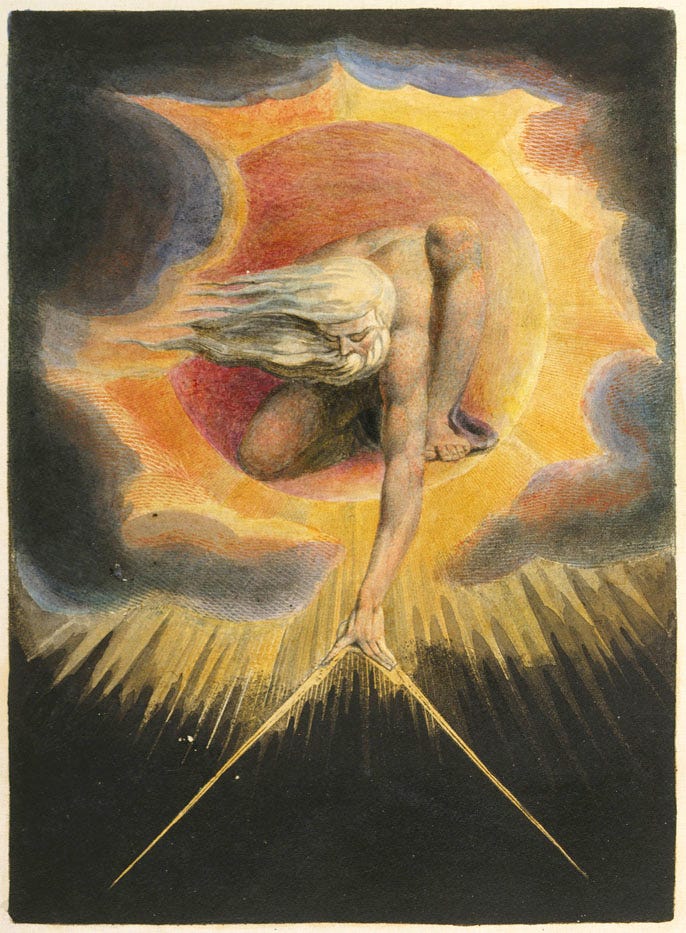
The Ancient of Days shows a bearded figure crouched inside the sun, reaching down with a compass. Most people read it as God creating the world. William Blake painted it as a warning against cold, rigid reason.

The Ancient of Days William Blake print
William Blake, The Ancient of Days, 1794, frontispiece to Europe a Prophecy.
  • Made: 1794, as the frontispiece to Europe a Prophecy

  • Figure: Urizen, Blake's invented symbol of rigid reason and law

  • Method: relief etching, hand colored by Blake himself


Learn art the fun way. Join 170,000 readers getting one painting and its story every week.


More Paintings That Aren't What They Look Like

If you like knowing what is actually going on inside a picture, start with these three.


I used to have a print of this hanging in a college dorm room, treated like a cool poster of an old testament God. Nobody I knew had any idea it was a criticism.

That gap between what the image looks like and what Blake meant by it is the whole story worth knowing here.

William Blake portrait by Thomas Phillips
William Blake, portrait by Thomas Phillips, 1807.

Who Is the Figure in the Painting

The title comes from the Book of Daniel, one of the biblical names for God. But the figure Blake actually painted is not God in any conventional sense. His name is Urizen, a character Blake invented for his own private mythology.

Urizen shows up across several of Blake's illuminated books as the embodiment of law, reason, and rigid order. He is the part of the mind that wants everything measured, labeled, and controlled.

Blake gave him a god's posture and a god's beard on purpose. The whole point is that Urizen looks like the God people worship without question, which is exactly the kind of unquestioned authority Blake spent his career pushing back against.

Blake's Own Mythology in Brief

Urizen is only one piece of a much larger cast Blake invented across his prophetic books. Los represents imagination and creative labor, Orc represents rebellion and defiant energy, and Enitharmon represents inspiration split away from her creator.

None of this comes from any existing religion or classical tradition. Blake built the entire system himself, borrowing biblical language and classical structure while inventing the actual cast of characters from nothing.

Urizen keeps reappearing as the villain of this private cosmology, not because Blake hated order itself, but because he watched order calcify into control, in the church, in factories, in laws that punished imagination on sight.

The Compass and What It Is Actually Measuring

Urizen leans out of a golden circle, one arm extended, holding a large compass down into a dark void beneath him.

The image draws on a line from the Book of Proverbs, where God sets a compass upon the face of the earth while shaping creation. Blake borrowed that language, then twisted its meaning.

In Blake's version, the compass is not a tool of divine generosity. It is an instrument of restriction, carving the infinite into measurable, controllable units. Urizen is not making the world beautiful. He is making it obedient.

Why Blake Feared Reason

Blake wrote and painted during the height of the Enlightenment, when scientists and philosophers were busy explaining the universe through mathematics, mechanics, and fixed laws.

He hated that project. Not science itself, but the idea that imagination should bow to it. Blake believed reason without imagination turns people into machines that follow rules instead of humans who feel and create.

Blake wrote Europe a Prophecy against the backdrop of the French Revolution and the wars that followed, when questions about authority, law, and who gets to control a nation's future were not abstract at all.

Urizen's compass reads differently once you remember Blake was watching real governments redraw real borders around real people.

A year after finishing this piece, Blake painted another crouching figure with a compass, this time explicitly titled Newton, showing the scientist bent over his calculations, blind to the beauty around him. The two images share a pose because they share a target.

Newton painting by William Blake
William Blake, Newton, 1795.

See art differently. 170,000 people read these free stories. Come find out why.


How Blake Made These Prints

Blake did not simply draw and print this the way most illustrators of his time worked. He developed his own method, called relief etching, where he wrote and drew directly onto a copper plate with an acid resistant liquid, then let acid eat away everything he had not covered.

The result let text and image live on the same plate, printed together in one pass, then hand colored afterward with watercolor and sometimes gold leaf. Every surviving copy is technically a unique object, not a mechanical duplicate.

That process explains why no two versions of The Ancient of Days look quite the same. Some glow gold and orange. Others lean colder, closer to blue and grey. Blake was still making creative choices decades after he first designed the image.

Ancient of Days different colored copy
William Blake, The Ancient of Days, Copy D, 1794, British Museum.

Where It First Appeared

Blake made this image in 1794 as the frontispiece for a book called Europe a Prophecy, one of his illuminated works combining hand printed text and image on the same page.

Only a small number of hand colored copies were ever produced, and each one survives today as a slightly different object, since Blake reworked the coloring across different print runs over several decades.

Europe a Prophecy was part of Blake's larger body of prophetic books, dense, invented mythologies that most readers at the time found baffling.

The frontispiece image outlived the confusing text by centuries, and today far more people recognize Urizen's silhouette than have ever read a page of the poem he opens.

The Version Blake Colored on His Deathbed

Blake kept returning to this image for the rest of his life, hand coloring new copies decades after the original etching. The most famous of these later versions has its own story attached.

According to an early account from the sculptor J.T. Nollekens, Blake colored one final print of The Ancient of Days while propped up in bed, only days before he died in 1827. He made it for his friend and patron Frederick Tatham.

Whether every detail of that story is exact or slightly polished by time, the fact remains that this image, a warning about cold rational control, was among the very last things Blake chose to spend his failing strength on.


Ten minutes, one masterpiece. That is the deal. 170,000 readers already took it, free.


Great Red Dragon painting by William Blake
William Blake, The Great Red Dragon and the Woman Clothed with the Sun, circa 1805.

Why This Image Still Gets Misread

Walk into almost any shop selling art posters and you will find this image sold as inspirational creation art, sometimes even printed on church merchandise.

I understand the instinct. A glowing figure reaching out of the clouds reads as majestic at a glance, and most viewers never look past the first impression to the compass, the void, or the crouched, tense posture of the body.

Blake would probably find the whole situation darkly funny. His warning against blind, unquestioning reverence became one of the most reproduced images of exactly that kind of reverence.

My Take on Why It Still Works

I think the image survives its own misreading because Blake was too good a designer for his own message. The golden circle, the outstretched arm, the wind whipping through the beard, it is simply a well built piece of composition regardless of what you know about Urizen.

That tension between craft and message is not unique to Blake. It shows up across the same period of art history, in some of the saddest paintings in art history, where technical beauty and genuine despair sit uncomfortably close together on the same canvas.

Blake rarely shows up on casual lists of the greatest painters of all time, partly because he worked outside every academy and trend of his own era.

That outsider streak is exactly why he belongs on any list of artists you need to know, since almost nobody else in his century was building an entire private mythology from scratch and illustrating it by hand.


More Secrets to Unlock

Three more paintings that reward a second, closer look.


One painting. One story. Every week. Free, with 170,000 readers who never sat through an art history lecture.


Frequently Asked Questions

  • Who is the figure in The Ancient of Days?

    His name is Urizen, a character from William Blake's own invented mythology who represents reason, law, and rigid order rather than a conventional depiction of God.

  • What does the compass symbolize?

    It references a line from the Book of Proverbs about God setting a compass upon the earth. Blake reinterpreted the gesture as an act of restriction, measuring and controlling the world rather than freely creating it.

  • When did Blake create this image?

    In 1794, as the frontispiece to his illuminated book Europe a Prophecy, printed using a relief etching method he developed himself and hand colored afterward.

  • Is this really a picture of God?

    Blake borrowed a title associated with God from the Book of Daniel, but the figure represents Urizen, a symbol of oppressive reason within Blake's personal mythology, not a straightforward religious portrait.

  • Why was this Blake's last work?

    According to an early account, Blake hand colored a final copy of the print while ill in bed just days before his death in 1827, making it for his friend and patron Frederick Tatham.

  • How does this connect to Blake's painting Newton?

    Blake painted Newton a year later, using a similar crouching pose and a compass to criticize the scientist Isaac Newton for reducing the universe to cold calculation.

  • Why do people often misread the image as positive?

    The glowing circle and outstretched god like figure read as majestic at first glance, and many viewers never learn the mythology behind Urizen or the critical intention Blake built into the composition.

  • Where can you see the original prints today?

    Surviving hand colored copies are held across major collections, including the British Museum and the Whitworth in Manchester, since Blake produced multiple individually colored versions rather than a single canvas.


Never miss a story. 170,000 readers get one painting explained every week, free.