What Does The Broken Column by Frida Kahlo Mean?

A shattered spine, a steel corset, fifty seven nails and a face that refuses to cry. Here is what Frida Kahlo really painted in 1944.

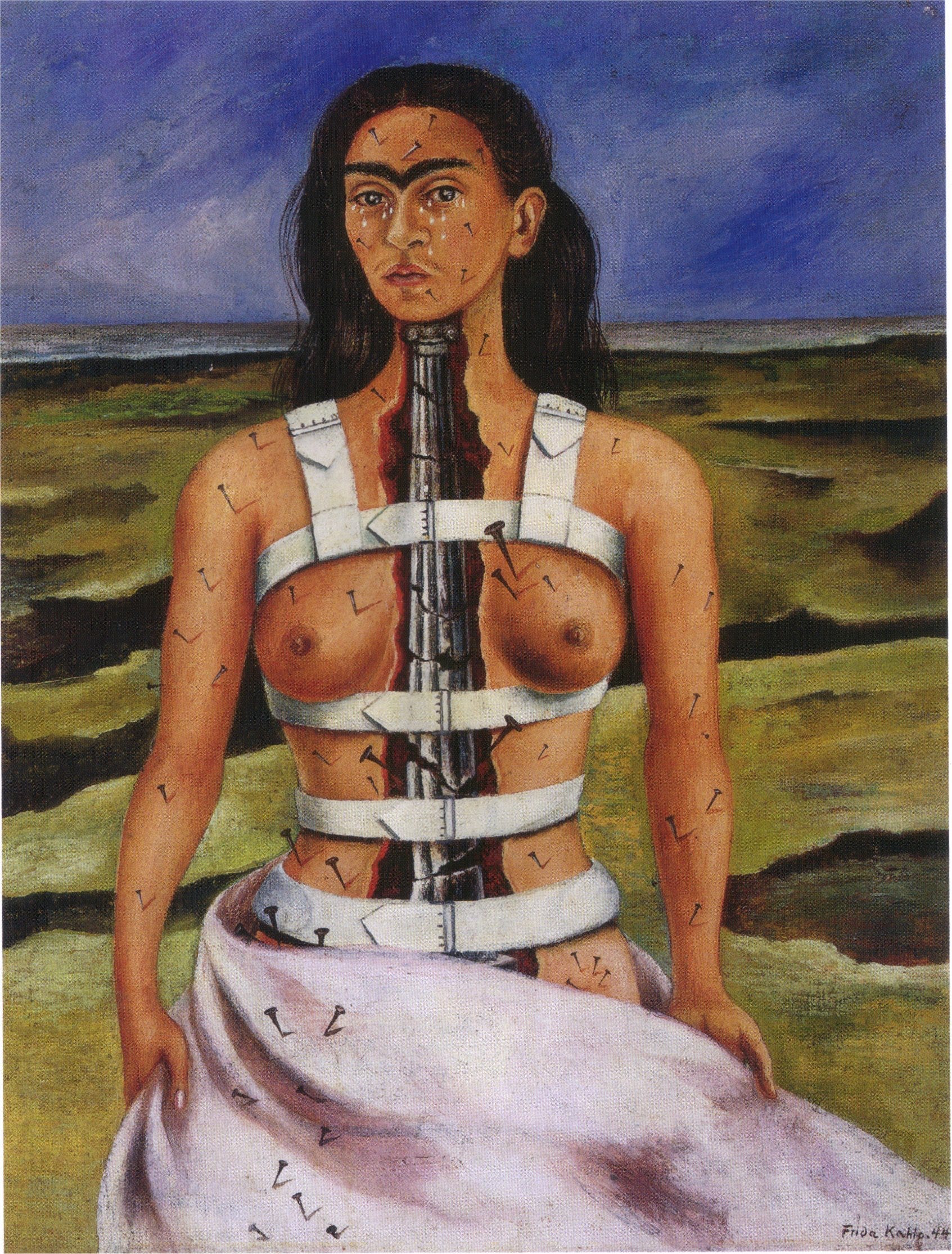
Frida Kahlo painted The Broken Column in 1944, her spine a cracked stone column strapped upright by a surgical corset, her skin driven with fifty seven nails. It is not a plea for pity. It is a body confessing exactly what breaking feels like.

Frida Kahlo, The Broken Column, a self portrait with a cracked column for a spine, surgical straps and nails across the skin
Frida Kahlo, The Broken Column, 1944.

This is not a scene she imagined. It is a description of what her spine actually looked like in 1944.

  • Date: 1944.

  • Medium: Oil on masonite, 40 by 30 cm.

  • Location: Museo Dolores Olmedo, Mexico City.


Learn art the fun way. Join 170,000 readers getting one painting and its story every week.


Three portraits with the same kind of nerve

The ones I would send you to next.


I have stood in front of a lot of paintings about pain. Most ask you to feel sorry for the person inside the frame.

This one does the opposite, and that is why it has never left me.

Frida opens her body down the middle like a cracked wall and shows you the ruin inside. Then she gives you a face that will not flinch.

You arrive expecting a victim. You meet someone harder than you are.

The accident that built this painting

Frida Kahlo photographed by her father Guillermo Kahlo in 1932
Frida Kahlo, photographed by Guillermo Kahlo, 1932.

In September 1925, Frida was a teenager on a wooden bus in Mexico City when a streetcar drove into it. A steel handrail entered near her hip and came out the other side.

Her spine broke in three places. Her pelvis was crushed, her right leg and foot shattered, her collarbone and ribs fractured.

She had already survived polio as a child, which left her right leg thinner and weaker. The crash landed on a body that was fragile before it ever happened.

She spent the rest of her life paying for that afternoon, through dozens of surgeries and long stretches in plaster casts. You can read the whole arc in the tragic life of Frida Kahlo.

She started painting during her first convalescence, using a mirror fixed above her bed. That is why she became her own most frequent subject.

The Broken Column comes near the end of that road, in 1944, right after a spinal operation that locked her into a steel corset for months. You are not looking at a symbol she dreamed up. You are looking at what she saw in the mirror.

The column is her spine, and it is already collapsing

Down the center of her opened torso runs an Ionic column, the fluted kind that holds up a Greek temple. Frida did not choose that shape by accident.

A column is the oldest visual idea we have for support. She puts one where her spine should be, then cracks it top to bottom.

A temple column signals strength and permanence. Hers is chipped and close to rubble, the grandest symbol of stability in Western art giving way inside her.

The corset is the only thing holding her together

Wrapped around her torso are white surgical straps. Without those bands, the broken column would fall apart.

The support that keeps her upright is also a cage. That double meaning is the heart of the work.

Frida really wore this. After her 1944 operation she was strapped into a steel and plaster corset for months, and she painted several of them, sometimes decorating the plaster itself.

So the corset is not a metaphor she reached for. It is the daily bargain of her life, drawn straight from the body.


One painting. One story. Every week. Free, with 170,000 readers who never sat through an art history lecture.


The nails are Saint Sebastian, with the faith taken out

Andrea Mantegna, Saint Sebastian, the martyr tied to a broken column and pierced with arrows
Andrea Mantegna, Saint Sebastian, circa 1480.

Nails are driven all over her, into her face, neck, arms, chest and leg. Historians count roughly fifty seven of them.

Anyone raised on Catholic imagery reads the reference at once. This is Saint Sebastian, the martyr tied to a post and shot full of arrows.

Watch what Frida changes, because the changes are the argument. The arrows become nails. The post becomes a surgical corset.

The meaning is stripped out too. Sebastian suffered for God and was rewarded with sainthood. Frida suffers for nothing, with no reward waiting.

She borrows the most famous image of holy suffering in Western art and quietly removes the holiness. The white cloth around her lower body even echoes the loincloth of a crucified Christ.

She is crying, but her face is not

Small tears sit on her cheeks. Yet her expression does not match them at all.

There is no trembling mouth, no screwed up eyes. Her gaze is level and direct, and it holds yours without asking for anything.

That gap between the tears and the calm is what gives the painting its strange authority. She is not performing grief. She is reporting it.

A physician writing in the British Medical Journal praised exactly this ability to show what medicine struggles to measure, the daily reality of chronic pain. It belongs among the saddest paintings in art history, and it earns the place.

The cracked desert behind her is the inside of her body

The land behind her is empty and split by deep ravines that rhyme with the crack running down her torso. No town, no figure, nothing living on the horizon.

The fissured ground is the same wound as the fissured column. Inside and outside have become one broken thing, and she stands alone in the middle of it.

The loneliness is not accidental. Most of her self portraits give her company, a monkey, a parrot, a deer, sometimes Diego Rivera himself. Five years earlier she had painted that companionship into The Two Fridas.

Frida Kahlo, The Two Fridas, two seated women with the same face holding hands
Frida Kahlo, The Two Fridas, 1939, Museo de Arte Moderno, Mexico City.

The Broken Column strips all of that away. No animal, no husband, no symbol. Chronic pain, the picture says, is something you finally face by yourself.


See art differently. 170,000 people read these free stories. Come find out why.


Why it is not really a Surrealist painting

The open torso, the column, the field of nails, all of it gets the work filed under Surrealism, and the Surrealists tried to claim her.

Frida refused the label with one of her sharpest lines. They painted their dreams, she said, and she painted her own reality.

There is nothing dreamed in a spinal fusion and a steel corset. Calling it a dream would let the viewer off the hook.

How small it actually is

People know The Broken Column from posters, so they imagine something wall sized. It is tiny.

The panel measures about forty by thirty centimeters, oil on masonite, not canvas. You could hold it in two hands.

That intimacy changes everything. As you lean in, the small nails on the face resolve into real punctures. The pain arrives at reading distance.

Where The Broken Column is now

It hangs in the Museo Dolores Olmedo in Mexico City, in the collection Olmedo built of both Rivera and Kahlo. She painted many works like it lying in bed in her family home, which you can walk through in a tour of Frida Kahlo's Blue House.


More stories worth your time

A few more paintings and lives worth the detour.


No boring lectures, ever. Join 170,000 readers learning art the fun way, free.


Frequently asked questions

  • What does The Broken Column represent?

    Frida Kahlo's own broken spine and lifelong pain after her 1925 bus accident, shown as a cracked Greek column held by a surgical corset, with nails borrowing the martyrdom of Saint Sebastian and removing the reward.

  • Why are there nails in her body?

    They echo the arrows shot into Saint Sebastian, but with the faith taken away, so they stand for pain endured for no higher purpose.

  • When did Frida Kahlo paint it?

    In 1944, shortly after a spinal operation that forced her into a steel corset for months.

  • Why is the column broken?

    It is an Ionic temple column standing in for her spine, cracked top to bottom to show the structure meant to hold her up is failing. Only the corset keeps it from collapsing.

  • Is it a self portrait?

    Yes, and a rare nearly nude one, which makes it far more exposed than her usual costumed portraits.

  • How many nails are in the painting?

    Around fifty seven, across her face, arms, torso and right leg.

  • Is it a Surrealist work?

    It is usually classed that way, but Frida rejected the label. She said the Surrealists painted dreams while she painted her reality.

  • Where can I see it?

    At the Museo Dolores Olmedo in Mexico City. It is small, about forty by thirty centimeters, so in person it is far more unsettling than any reproduction.


Never miss a story. Join 170,000 readers who get one painting and its secret every week.