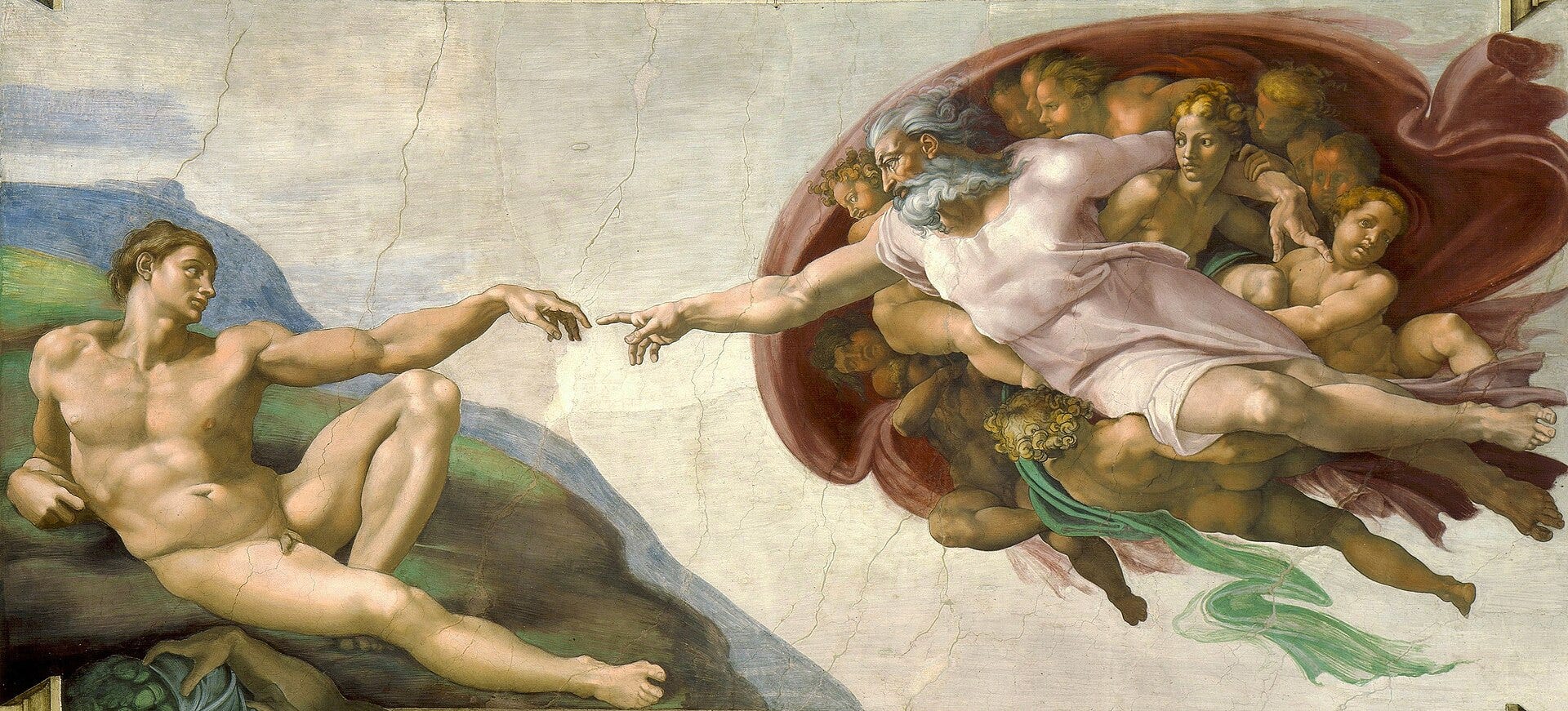
The Creation of Adam shows God reaching toward Adam at the instant before their fingers touch, the moment life passes from creator to creation.
The narrow gap has been read as a symbol of free will, as the distance between man and God, and as the spark of divine intellect entering the human body.
What gets lost in most explanations is how deliberately unfinished this gesture is. Michelangelo had painted contact plenty of times elsewhere on the ceiling, so leaving these two fingers apart was a choice, not a limitation. I read it less as a single symbol and more as an argument that creation and free will are the same event, not two separate ones.
What The Creation of Adam Actually Depicts
The Creation of Adam is one panel of nine scenes from Genesis that Michelangelo painted on the Sistine Chapel ceiling between 1508 and 1512.
It shows God reaching toward Adam, who lies on a barren hillside, his body already formed but his arm still limp.
Their index fingers stretch toward each other and almost touch, separated by a narrow gap of bare plaster.
Michelangelo painted the ceiling almost entirely alone, working on scaffolding a few feet from the plaster for four years.
The Space Between the Fingers
That gap is the most reproduced detail in the whole ceiling, more famous than the scene around it.
God's finger reaches fully, tense and extended, while Adam's finger droops, barely lifted off his knee.
The unevenness is deliberate. One figure strains toward contact, the other has not yet found the strength to meet him.
Restorers cleaning the ceiling in the 1980s found the original colors brighter than centuries of soot had suggested, though the composition of the hands never changed.
A Reach That Never Completes
Michelangelo painted the moment just before contact, not the moment of touch itself.
Scholars have long read that gap as the instant life passes from God to Adam, a spark crossing open space rather than a handshake.
The image works because it freezes a transfer we never actually see finish.
That incompleteness is also what keeps the panel from feeling static. Motion is implied in a scene where nothing actually moves.
More Michelangelo and Renaissance Stories
Free Will in a Few Inches of Plaster
One common reading treats the gap as a picture of free will. God offers life, but Adam's hand has not yet closed around it.
In that view, humanity has to complete the reach on its own, which is a different idea than being handed life ready made.
Other readings frame the same gap as the permanent distance between the human and the divine, present even at the moment of creation.
Both readings can be true at once. Michelangelo left the space empty enough for either one.

The Brain Theory, and Why It Is Still a Theory
In 1990 a physician named Frank Meshberger argued that the red cloak and figures around God trace the shape of a human brain in cross section, folds included.
The claim spread fast because it fits neatly with the idea of God granting Adam intellect, not just a body.
Michelangelo studied anatomy through dissection, so the skill needed to hide a brain in the drapery was within his reach.
Even so, Michelangelo left no note confirming it, and art historians still treat the reading as a theory, not a documented fact.
Who Are the Figures Around God
God does not travel alone. A crowd of figures presses close around him inside a billowing cloak.
One woman tucked under God's arm is often identified as Eve, not yet created but already present in his plan.
The other figures are less settled in the scholarship, read variously as angels or as souls waiting to be born.
Some historians count as many as twelve figures pressed into the cloak, though the crowded pose makes an exact tally difficult.
Man Made in God's Image
Adam's pose mirrors God's, arm for arm, a visual echo of the Genesis line that man was made in God's image.
Michelangelo used that mirroring instead of a caption. The bodies argue the theology on their own.
It is also why Adam looks less like a newborn and more like a finished sculpture waiting to be switched on.
Even Adam's slightly turned head follows the same logic, echoing the tilt of God's head across the gap.
Why This Single Gesture Became Universal
Of the nine ceiling scenes, this is the one people picture first, often without knowing the other eight exist.
Two hands reaching and almost touching translates across religions and languages in a way a full narrative scene does not.
That portability is why the gesture shows up on posters, classrooms, and murals that have nothing to do with the Sistine Chapel.
NASA even used the gesture, with an astronaut's glove replacing God's hand, in an unrelated illustration decades later.
Carry on exploring
Frequently Asked Questions About the Creation of Adam
What does the Creation of Adam mean?
It shows God giving life to Adam at the instant before their fingers touch, read as the moment the spark of life, and by extension intellect, passes from creator to creation.Why do the fingers not touch in the Creation of Adam?
Michelangelo painted the moment just before contact. The gap has been read as the passage of divine life crossing space, and separately as a symbol of human free will or of the distance between man and God. Neither reading cancels the other out.Is the brain shape around God in the Creation of Adam real?
It is a theory, first proposed by a physician in 1990, arguing the cloak and figures around God trace a human brain in cross section. Michelangelo left no record confirming it, so historians treat it as a reading, not a fact. Supporters point to the accuracy of the folds, skeptics note Michelangelo never wrote about it.Who is the woman under God's arm in the Creation of Adam?
She is commonly identified as Eve, shown already present in God's plan before her own creation, which appears in a separate panel of the ceiling.Does the Creation of Adam show original sin?
No. That scene, the Fall and Expulsion, is a separate panel elsewhere on the Sistine Chapel ceiling, painted at a different point in the project.When did Michelangelo paint the Creation of Adam?
It was painted as part of the Sistine Chapel ceiling, completed between 1508 and 1512, commissioned by Pope Julius II. He worked mostly alone, high on scaffolding, for roughly four years.Why does Adam's pose mirror God's pose?
The mirrored posture is a visual argument for the Genesis line that man was made in God's image, letting the bodies carry the theology without any text.Where can I see the Creation of Adam?
It remains in its original location, on the ceiling of the Sistine Chapel in Vatican City, viewable by visitors as part of the chapel tour. Tickets are sold through the Vatican Museums, and the ceiling is best seen with binoculars or a zoom lens.