What Does Landscape with the Fall of Icarus Mean?

A boy falls out of the sky and drowns in the corner of the canvas, and almost nobody in the painting even looks up. That is the entire point.

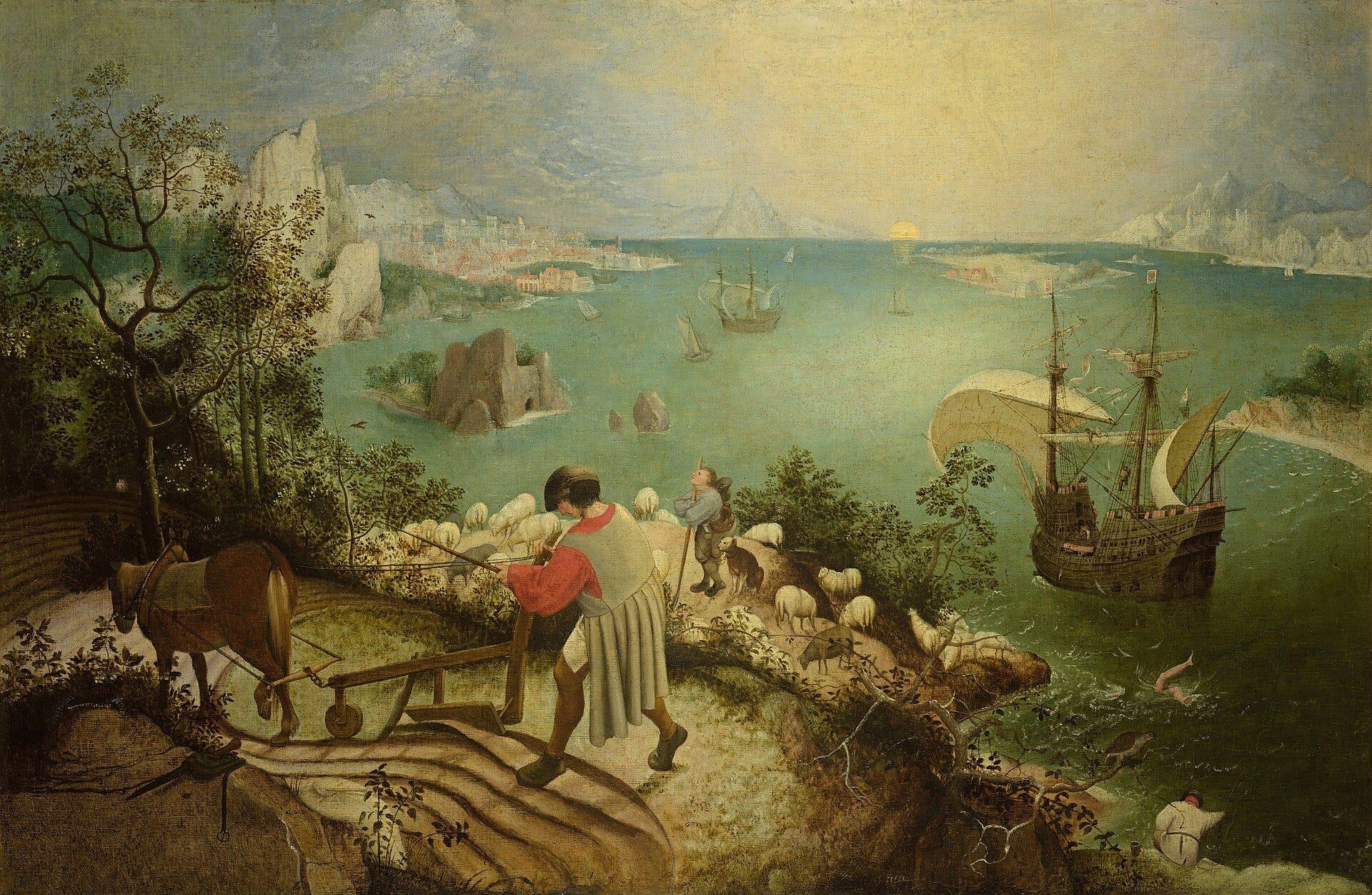
A farmer plows his field, a shepherd watches his flock, a ship sails past, while a boy drowns almost unnoticed in the corner of the water. The painting has been credited to Bruegel for centuries, but a 1996 technical analysis cast serious doubt on that.

Landscape with the Fall of Icarus painting
Landscape with the Fall of Icarus, circa 1560s, after a lost original by Pieter Bruegel the Elder.

That is not an accident of composition. It is the entire argument the painting is making.

  • Painted: circa 1560s, long attributed to Pieter Bruegel the Elder

  • Subject: the myth of Icarus, drowning unnoticed while ordinary life continues

  • Housed: Royal Museums of Fine Arts of Belgium, Brussels


Ten minutes, one masterpiece. That is the deal. 170,000 readers already took it, free.


Three More Paintings Worth a Second Look

If you like knowing what is actually going on inside a picture, start with these three.


The Myth Being Illustrated

In Greek mythology, the inventor Daedalus builds wings of feathers and wax so he and his son Icarus can escape imprisonment on Crete.

Daedalus warns Icarus not to fly too close to the sun, since the heat will melt the wax. Icarus, caught up in the thrill of flight, ignores him, climbs too high.

He watches his wings dissolve feather by feather before he drops into the sea. The story survives in full through Ovid's Metamorphoses, written more than fifteen centuries before this painting.

That gives you some sense of how long artists have been drawn back to the same small, brutal detail: a father watching feathers fall instead of his son.

It is usually read as a warning about overconfidence and ignoring wise advice. This painting is not really interested in that part of the story at all.

Where Icarus Actually Is in the Painting

You would expect a painting about a mythological fall to put that fall front and center. This one buries it in the bottom right corner, almost off the edge of the canvas entirely.

All you actually see of Icarus are two pale legs kicking out of the water, next to a scatter of falling feathers. No wings, no face, no dramatic mid air plunge.

Just the last splash of a boy nobody is watching. Everything else in the frame gets more visual weight than the myth the painting is named after.

The farmer with his plow occupies the entire foreground, working land that has nothing to do with gods or wax wings.


See art differently. 170,000 people read these free stories. Come find out why.


The Ploughman Who Does Not Look Up

The farmer is the largest figure in the composition, and he never once glances toward the water. His entire focus stays on the furrow in front of him.

A shepherd stands nearby with his flock, gazing up at the sky in the wrong direction to see the fall. A fisherman crouches by the shore, focused entirely on his line.

A large ship sails past close enough to have noticed a drowning boy, and keeps moving.

Every single figure in this landscape has a plausible, ordinary reason to miss the most extraordinary event happening a few hundred feet away from them. That is the whole message.

Catastrophe rarely interrupts anyone's Tuesday.

Is This Actually a Bruegel?

Pieter Bruegel the Elder portrait engraving
Pieter Bruegel the Elder, portrait engraving attributed to Jan Wierix, 1572.

For centuries, this painting hung under Pieter Bruegel the Elder's name without much question. He was the leading Flemish painter of his generation, famous for crowded peasant scenes and landscapes.

Technical examination of the canvas in 1996 changed that picture considerably. Researchers found the work is painted in oil on canvas, while Bruegel's other confirmed paintings from the period use tempera on wood panel.

That is a meaningfully different technique for an artist of his era. Most scholars today consider the museum's version a skilled early copy of a lost Bruegel original.

Likely made not long after his death by a follower who had access to the composition, rather than a painting from Bruegel's own hand.

A Second Version With Daedalus Still in the Sky

The Brussels museum canvas is not the only surviving copy of this composition. A second painting surfaced on the art market in 1935, this one painted on wood panel.

It was purchased by the collector David van Buuren in 1951. It still hangs today in the Van Buuren Museum in Uccle, on the edge of Brussels.

It includes one figure missing from the more famous version, Daedalus himself, still airborne in the sky above his drowning son.

Tree ring dating of the wood panel places the van Buuren version at around 1583, well over a decade after Bruegel died in 1569.

Analysis of the underlying drawings suggests the two surviving copies were made by two different artists, both apparently working from the same lost original.

The Clues That Gave It Away

Beyond the material used, art historians pointed to small inconsistencies in the composition itself. The setting sun near the horizon does not match its own reflection in the water.

That is a detail a painter working from direct observation would rarely get wrong. The ship's rigging is also drawn in a way that does not correspond to how a real vessel of the period would actually be built.

That suggests a copyist working from someone else's design rather than firsthand knowledge of sailing ships.

None of this erases the painting's importance. It simply means the composition, the idea, almost certainly belongs to Bruegel, even if the specific brushstrokes on this particular canvas do not.


No boring lectures, ever. Join 170,000 readers learning art the fun way, free.


Bruegel's Bigger Picture

Hunters in the Snow painting Bruegel
Pieter Bruegel the Elder, The Hunters in the Snow, 1565.

Whether or not his hand actually touched this exact canvas, the underlying idea fits everything else we know about Bruegel's career.

He spent his life painting peasants harvesting wheat, villagers skating on frozen ponds, and hunters trudging home through snow, ordinary labor rendered with the same seriousness other painters of his century reserved for kings and saints.

He worked in Antwerp and Brussels in the middle of the sixteenth century, a period when Northern European painting was shifting away from purely religious subjects toward scenes of everyday life.

Bruegel became one of the artists who made that shift permanent. Icarus fits that pattern perfectly, even filtered through a copyist's hand.

The myth gets shrunk down to a footnote, while the ordinary working people Bruegel painted his whole career take up the entire canvas.

Pieter Bruegel the Elder, The Harvesters, oil on wood, 1565
Pieter Bruegel the Elder, The Harvesters, 1565.

The Poem That Made It Famous

Tower of Babel painting Bruegel Vienna
Pieter Bruegel the Elder, The Tower of Babel, Vienna version, 1563.

This painting might still be a footnote in Bruegel scholarship if not for a poem written more than three centuries after it was made.

In December 1938, the poet W.H. Auden visited the museum in Brussels where the painting hangs and wrote Musee des Beaux Arts shortly afterward.

The poem describes how suffering always happens while someone else is doing something completely unrelated, eating, opening a window, walking along.

Auden zeroes in on the ploughman, imagining that he may have heard the splash and the cry, and simply decided it was not important enough to stop working for.

That single observation is probably why more people can describe this painting today than can name the artist who may or may not have painted it.

Icarus is only the closing example in the poem. Auden opens by talking about how the old masters understood suffering happening in a corner, while somewhere else people are simply eating or opening a window.

Why Indifference Still Feels Modern

I think about this painting every time a tragedy trends online for a day and then vanishes under the next thing competing for attention.

The ploughman is not cruel. He simply has his own furrow to finish. That reading feels more honest to me than the traditional moral about flying too close to the sun.

The painting is not really warning Icarus. It is describing everyone else, going about their ordinary lives while someone nearby drowns.

It belongs in the same conversation as the saddest paintings in art history, not because it shows grief directly, but because it shows the far more common tragedy of grief that nobody around even notices.

Whether or not Bruegel personally touched this exact canvas, the composition still earns him a place among the greatest painters of all time.

And among any list of artists you need to know if you want to understand how Northern European painting turned ordinary daily life into serious subject matter.


More Secrets to Unlock

Three more paintings that reward a second, closer look.


Never miss a story. 170,000 readers get one painting explained every week, free.