What Does The Fourth Estate by Pellizza da Volpedo Mean?

Giuseppe Pellizza da Volpedo spent nearly ten years and three paintings getting to this final crowd of workers. Here is what the finished picture is really arguing.

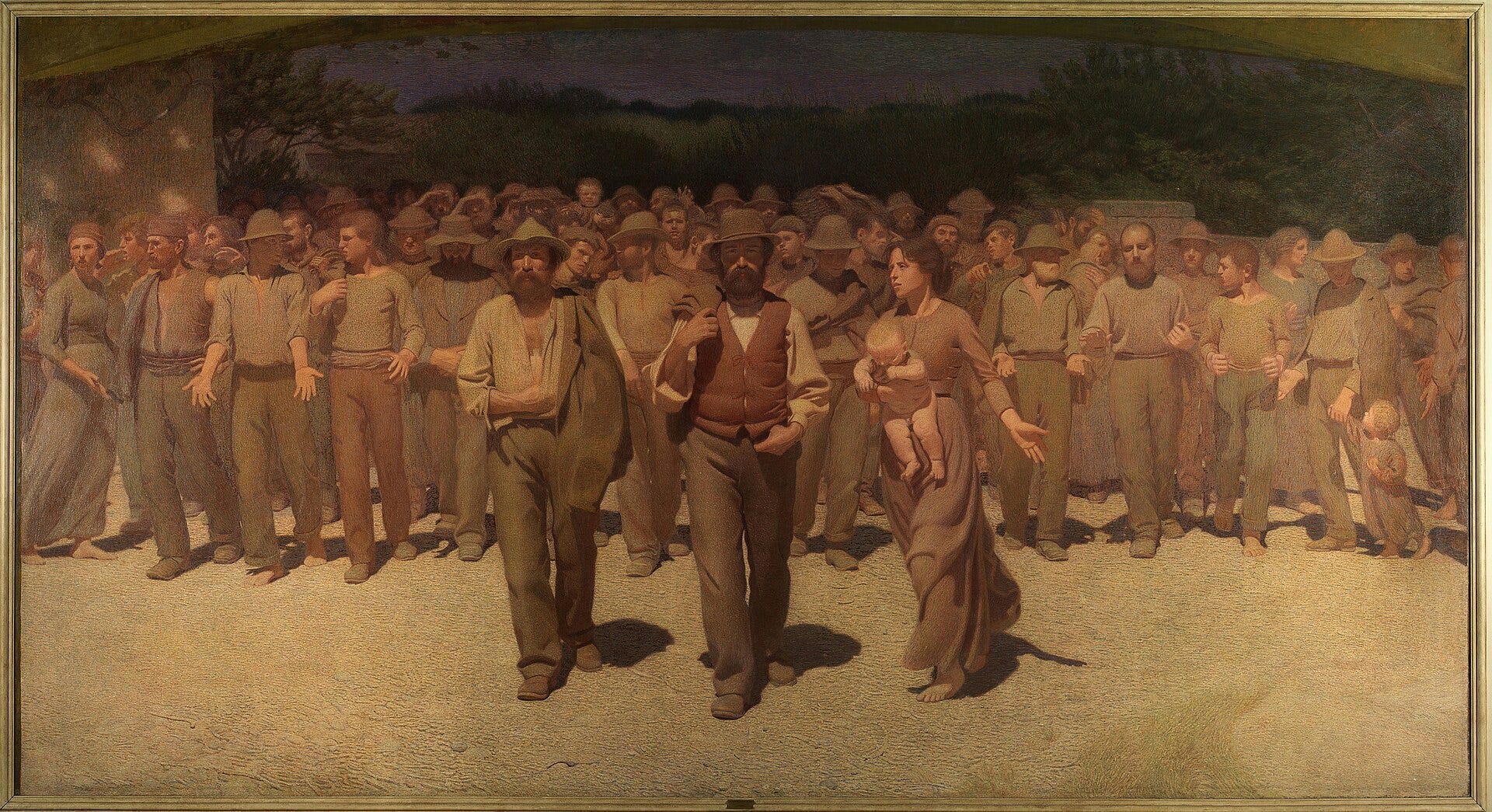
Giuseppe Pellizza da Volpedo's The Fourth Estate shows workers marching straight at the viewer. Milan's city government bought it in 1920 for 50,000 lire, raised through a public fundraiser rather than from its own budget.

The Fourth Estate painting
Giuseppe Pellizza da Volpedo, The Fourth Estate, 1901.

Nobody in the crowd is shouting or raising a fist. They are simply walking forward, together, at the same pace.

  • Date: Completed in 1901, after close to a decade of work

  • Medium: Oil on canvas, about 293 by 545 centimeters

  • Location: Museo del Novecento, Milan


Learn art the fun way. Join 170,000 readers getting one painting and its story every week.


More Paintings With a Political Edge

Pellizza was not the only painter using a canvas to make an argument. These three did the same.


Ten Years, Three Paintings

Pellizza spent close to a decade reaching the final composition. He began with Ambassadors of Hunger in 1892, reworked it into The Human Flood in 1895 and 1896, then flattened the perspective again for The Fourth Estate in 1901, pulling the marching crowd closer to the viewer with each version.

The final composition did not arrive first. Each earlier attempt kept the same general idea, a crowd of workers walking forward, but placed them further back in the scene.

Every version pushed the crowd closer to the viewer and flattened the perspective, until the final canvas placed the workers almost at arm's length, walking directly at whoever stands in front of it.

What strikes me is that the crowd only got closer with each version. Pellizza kept pulling them nearer until they were almost stepping out of the frame.

Fiumana earlier version
Giuseppe Pellizza da Volpedo, The Human Flood, 1895 to 1896.

A Technique Built From Science

Pellizza worked in Divisionism, an Italian technique related to French Pointillism. Paint went onto the canvas in separate strokes of pure color that only blend together in the eye of a viewer standing back from the surface. He used this careful, near scientific method for a picture with an openly political subject.

Divisionist painters believed that colors mixed in the eye looked more luminous than colors mixed on the palette, a theory borrowed partly from optical science of the period.

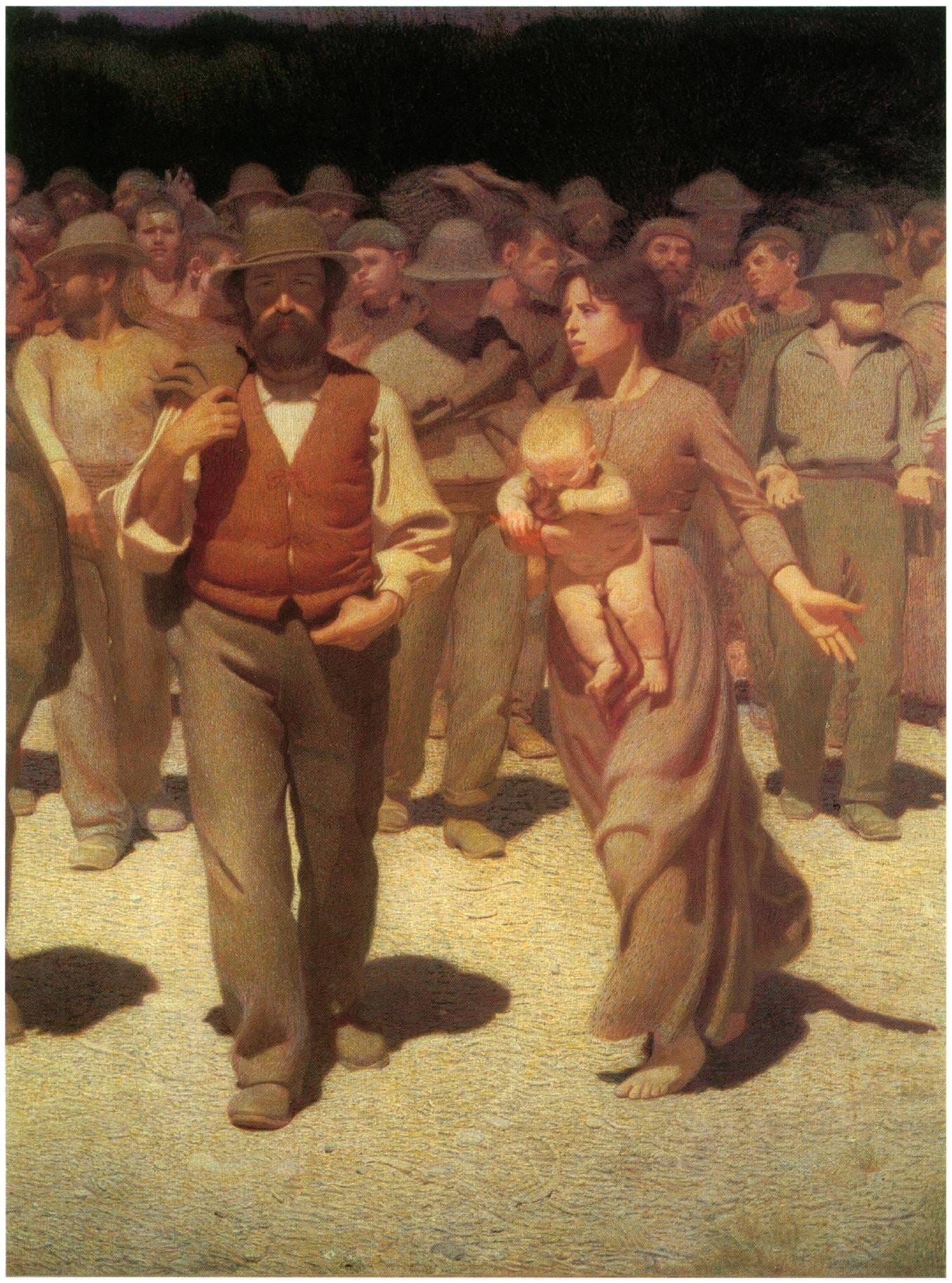
Up close, the crowd's faces dissolve into small dashes of ochre, pink, and grey. Only from several steps back do they resolve into individual people.

To me the dissolving faces are the real point. Step back and the crowd becomes people. Step closer and it becomes paint.

The Fourth Estate detail of faces
The Fourth Estate, detail of the front row.

Ten minutes, one masterpiece. That is the deal. 170,000 readers already took it, free.


Why the Title Matters

Pellizza first sketched the idea in 1891 after watching a workers protest in Turin, calling the earliest studies Ambassadors of Hunger. The finished picture was originally titled The Path of Workers. The name The Fourth Estate came later, borrowed from the old language of social orders, adding industrial and farm workers as a class of their own.

Pellizza kept a diary through the process and wrote that the social question deserved art's attention too, not only politics and economics.

By 1901, Italy's labor movement was organizing at scale, and the borrowed title treated ordinary workers as a political force in their own right, not a backdrop to someone else's story.

I read the title change as the clearest signal of intent. Pellizza wanted this crowd read as a class with a claim, not a scene from daily life.

How Milan Bought It for the Public

In 1920, the Municipality of Milan bought The Fourth Estate for 50,000 lire, not from its own treasury but through a public fundraiser. Banks, associations, and private citizens all contributed. The campaign was pushed by Emilio Caldara, the city's socialist mayor, turning a painting once dismissed by critics into public property.

The purchase happened nineteen years after the picture's cold public debut, long enough for opinion to shift from confusion to civic pride.

It first hung in the Gallery of Modern Art inside Palazzo Marino, Milan's town hall, before moving to the Museo del Novecento in 2010.


See art differently. 170,000 people read these free stories. Come find out why.


A Cold Reception at First

When the finished picture showed in 1901 at an exhibition in Turin, it landed badly. Critics were confused, and even friends who had followed a decade of work on it had little good to say. One later called the canvas grey and monotonous, a verdict that would have stunned the collectors who eventually paid millions for paintings it inspired.

Its fame as a symbol of the Italian left arrived only after Pellizza's death, spread mostly through reproduction in socialist magazines rather than anything that happened in a gallery during his own lifetime.

The chilly debut did not stop him from reworking related themes in later paintings, proof that one bad reception rarely ends a career built over a decade.

A Painting That Outlived Its Painter

Pellizza died in 1907, six years after finishing The Fourth Estate, not long after the death of his wife. In 1906, the Italian government had bought another of his canvases, The Sun, finished the year before, using the same small strokes of pure color aimed at sunlight instead of marching workers.

Pellizza da Volpedo self portrait
Giuseppe Pellizza da Volpedo, Self Portrait, 1899.

The Sun was his only major state purchase, and it now hangs in the Galleria Nazionale d'Arte Moderna in Rome, a rare official recognition during a career mostly ignored by institutions.

Pellizza da Volpedo The Sun painting
Giuseppe Pellizza da Volpedo, The Sun, 1904.

The Fourth Estate went on to become one of the most reproduced images of the Italian left, appearing on posters, book covers, and as the opening shot of Bernardo Bertolucci's 1976 film Novecento.

The Model Was His Own Village

Pellizza set every version of the scene in Piazza Malaspina, the town square of Volpedo, his own birthplace in Piedmont. The shadow falling across the workers' path belongs to a real building on that square, meaning he never had to invent the setting he wanted for the picture.

Volpedo sits in the Piedmont countryside, a farming region where Pellizza spent most of his working life rather than in Rome, Milan, or Turin.

He never needed to invent a crowd either. Local residents and family members sat for individual figures across the years he spent on the composition.

More Stories Worth Reading

A few more paintings that reward a second, closer look.


Frequently Asked Questions

  • What does The Fourth Estate actually show?

    A wide crowd of workers advancing toward the viewer in bright daylight, led by two men and a woman holding a baby, all walking at the same steady pace with no visible leader ahead of them.

  • Why is it called The Fourth Estate?

    The phrase borrows the old idea of social estates such as clergy, nobility, and commoners, and adds a new one for industrial and agricultural workers, treating them as an organized political force in their own right.

  • How long did it take Pellizza to paint it?

    Close to a decade. He worked through two earlier versions, Ambassadors of Hunger and The Human Flood, before arriving at the final composition in 1901.

  • What painting technique did he use?

    Divisionism, an Italian approach related to French Pointillism, built from separate strokes of pure color that blend together only when seen from a distance.

  • What happened to Pellizza after finishing the painting?

    He died in 1907, six years later, not long after the death of his wife. The painting went on to become one of the most reproduced images of the Italian labor movement.

  • How did the painting end up in a public museum?

    The Municipality of Milan bought it in 1920 for 50,000 lire, raised through a public fundraiser pushed by the socialist mayor Emilio Caldara, rather than paid for from the city's own budget.


No boring lectures, ever. Join 170,000 readers learning art the fun way, free.