What Does The Garden of Earthly Delights Mean?

The Garden of Earthly Delights is a triptych by Hieronymus Bosch showing Eden, a crowded garden of pleasure, and Hell. Historians debate whether it warns against sin, with the center panel showing wasted paradise, or depicts a lost, imagined paradise without judgment.

It was likely painted for a private palace, not a church.

What strikes me most is how rarely the private commission gets mentioned next to the moral reading. A painting meant for a church has to instruct a crowd, but a painting meant for a private room can afford to stay ambiguous, and Bosch clearly took that freedom. I do not think the center panel needs to pick a single side between temptation and paradise, since the whole point may be that they look identical until the hinge turns.

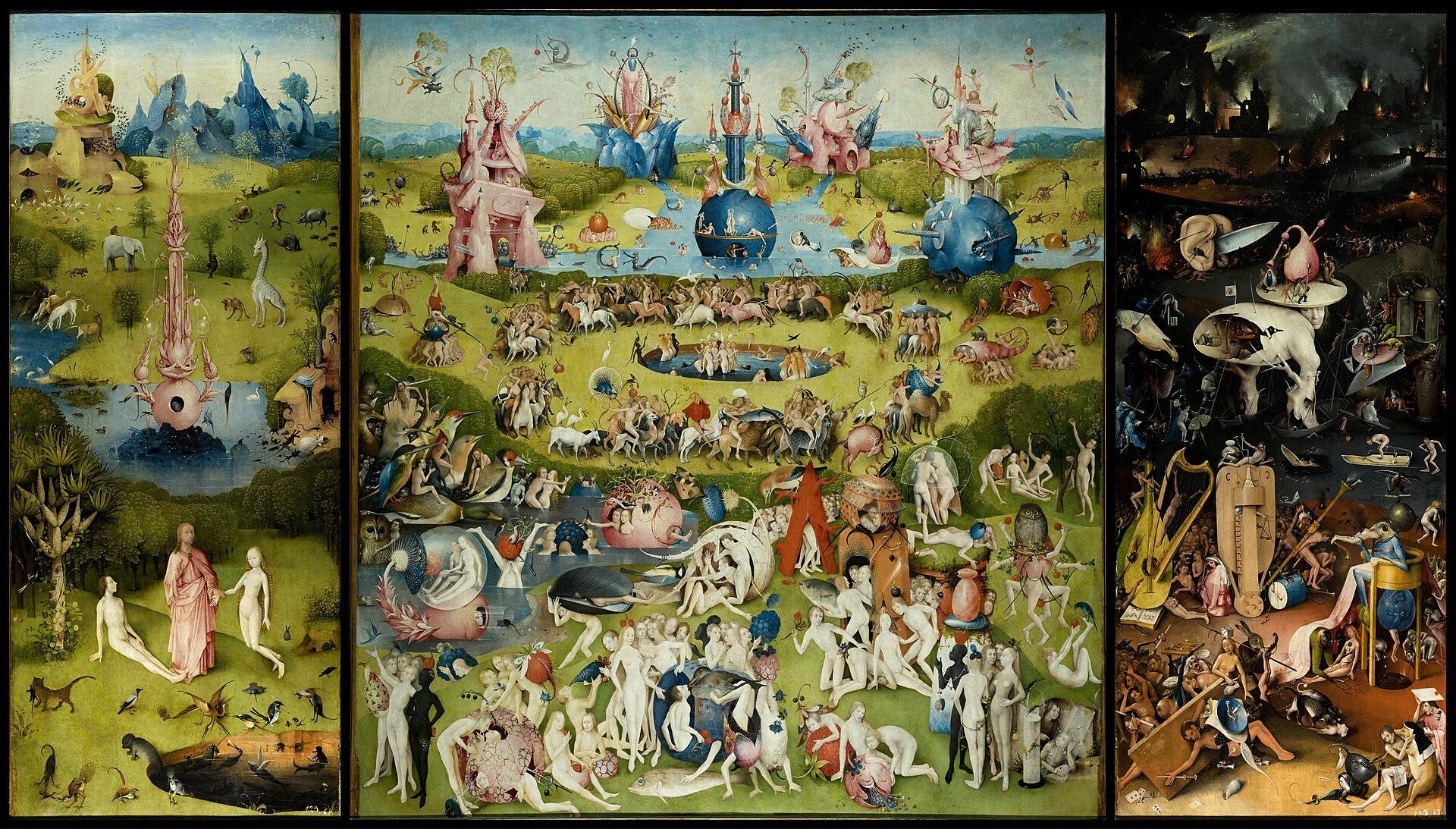
Hieronymus Bosch's triptych The Garden of Earthly Delights showing Eden, the garden of pleasure, and Hell
The Garden of Earthly Delights, painted by Hieronymus Bosch around 1500, now in the Museo del Prado.

Learn art the fun way. Free stories every week, no boring lectures.


What The Garden of Earthly Delights Shows

The Garden of Earthly Delights is a triptych, a painting in three hinged panels, made by Hieronymus Bosch around 1500.

Opened up, it reads left to right: Eden, a crowded garden of pleasure, and a nightmare version of Hell.

Closed, the outer panels show a gray sphere, the earth on the third day of creation, before plants, animals, or people existed.

Bosch signed no explanation onto the work itself, so every panel has to be read from the images alone.

The Left Panel: Eden Before the Fall

The left panel shows God presenting Eve to Adam in a landscape full of unusual animals, some real and some invented.

The mood is calm compared to the two panels beside it, but the strange creatures already hint that this world will not stay orderly.

Nothing here shows sin yet. That comes only once the eye moves to the center.

Some of the animals, like a giraffe and an elephant, come from travelers' reports rather than firsthand observation, since Bosch never left the Netherlands.

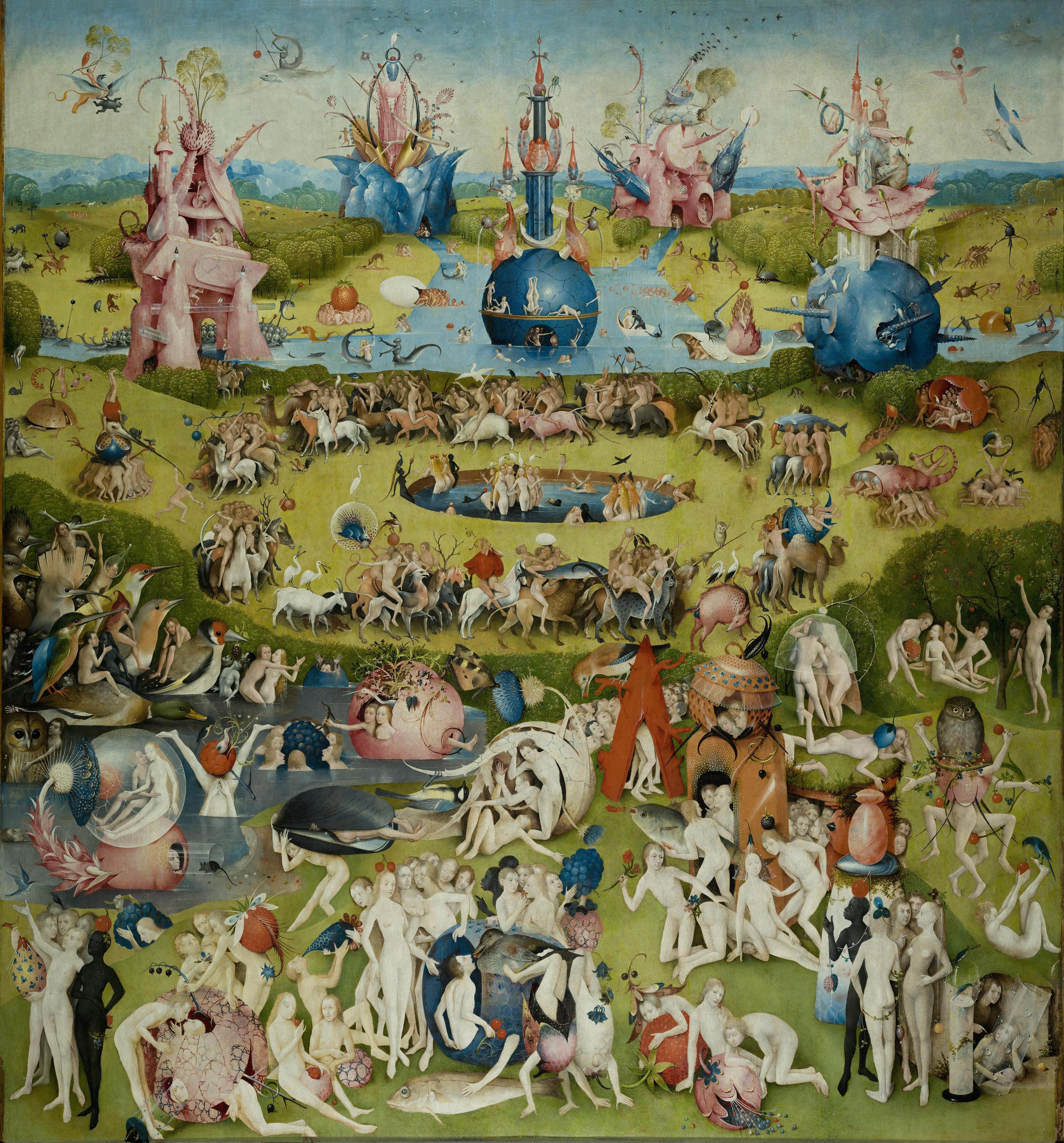
Detail of the crowded center panel of the Garden of Earthly Delights showing nude figures and oversized fruit
The center panel crowds hundreds of figures into scenes of pleasure and appetite.

The Center Panel: A Garden Built From Temptation

The center panel is packed with nude figures, oversized fruit, birds, and structures that look part building and part organism.

People ride animals, embrace inside giant shells, and reach for fruit in scenes read as symbols of lust and appetite.

Nobody in this panel appears to be in pain. The trouble is that they do not know what comes next.

Birds appear constantly, some enormous compared to the humans, feeding fruit to the crowd below in scenes nobody has fully explained.

Detail of the hell panel from the Garden of Earthly Delights showing musical instruments used as torture devices
In the right panel, a harp and a lute are turned into devices that pin down the damned.

More Hieronymus Bosch and Northern Renaissance Stories


The Right Panel: Hell as a Nightmare

The right panel flips the mood entirely. Fire lights a dark landscape where the pleasures of the center panel turn into punishment.

Figures are trapped, pierced, and tormented by devices built from everyday objects scaled up into instruments of pain.

The panel reads as consequence, the place where every appetite shown in the center panel gets settled.

A giant pair of ears, pierced by a blade, crushes figures beneath it, one of several images repeated in later Bosch inspired art and film.

Detail of the Tree Man figure from the hell panel of the Garden of Earthly Delights
The Tree Man, the most reproduced figure from the hell panel, still divides historians on its meaning.

The Tree Man, Bosch's Strangest Creation

The most reproduced figure in the hell panel is the Tree Man, a hollow torso balanced on legs that end in boats, with a head that turns to face the viewer.

Historians still argue about what the Tree Man represents, from a self portrait of Bosch to a symbol of a world hollowed out by sin.

No single explanation has won. The figure stays open, which is part of why it is copied so often outside the painting.

The Tree Man's flat, mask like face gazes directly out of the panel, the only figure in the entire triptych that seems to know it is being watched.

Instruments of Torture, Literally

Bosch turned musical instruments into torture devices in the hell panel, with a harp and a lute used to pin down the damned.

The choice connects music, an earthly pleasure celebrated in the center panel, directly to punishment in the panel beside it.

Read together, the two panels argue that delight and consequence sit right next to each other, separated by a single hinge.

Sheet music is even painted onto one damned figure's body, so precisely that people have transcribed and performed it centuries later.


Cool Stories About Art is a free newsletter. The stories behind the paintings, straight to your inbox.


Warning or Lost Paradise, The Real Debate

One reading treats the whole triptych as a warning against sin, with the center panel showing humanity wasting its one chance at paradise.

A different reading treats the center panel as a lost, imagined paradise, closer to nostalgia than accusation, since nobody in it looks punished yet.

The Prado, which owns the painting, favors the warning reading, noting that sin is the only thread connecting all three panels.

Both readings agree on one point. Whatever the center panel is, it does not last.

Painted for a Private Room, Not a Church

Unlike most triptychs of its size, the Garden of Earthly Delights was not made for a church altar.

It was likely commissioned for a private palace, meant to be studied up close in conversation rather than viewed from a distance during a service.

That context changes the reading. A private commission had more room for a strange, debated image than a public altarpiece would have allowed.

Its first documented owner was a Netherlandish noble family, and it later passed through Spanish royal hands before reaching the Prado.

Why It Still Resists a Single Reading

Five centuries later, historians still cannot agree whether Bosch intended a moral warning, a fantasy, or something closer to both at once.

The painting has no accompanying text from Bosch explaining any of it, so every reading is built from the images themselves.

That absence of a fixed answer is exactly why the Garden of Earthly Delights keeps pulling in new viewers who want to solve it themselves.

Even the title is not Bosch's own. It was assigned later, based on the crowded center panel, not on any label Bosch left behind.


Another story worth your time


Frequently Asked Questions About the Garden of Earthly Delights

  • What does the Garden of Earthly Delights mean?
    Most historians read it as a warning against sin, moving from Eden on the left through a crowded garden of pleasure in the center to punishment in Hell on the right, with sin as the thread connecting all three panels.

  • Is the Garden of Earthly Delights a warning or a fantasy of paradise?
    Both readings exist. The Prado favors the warning reading, while other historians see the center panel as an imagined lost paradise rather than an accusation, since nobody in it appears punished yet.

  • What is the Tree Man in the Garden of Earthly Delights?
    He is a hollow bodied figure in the hell panel, balanced on legs that end in boats, sometimes read as a self portrait of Bosch and sometimes as a symbol of a world hollowed out by sin. No single reading has won. His flat, mask like face is the only one in the triptych that looks straight out at the viewer.

  • Why are musical instruments used as torture in the painting?
    Bosch turns instruments like a harp and a lute into devices that pin down the damned, linking music, an earthly pleasure shown in the center panel, directly to punishment in the panel beside it.

  • Was the Garden of Earthly Delights painted for a church?
    No. It was likely made for a private palace, to be studied up close in conversation, not displayed on a church altar during a service.

  • What do the closed outer panels of the triptych show?
    A gray sphere showing the earth on the third day of creation, before any plants, animals, or people existed, painted in grisaille rather than color.

  • When did Bosch paint the Garden of Earthly Delights?
    Around 1500, though the exact date is debated among historians who place it anywhere from the late 1490s to shortly after 1500.

  • Where is the Garden of Earthly Delights displayed today?
    It hangs in the Museo del Prado in Madrid, which has owned the painting since the nineteenth century. It is regularly cited as one of the most visited single works in the museum.


Join 170,000 readers learning art the fun way. Free stories every week, no boring lectures.