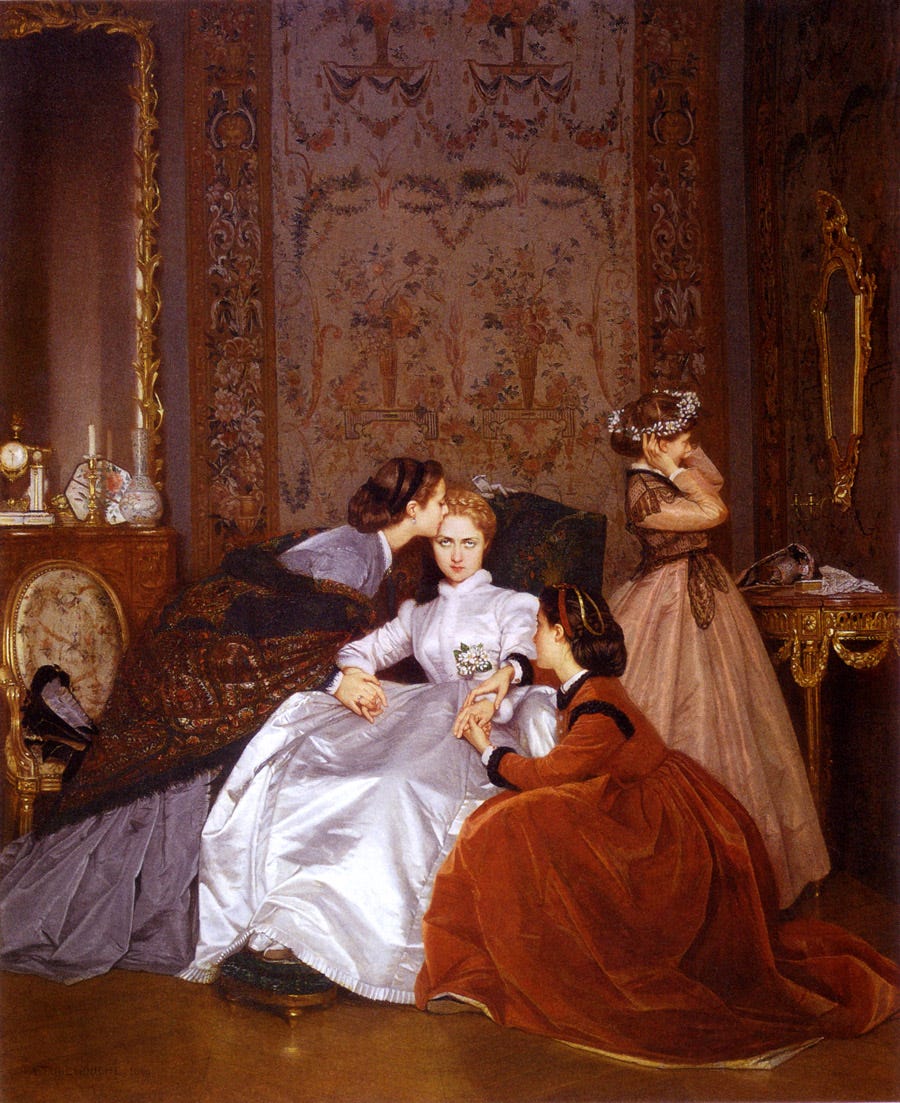
The Hesitant Fiancee is an 1866 painting by the French artist Auguste Toulmouche. It shows a bride slumped in a chair on her wedding day, arms crossed, refusing to look at the women trying to dress her, while her wedding gown waits untouched beside her.
Toulmouche originally exhibited it at the 1866 Paris Salon under a very different title, Un mariage de raison, a marriage of convenience. In 2023, more than 150 years later, that exact expression turned the painting into one of the biggest art memes TikTok has ever produced.
Artist: Auguste Toulmouche, French, 1829 to 1890
Painted: Paris, 1866, shown that year at the Salon
Now known as: The Hesitant Fiancee, after going viral on TikTok in 2023
Three More Paintings Hiding Something
The Hesitant Fiancee is not the only painting built around a woman keeping her real feelings just out of reach. These three go even deeper.
What Is Actually Happening in the Painting
Four women fill the canvas. Three of them are fussing over the bride, adjusting fabric, offering flowers, doing the practical work of getting her ready. The bride herself is doing none of it.
She sits with her arms folded, staring straight out of the canvas at the viewer instead of at anyone in the room. Her gown, a high necked white silk dress trimmed with fur, sits mostly unworn. She has not fully dressed herself for her own wedding.
It is unusual for Toulmouche. Most of his paintings show one elegant woman alone in a comfortable room, doing something quiet and pleasant. This one is a small crowd scene, and the tension in it is the entire point.
The Details Almost Nobody Notices
Look past the bride and the other three women read as a small, quiet drama of their own. One leans in close, clearly trying to reason with her. Another keeps working on the dress, focused on the task instead of the mood. A third watches from slightly behind, more observer than participant.
None of them look shocked. Nobody in the room seems surprised that the bride is furious. That detail matters. It suggests this is not a sudden outburst but a mood everyone in the room already expected and is simply managing around.
The room itself is doing quiet work too. Gilded furniture, heavy drapery, a decorated upper half of the canvas that signals wealth even before you notice the faces. Toulmouche is telling you this family can afford exactly the kind of marriage that requires no love at all.
The Original Title Told a Different Story
Toulmouche called it Un mariage de raison, a marriage of reason, the standard 19th century French term for a marriage arranged for money, status, or family alliance rather than love.
That title changes how you read the scene. This is not generic bridal nerves. It is a woman being married off for practical reasons that have nothing to do with what she wants, and Toulmouche painted her not hiding that fact from the viewer.
Later collectors and reproductions renamed it The Hesitant Fiancee and, in some English language sources, The Reluctant Bride. Both later titles focus on her emotion rather than the social arrangement that caused it.
Who Auguste Toulmouche Was
Toulmouche was born in Nantes in 1829 and moved to Paris as a teenager to study under Charles Gleyre, one of the most respected academic painters of the era. He exhibited his first Salon painting at just 19.
He built his career on a specific formula, wealthy Parisian women in luxurious interiors, painted with an almost obsessive attention to silk, satin, and lace. Critics liked him. He won Salon medals in 1852 and 1861 and was made a Chevalier of the Legion of Honor in 1870.
Napoleon III himself bought one of Toulmouche's paintings in 1852 as a gift for the future empress Eugenie, which tells you how mainstream and respectable his style was considered at the time.
He worked alongside other academic Salon painters of the era, the kind whose careers depended on flattering wealthy buyers rather than challenging them. That is what makes The Hesitant Fiancee stand out inside his own body of work.
The Monet Connection Nobody Expects
In 1861, Toulmouche married a cousin of Claude Monet, right around the time Monet's father was looking for someone respectable to supervise his son's art education in Paris.
When the 21 year old Monet arrived in Paris in late 1862, it was Toulmouche who steered him toward Charles Gleyre's studio, the same teacher who had trained Toulmouche himself years earlier.
That single introduction put Monet in contact with the circle of students who would later become the core of Impressionism. The tidy, polished academic painter and the movement that would make his style look old fashioned within a decade were connected by one family wedding.
Marriage of Convenience in 1866 France
Arranged marriage among the French bourgeoisie in the 1860s was not scandalous. It was normal, often treated as a practical business decision between families rather than a romantic choice.
Women of the class Toulmouche painted had very limited legal and financial independence. A marriage negotiated for money or status was simply how a comfortable life got secured, for the bride's family as much as for her.
What makes this painting unusual is not the situation, which was common, but that Toulmouche chose to paint the bride's open resentment instead of quiet acceptance. Most society portraits from this period assume compliance. This one does not.
The Night It Went Viral on TikTok
On November 5, 2023, a TikTok user posted a video using the painting with text overlaid on it, captioned literally me when i'm right, set to Verdi's Dies Irae from his Requiem.
The video passed 6 million views and 1 million likes within 10 days. Within a week, thousands of women were reposting the same image with their own overlaid text, using the bride's face and posture to represent every version of being right and being ignored anyway.
The trend spread past TikTok into Instagram, X, and general meme culture, and museums and art historians started writing about a 157 year old academic salon painting purely because of how it was being used online.
What People Actually Wrote Over Her Face
The captions people layered onto the image tended to follow a pattern, a short exchange where someone is dismissed or talked over, followed by the bride's expression standing in for the exact feeling of being right and unheard.
Some used it for small daily frustrations, being interrupted in a meeting or ignored in a group chat. Others used it for heavier situations, arguments about relationships, family pressure, decisions being made without them.
What stayed constant across almost every version was the framing. She is not sad in these captions. She is certain, and furious that certainty is not enough to change what is happening to her.
Why Her Face Works So Well as a Meme
Most meme worthy paintings work because the expression is ambiguous enough to project onto. This one is almost the opposite. The bride's face is completely specific and completely clear.
Arms crossed. Eyes locked on the viewer, not on anyone in the scene. Body angled slightly away from the women fussing over her. It reads instantly as someone who has already made up her mind and is simply waiting for everyone else to catch up.
That specificity is exactly what made it so easy to caption. The expression does not need translation across 157 years, because the situation it captures, being expected to go along with something you clearly do not want, has not gone anywhere.
Where the Painting Lives Now
The Hesitant Fiancee is currently held in a private collection rather than a public museum, which is part of why most people only ever see it as a digital reproduction shared online.
At 65 by 54 centimeters, it is a relatively small painting, closer in scale to a portrait meant for a private home than a grand Salon showpiece, even though it debuted at the biggest art exhibition in France.
That private ownership means the wave of attention it got in 2023 came entirely through reproductions and museum databases, not through a single institution promoting it. The image did the work on its own.
Why 157 Year Old Rage Still Resonates
Toulmouche was not trying to make a feminist statement in 1866. He was a successful Salon painter giving buyers a version of the elegant, decorative women they already wanted to purchase.
But he painted the bride's resistance honestly enough that it survived completely intact into a context he could never have imagined, a phone screen, a caption, a sound clip from a requiem mass.
That gap, between what an artist intended and what an image ends up meaning generations later, is one of the strangest and most durable things about painting as a medium.
More Paintings With a Secret Underneath
If a woman keeping the real story to herself is your kind of painting, these three keep going.
FAQ
Is The Hesitant Fiancee based on a real wedding? No. There is no record identifying the bride or a specific event. Toulmouche painted a type of arranged marriage that was common among the French bourgeoisie in the 1860s, not a documented couple.
Where is The Hesitant Fiancee today? It is held in a private collection rather than a public museum, which is part of why most people only ever see it as a digital reproduction.
Why did the painting go viral on TikTok in 2023? A November 2023 video paired the image with the caption literally me when i'm right, set to Verdi's Dies Irae. It passed 6 million views in 10 days and spread into a wider meme format.
What was the painting's original title? Toulmouche exhibited it at the 1866 Paris Salon as Un mariage de raison, a marriage of reason, the standard French term for a marriage arranged for money or status rather than love.