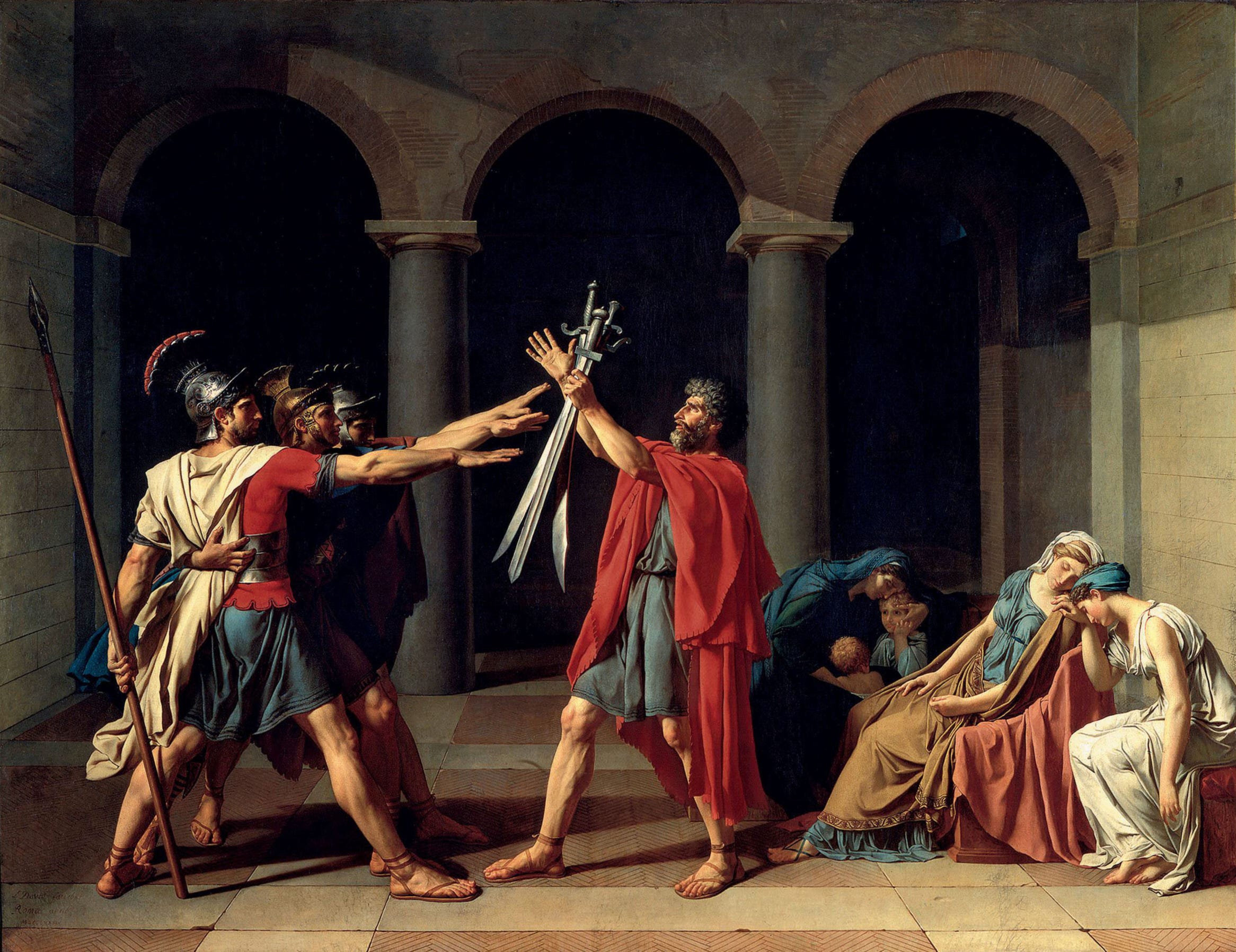
What Does The Oath of the Horatii Mean?

Three Roman brothers swear to their father they will die for Rome, arms stretched toward the swords he holds out. Jacques Louis David painted it in 1784, five years before the Revolution, and the women beside them pay the emotional cost.

David Oath of the Horatii
Jacques Louis David, Oath of the Horatii, 1784.

David built the whole scene from a Roman legend, and then invented the parts the legend never wrote.

  • Artist: Jacques Louis David

  • Date: 1784

  • Where to see it: Musee du Louvre, Paris


Ten minutes, one masterpiece. That is the deal. 170,000 readers already took it, free.


Power, Politics, and the Art That Captures Both

David was not the only painter who turned art into a political statement. These three stories dig into that same territory.


The Roman Legend David Chose to Paint

The story comes from the Roman historian Livy, writing about a dispute between Rome and the neighboring city of Alba Longa around the seventh century BC.

Rather than send full armies to slaughter each other, the two cities agree on something closer to a duel. Each side picks three brothers from one family to fight to the death, and the outcome decides the war.

Livy places the story under Tullus Hostilius, the third king of Rome. The two armies had already marched out and faced each other when the leaders proposed the duel instead.

Three lives were a smaller price than a full war between neighbors who would eventually have to live side by side again.

Rome sends the three Horatii brothers. Alba Longa sends the three Curiatii brothers. The families are not strangers, one Horatii sister is engaged to a Curiatii man, and the Horatii's own sister in law is a Curiatii by birth.

Whoever wins, someone in this household loses a fiance, a brother, or a husband. Two of the three Horatii brothers die almost immediately in the fight.

The last one survives by pretending to flee, which forces his three wounded opponents to chase him at different speeds and split apart. He kills each Curiatii brother alone, one at a time, and Rome wins the war.

The Scene on the Canvas Never Actually Happened

Here is the detail most articles about this painting skip. Livy never describes a scene where the father hands his sons their swords and they swear an oath together.

That moment, the one everyone associates with this painting, does not exist in the original Roman account. David built it from nothing.

Some of his students later claimed he borrowed it from Pierre Corneille's 1640 play Horace, which David had seen performed in Paris in 1782. But nobody has ever found an oath scene in Corneille's script either.

The claim traces back to Etienne Jean Delecluze, one of David's own pupils, writing decades after the fact. Even he admitted the connection was shaky at best.

David invented the gesture himself, the raised swords, the outstretched arms, the father as the pivot point of the whole composition.

The most quoted image of civic duty in Western painting is not history, it is one artist deciding what devotion should look like. You can still see painters borrowing it generations later, including a few names covered in 10 artists you need to know.

Straight Lines for the Men, Curves for the Women

David built the composition around a contrast that is almost mathematical. The three brothers on the left stand in rigid diagonals, their legs planted, their arms locked into straight lines pointing at the swords.

Nothing about their bodies bends. The women on the right do nothing but bend.

Camilla, engaged to one of the Curiatii men, has already collapsed into her sister's lap. Sabina, born a Curiatii and married into the Horatii family, sits with her head turned away, unable to watch either family win.

Look closely at the group on the right and there is also a small child tucked among the women, easy to miss on a first pass. Whichever way the fight goes, that child grows up in a family missing someone.

The father stands in the middle, holding the swords, the only figure who connects both halves of the painting. He gets to choose duty. His daughters and daughters in law only get to grieve.

That is exactly the point David is making about what public virtue actually costs at home. If you want to see how differently painters have handled that kind of private grief, the roundup on the saddest paintings in art history is worth a look.

A King's Commission and a New Kind of Painting

The Oath of the Horatii was not a personal project. It was commissioned in 1783 by the Comte d'Angiviller, the official in charge of royal art commissions under Louis XVI.

It was part of a program meant to revive serious moral subjects in French painting. Angiviller had a whole list of subjects in mind, stories of Roman and Greek figures choosing duty over comfort.

He assigned them to the artists he considered the most promising of his generation. Getting picked for the list was already a mark of favor.

Angiviller wanted history paintings that taught virtue, not the powdered, flirtatious scenes of Rococo painters like Fragonard and Boucher that had dominated French taste for decades.

David, still an ambitious painter in his mid thirties, was exactly the kind of artist the crown wanted. He went to Rome to paint it, partly for the classical references and partly for distance from the Paris art world.

The finished canvas is enormous, about fourteen feet wide and eleven feet tall, closer to a wall than a picture.

Jacques Louis David Intervention of the Sabine Women
Jacques Louis David, The Intervention of the Sabine Women, 1799.

French painting in the decades before David had been about pleasure. Soft brushwork, pastel colors, aristocrats flirting in gardens, bodies painted for how good they felt to look at.

David threw all of that out. The colors in the Oath of the Horatii are sober, mostly stone gray, red, and brown. The brushwork is smooth to the point of being almost invisible.

The setting is a plain Roman courtyard with three matching arches, borrowed straight from ancient architecture, not a garden or a bedroom.

Every choice, the archaeology, the restraint, the moral subject, pushed against the taste of the previous generation on purpose. That is precisely why art historians treat this canvas as the moment Neoclassicism became the dominant style in France rather than one option among several.


No boring lectures, ever. Join 170,000 readers learning art the fun way, free.


Painted for a King, Read as a Warning to One

Louis XVI paid for this painting. He hung it in his own royal collection. Within a decade, French crowds were reading it as an argument against everything his throne stood for.

The Horatii choose the state over their own bloodline, and they do it with no hesitation. Five years after the painting appeared in Paris, French citizens were making a version of that same choice.

Jacques Louis David Death of Marat
Jacques Louis David, The Death of Marat, 1793.

Several of them literally quoted the raised arm gesture in prints and civic ceremonies during that period. David himself made the switch from painter of kings to painter of the new republic obvious.

He went on to vote for the execution of Louis XVI in the National Convention and to paint the movement's own martyrs, including Marat dead in his bathtub.

Once the Revolution settled into an empire, he became the official painter of Napoleon, applying the same rigid, geometric heroism to a French general on his way to becoming an emperor.

Jacques Louis David Napoleon Crossing the Alps
Jacques Louis David, Napoleon Crossing the Alps, 1801.

The Salon of 1785, and Where to See It Now

The painting reached Paris ahead of David, who was still finishing details in Rome, and it went up at the Salon of 1785 to what contemporaries described as a genuine sensation.

Crowds gathered in front of it. Critics who normally fought over everything agreed this canvas was something new.

When it had shown earlier in Rome, cardinals and members of the papal court reportedly came to see it too, which was rare for a French artist still building his reputation.

David was in his mid thirties and this single canvas made him the most talked about painter in France almost overnight.

The Oath of the Horatii hangs today in the Louvre in Paris, not far from works by some of the other painters historians still rank among the greatest painters of all time.

Jacques Louis David Self Portrait
Jacques Louis David, Self Portrait, 1794.

If you go, stand back before you get close. The painting is meant to hit you from across the room first, and only then reward you for looking at the details.


More Faces, More Rule Breakers

David was far from the only artist who rewrote the rules of portraiture and power. These three stories go further.


See art differently. 170,000 people read these free stories. Come find out why.


FAQ

  • What does the Oath of the Horatii mean?

    It shows three brothers swearing to fight to the death for Rome rather than for their own family, while the women around them grieve the same choice before a single sword is even raised.

  • Who painted the Oath of the Horatii and when?

    Jacques Louis David painted it in 1784, working mostly in Rome, and it was shown publicly at the Paris Salon of 1785.

  • What is the real story behind the Oath of the Horatii?

    It comes from the Roman historian Livy. Rome and the city of Alba Longa agreed to settle a war by picking three brothers from each side, the Horatii and the Curiatii, to fight instead of sending full armies.

  • Why are the women crying in the Oath of the Horatii?

    The two families are related by marriage. Camilla, sister of the Horatii, is engaged to a Curiatii man, and Sabina, wife of a Horatii brother, was born a Curiatii. Whoever wins the fight, the women in this room lose a brother, a fiance, or a husband.

  • Who commissioned the Oath of the Horatii?

    The Comte d'Angiviller commissioned it in 1783 on behalf of King Louis XVI, as part of a wider program to bring serious moral subjects back into French painting.

  • Is the oath gesture in the painting historically accurate?

    No. Livy never describes a scene where the father hands his sons their swords and they swear together. David invented that moment himself, and it became one of the most copied gestures in Neoclassical painting.

  • Why is the Oath of the Horatii considered a landmark of Neoclassicism?

    It rejected the soft colors and playful subjects of Rococo painting in favor of sober colors, precise drawing, and a moral Roman subject, and it did so at a scale and with a level of public success that made the style impossible to ignore across Europe.

  • Where can I see the Oath of the Horatii today?

    It hangs in the Louvre in Paris, where it has remained since entering the royal collection in the 1780s.


Learn art the fun way. Join 170,000 readers getting one painting and its story every week.