What Does The School of Athens Mean? Raphael Guide

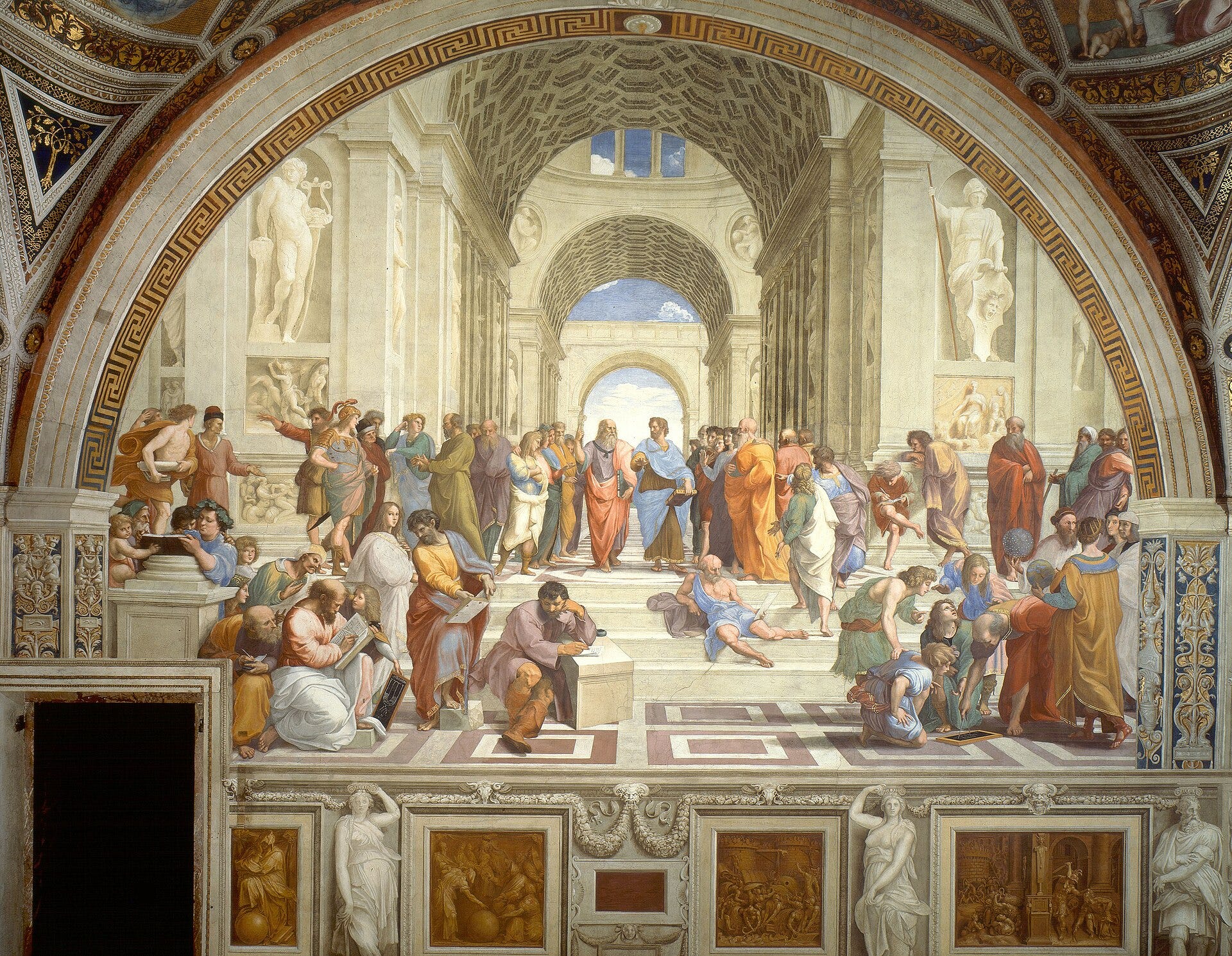
The School of Athens is Raphael's fresco of ancient philosophy, built around Plato and Aristotle at its center.

Plato is widely believed to be modeled on Leonardo da Vinci, and a brooding figure added later is usually read as a portrait of Michelangelo, who was painting the Sistine ceiling nearby.

What gets me about this fresco is how much of it is gossip painted in plaster. Raphael was working a few rooms away from Michelangelo, who was up on the Sistine scaffolding at the same time, and Raphael seems to have gone back into his own painting to add Michelangelo's face after seeing the ceiling. That is not a detached history lesson. That is one painter reacting, in real time, to a rival down the hall.

Raphael, The School of Athens
Raphael, The School of Athens, 1509 to 1511, Apostolic Palace, Vatican

Learn art the fun way. Free stories every week, no boring lectures.


What The School of Athens Actually Shows

The School of Athens is a fresco, painted directly onto wet plaster, not a canvas or panel.

Raphael painted it between 1509 and 1511, inside a room now called the Stanza della Segnatura, in the Apostolic Palace at the Vatican.

Pope Julius II commissioned it, along with three other frescoes in the same room, each representing a different branch of knowledge.

This one represents philosophy, and it gathers ancient Greek thinkers into one impossible meeting, none of whom actually lived at the same time.

Plato and Aristotle at the Center

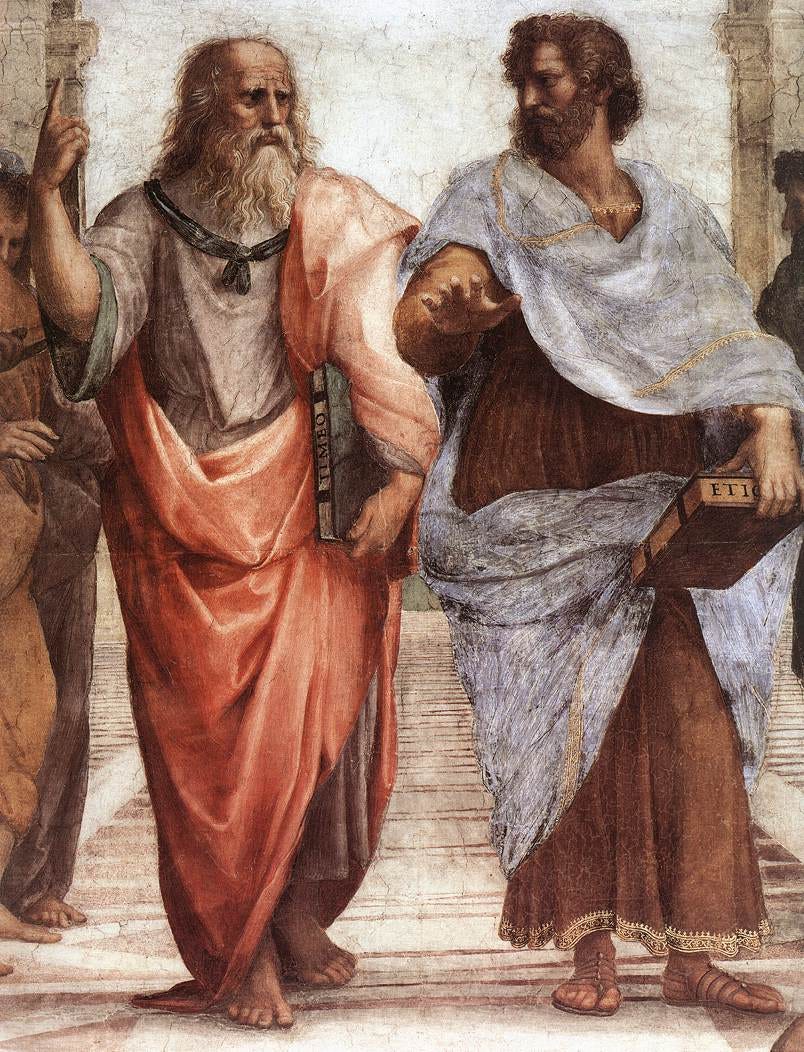
Two figures stand at the exact vanishing point of the painting, where every architectural line pulls the eye.

On the left, an older man points upward. That is Plato, holding a copy of his dialogue Timaeus.

On the right, a younger man gestures forward with his palm down. That is Aristotle, holding his Nicomachean Ethics.

The gestures are usually read as a summary of their philosophies, Plato reaching toward abstract forms above, Aristotle pointing toward the physical world in front of him.

Portrait of Leonardo da Vinci
Leonardo da Vinci, widely believed to be the model Raphael used for Plato's face

Leonardo's Face on Plato

Plato's face is widely believed to be a portrait of Leonardo da Vinci, painted while Leonardo was still alive.

Raphael had studied Leonardo's work closely, including his use of perspective, which shaped how Raphael built the architecture in this fresco.

Giving Leonardo the face of Plato was, in a sense, Raphael paying tribute to the older painter he learned the most from.

I rate his whole career in Is Raphael the GOAT, Rating Him Like a Modern Player.

Portrait of Michelangelo
Michelangelo, working on the Sistine Chapel ceiling nearby while Raphael painted this fresco

More Raphael and the Renaissance


The Brooding Man Added Late

One figure sits alone in the foreground, leaning on a block of marble, ignoring everyone around him.

This man is usually identified as Heraclitus, a philosopher known for his gloomy outlook.

His face is believed to be a portrait of Michelangelo, who was working on the Sistine Chapel ceiling in the building next door while Raphael painted this room.

The figure is missing from Raphael's preparatory cartoon, the full size drawing now kept in Milan, which suggests he added Michelangelo's likeness only after seeing the ceiling in progress.

I compare the two artists side by side in Leonardo vs Michelangelo.

Raphael Puts Himself in the Room

Raphael did not leave himself out of his own fresco.

On the right edge of the composition, a young man in a dark cap looks straight out at the viewer.

That is Raphael's self portrait, placed beside a figure identified as the astronomer Ptolemy.

It is a quiet signature, easy to miss next to the philosophers dominating the center of the scene.

The Figure Everyone Misnames

A myth I want to correct. The one figure in the whole fresco who looks directly at the viewer is often called Hypatia, the Alexandrian mathematician.

That identification is popular, but it is not settled. Historians dispute who this figure actually represents, and Raphael left no notes confirming a name.

I would rather say honestly that this face is debated than repeat a label as fact just because it is the version people share the most.


Cool Stories About Art is a free newsletter. The stories behind the paintings, straight to your inbox.


Two Gods Watching From the Walls

Behind the crowd, two marble statues stand in niches built into the architecture.

On the left is Apollo, god of light and music, holding a lyre.

On the right is Athena, shown in her Roman form as Minerva, goddess of wisdom.

Their presence frames the whole scene as a meeting point between reason and inspiration, watched over by the gods most associated with both.

The Apostolic Palace at the Vatican
The Apostolic Palace at the Vatican, where the fresco has remained since it was painted

Part of a Bigger Room

The School of Athens was not painted alone. It shares its room with three other frescoes, each covering a different subject.

Across from it is the Disputa, representing theology. Nearby are Parnassus, representing poetry, and a scene representing justice.

Vasari, who wrote the first major history of Renaissance art, described the four together as theology, philosophy, poetry, and law brought into harmony.

The building shape inside the painting, a Greek cross, echoes the design Bramante was drawing up at the same time for the new Saint Peter's Basilica next door.

Why It Still Matters

The School of Athens is often called Raphael's finest work, and it still gets cited as the clearest visual summary of what the Renaissance was trying to do: pull ancient learning back into the present.

The perspective alone was a technical achievement, every line in the architecture converging exactly on Plato and Aristotle.

If you want the fuller picture of how Raphael got this commission and what came after it, I cover his career in the complete Raphael story.

What stands out is how many real relationships are folded into the crowd: a rival honored, a teacher acknowledged, a painter signing his own work quietly in the corner.


More art, more stories


The School of Athens: questions people ask

  • What does The School of Athens mean?
    It shows an idealized gathering of ancient Greek philosophers, built around Plato and Aristotle, representing philosophy as one of four branches of knowledge in the room.

  • Who are Plato and Aristotle modeled on?
    Plato is widely believed to be modeled on Leonardo da Vinci. Aristotle's model is not confirmed.

  • Is the brooding figure really Michelangelo?
    Most historians believe the seated figure identified as Heraclitus is a portrait of Michelangelo, added after Raphael saw the Sistine Chapel ceiling in progress.

  • Where is Raphael in the painting?
    He painted a self portrait on the right edge of the fresco, next to the figure identified as Ptolemy.

  • Is the figure looking at the viewer really Hypatia?
    That identification is popular but not confirmed. Historians still debate who this figure represents.

  • Where is The School of Athens located?
    In the Stanza della Segnatura, inside the Apostolic Palace at the Vatican.

  • When was it painted?
    Between 1509 and 1511, commissioned by Pope Julius II.

  • What are the two statues in the background?
    Apollo, god of light and music, on the left, and Athena, shown as Minerva, on the right.


Join 170,000 readers learning art the fun way. Free stories every week, no boring lectures.