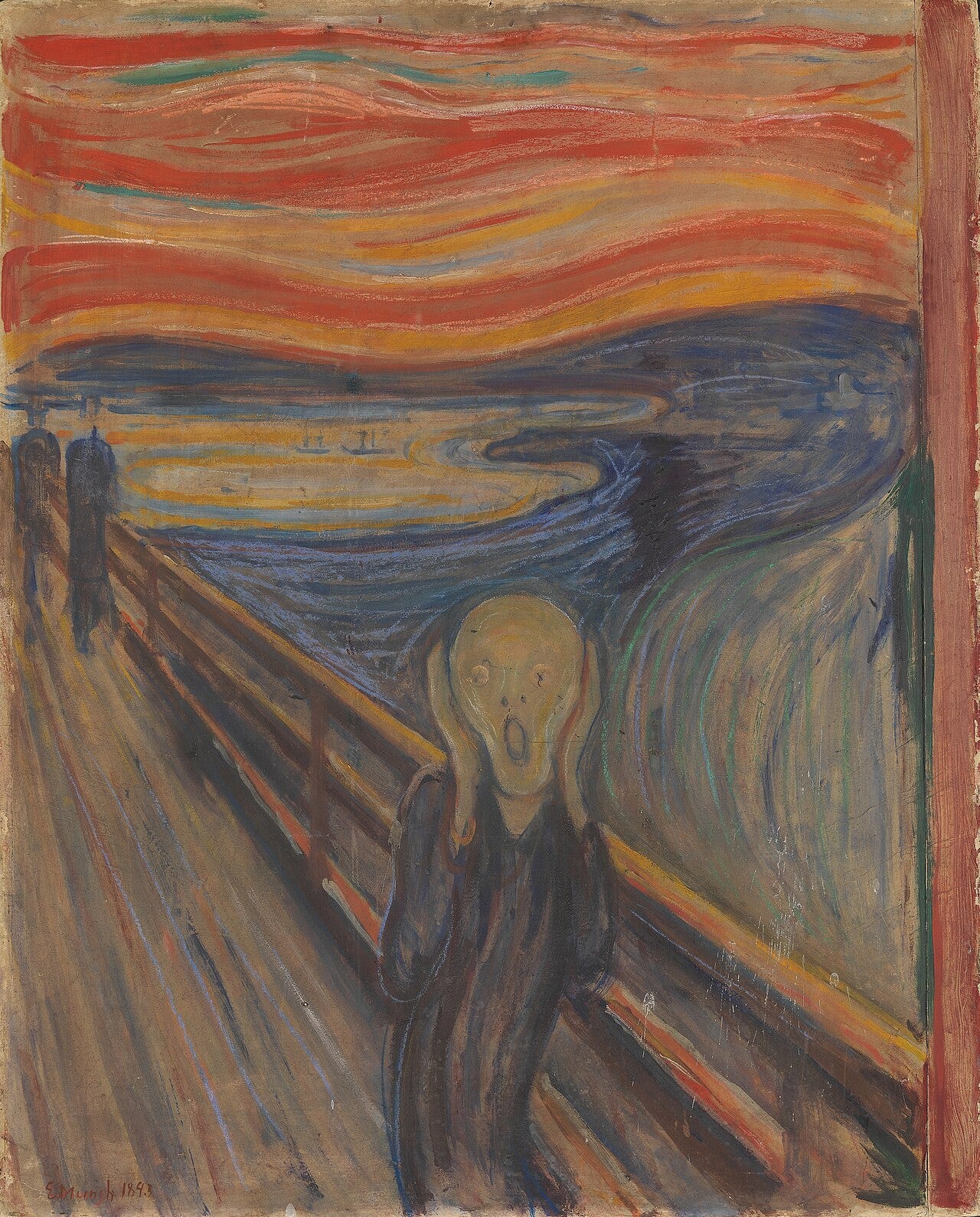
Edvard Munch was walking with two friends on a path above the Kristiania fjord, near what is now Oslo. The sun was setting. The sky turned red, and Munch stopped. His friends walked on without him.
The Scream shows a figure covering its ears against a scream that Munch said came from nature itself, during a sunset walk near Oslo in the early 1890s. It expresses overwhelming anxiety, and it became a universal image of modern alienation.
That short answer holds the two facts most people get wrong. The scream belongs to the landscape. The figure is trying to block it out.
It started with a real walk
Munch wrote down the origin of the image himself, in a diary text.
He was out walking with two friends at sunset when he felt suddenly overcome. The sky turned "blood red," and he sensed what he called "an infinite scream passing through nature." He stood there trembling with anxiety while his companions continued along the path.
The painting keeps the geography of that evening. It shows the fjord of Kristiania seen from Ekeberg hill, and the two small figures walking away at the left are the friends from his account.
The figure has its hands over its ears
Look at what the central figure is actually doing. Both hands are pressed flat against the sides of its head.
Munch's own words settle the question of who screams. The scream passes through nature. The figure hears it and covers its ears against it.
The bald, sexless, almost skull like face has become shorthand for panic. Munch built it as a receiver of the panic, overwhelmed by something coming from the red sky and the fjord around it.
Anxiety, painted before the word Expressionism existed
The first version dates from 1893. Expressionism did not yet exist as a movement. Munch was working in a Symbolist mode, using color and distortion to carry inner states rather than to describe a view.
That is why the painting reads as prophetic. It gave modern anxiety and alienation a face decades before those words became common currency, and later Expressionists treated it as a founding image.
Biographers connect the theme to Munch's own life. His sister Laura was institutionalized for mental illness, and Munch himself struggled with anxiety and depression throughout his life.
There is no single scream, there are four
Munch returned to the image again and again. Four finished versions exist.
The first, from 1893, is tempera and crayon on cardboard, held at the Nasjonalmuseet in Oslo. A second version from the same year is a pastel. A third pastel followed in 1895, and a final tempera version came in 1910, now at the Munch Museum in Oslo.
Two of these versions were stolen and later recovered, in separate crimes a decade apart.
Why it still works
The meaning has stayed legible for more than a century because the image needs no caption. A red sky, a bridge, a figure holding its head: anyone who has felt dread recognizes the situation on sight.
Munch anchored it in one specific evening, one specific hill above one specific fjord. The precision of the memory is what lets everyone else project their own version onto it.
FAQ
Is the figure in The Scream screaming? No. According to Munch's own account, the figure covers its ears against "an infinite scream passing through nature." The sound comes from the landscape, and the figure reacts to it.
When was The Scream painted? The first version dates from 1893. Munch made four finished versions in total: two in 1893, a pastel in 1895, and a tempera in 1910.
Where is The Scream located? The 1893 painted version is at the Nasjonalmuseet in Oslo, and the 1910 tempera is at the Munch Museum, also in Oslo. The 1895 pastel is in private hands.
What place does The Scream show? The view is the Kristiania fjord, today's Oslo, seen from Ekeberg hill. The two figures at the left are the friends Munch described walking with at sunset.
Was The Scream ever stolen? Yes, twice, and both times the painting was recovered, in separate thefts in 1994 and 2004.
One number shows what this image of anxiety became on the open market. In May 2012, the 1895 pastel version sold at Sotheby's for 119.9 million dollars, at the time the highest price ever paid for a work of art at a public auction.