What Does The Third of May 1808 Mean? Goya Decoded

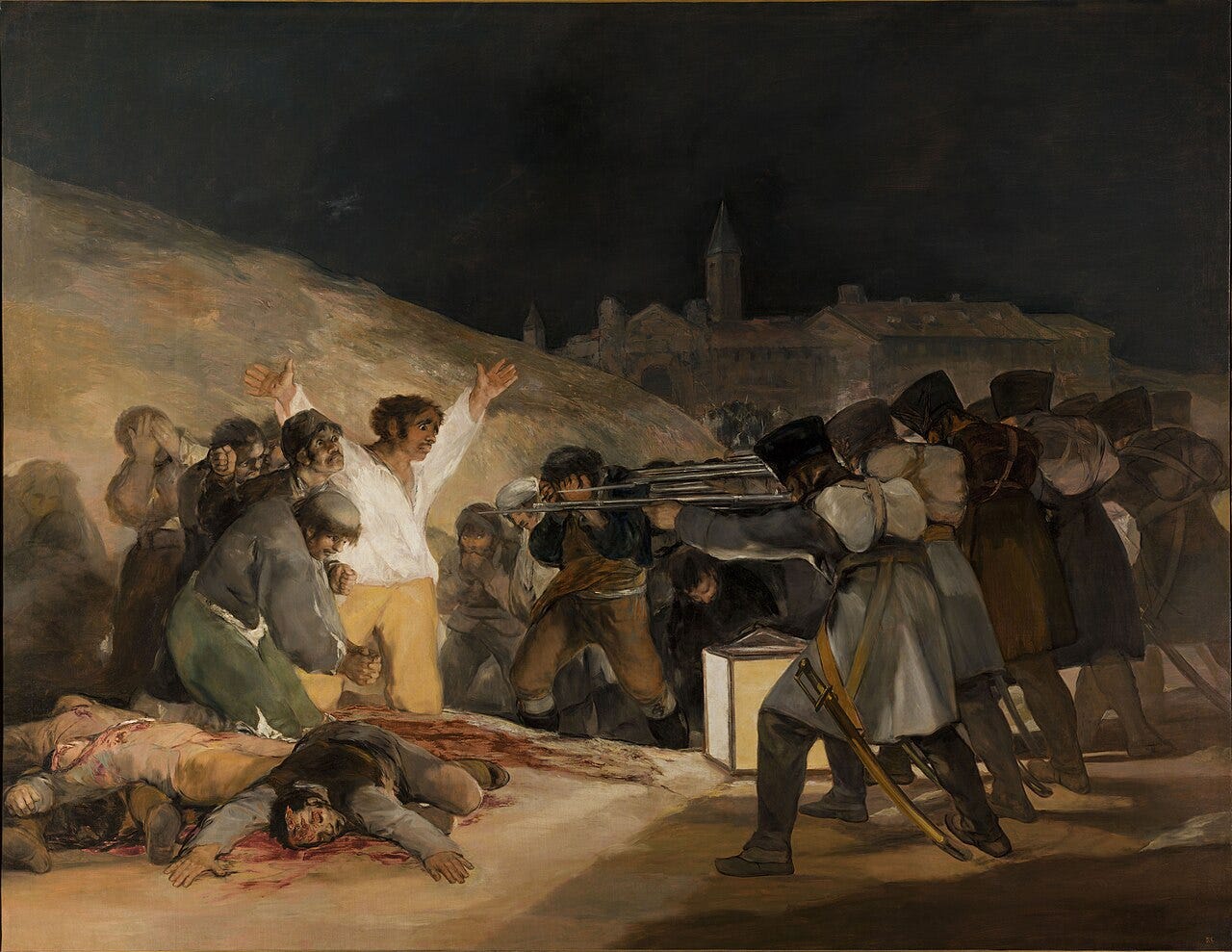
A square lantern sits on the ground. It is the only light in the picture.

Goya's The Third of May 1808, a kneeling man in a white shirt facing a row of faceless soldiers
Francisco Goya, The Third of May 1808, 1814, Museo del Prado, Madrid

Its glow falls on a man in a white shirt, kneeling, arms flung wide. In front of him, a row of soldiers raise their rifles. You cannot see a single one of their faces.

So what does The Third of May 1808 mean? Goya's painting shows French soldiers executing Spanish civilians after the Madrid uprising of May 2, 1808. It presents war as anonymous killing, with the victims lit and individual and the executioners reduced to a faceless machine.

What is actually happening in the painting

Goya's The Second of May 1808, chaotic street fighting in Madrid the day before the executions
Francisco Goya, The Second of May 1808, 1814, Museo del Prado, Madrid

The scene is a real event. In the early hours of May 3, 1808, French troops executed Spanish civilians on a hill called Principe Pio, outside Madrid.

The killings were reprisals. The day before, on May 2, the people of Madrid had risen up against Napoleon's occupying army, in what became known as the Dos de Mayo uprising.

Francisco Goya painted the scene in 1814, six years after the fact. The restored Spanish government commissioned it to commemorate the resistance against the French. The canvas is enormous, about 2.68 by 3.47 meters, and it hangs today at the Museo del Prado in Madrid.

The man in the white shirt

Goya's dark Saturn Devouring His Son from the Black Paintings of his later years
Francisco Goya, Saturn Devouring His Son, 1820 to 1823, Museo del Prado, Madrid

Everything in the composition pushes your eye toward one figure. A kneeling man in a white shirt, arms thrown open, facing the rifles.

His pose has been compared to a crucifixion for as long as people have written about this painting. The open arms, the raised face, the light falling on him alone.

Goya painted that white shirt with unusually thick, textured paint, applied with a palette knife. The technique is called impasto, and it was unusual for the period. The brightest object in the painting is also, physically, the thickest paint on the canvas.

New here? Learn art the fun way. Free stories every week, no boring lectures.

Why the soldiers have no faces

The firing squad is a single shape. A row of identical uniforms, backs partly turned to the viewer, in near silhouette.

Goya denied them any individual identity. There is no proud officer, no heroic soldier, no one to admire or even to blame by name. The squad functions as one machine with many rifles.

This is the core of the painting's meaning. Many art historians consider it one of the first works in Western art to show the facelessness of modern warfare without glorifying the victors or wrapping the scene in national triumph.

That was a break from centuries of battle painting, which existed mostly to make war look noble.

Did Goya see this happen

Goya lived in Madrid during the French occupation and its aftermath. He would have known the atmosphere of those years firsthand.

He did not personally witness the executions on Principe Pio. The painting is a reconstruction, built six years later, from a man who had lived through the occupation that produced it.

Why nobody cared at first

Here is the strange part of the story. The painting had little immediate public impact.

After Goya finished it in 1814, it spent decades in storage. Its reputation as a landmark of modern painting came much later, in the nineteenth and twentieth centuries.

Once it was rediscovered, its influence ran deep. Edouard Manet drew on it directly for The Execution of Emperor Maximilian, painted in 1868 to 1869. Pablo Picasso drew on it for Guernica in 1937. Two of the most famous images of political violence in art descend from this one canvas.

FAQ

  • Who painted The Third of May 1808? Francisco Goya painted it in 1814, in oil on canvas. It was commissioned by the restored Spanish government to commemorate Spanish resistance against Napoleon's occupation.

  • What event does the painting show? The execution of Spanish civilians by a French firing squad in the early hours of May 3, 1808, on the hill of Principe Pio outside Madrid, in reprisal for the Dos de Mayo uprising of the previous day.

  • Why is the man in the white shirt so important? He is the emotional center of the painting. His pose, arms flung wide under the only light source, is widely compared to a crucifixion, and Goya built his shirt from unusually thick impasto paint.

  • Where is The Third of May 1808 today? At the Museo del Prado in Madrid. The canvas measures about 2.68 by 3.47 meters.

  • What later paintings did it influence? It is widely cited as a direct influence on Manet's The Execution of Emperor Maximilian (1868 to 1869) and Picasso's Guernica (1937).

Enjoyed this? Join the readers who learn art the fun way, free every week.

One detail says more than any interpretation. The square lantern Goya placed on the ground is the only light source in the entire painting. Every soldier in the firing squad has his back turned partly away from it, faceless. Only the condemned men are lit.

Related reading