What Does The Unequal Marriage by Pukirev Mean?

It reads like a sad wedding scene from old Russia. Pukirev may have painted himself into it, watching the woman he lost marry someone else.

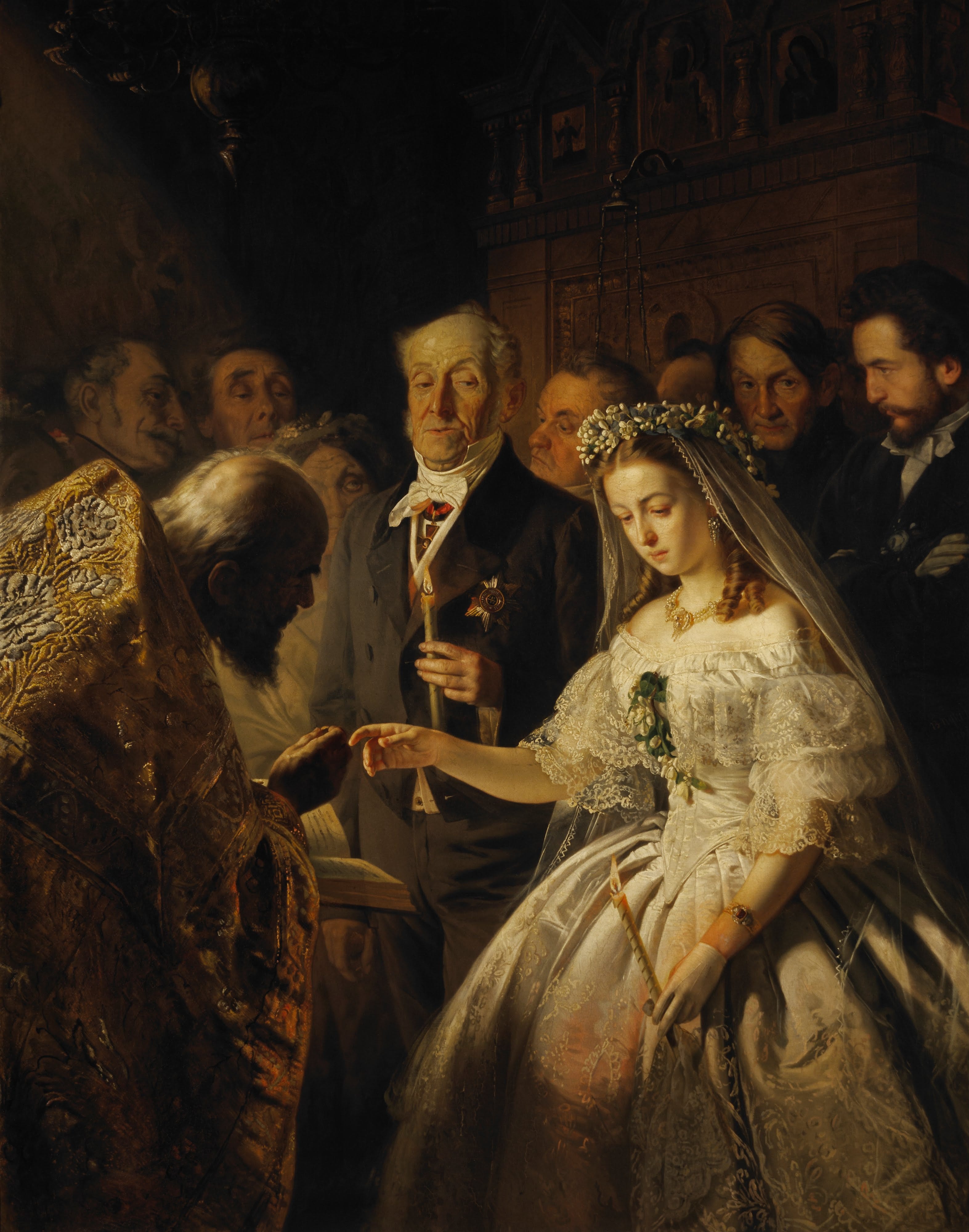
The Unequal Marriage, painted by Vasili Pukirev in 1862, shows a young woman forced to marry a rich old man. It attacks a real practice in Imperial Russia. Pukirev may have painted himself into the scene, watching in disapproval.

The Unequal Marriage painting by Pukirev
Vasily Pukirev, The Unequal Marriage, 1862.
  • Painted: 1862, by Vasili Pukirev

  • Subject: a young bride forced to marry a wealthy old man

  • Housed: Tretyakov Gallery, Moscow


No boring lectures, ever. Join 170,000 readers learning art the fun way, free.


More Paintings About Women History Almost Erased

If you like knowing what is actually going on inside a picture, start with these three.


The Scene: Who Is Standing at This Altar

The painting opens on a scene most people in nineteenth century Russia would recognize instantly. We are inside an Orthodox church, mid ceremony, candles burning, a priest reaching for the bride's hand to place the ring.

The bride is barely more than a girl. Her eyes are red from crying, her face pale, her posture bent forward like she wants to disappear into the floor.

Look closely at the candle in her hand. It leans, wax dripping onto her dress, and in Russian folk belief a crooked wedding candle was said to predict a miserable marriage ahead, which makes this one small prop feel almost too pointed to be an accident.

Beside her stands the groom, an old man dressed for the occasion in a stiff formal coat with a high collar. He wears the Order of Saint Vladimir on his chest, a decoration for state or military service that has no place at a wedding altar, which only makes the mismatch sharper.

His posture is unnaturally straight, almost frozen, and some accounts claim Pukirev gave him a corset to exaggerate just how artificial the whole scene feels.

Behind the bride, slightly apart from the other guests, stands a younger man with his arms crossed and his eyes fixed on the groom. That man is widely believed to be Pukirev himself, and I will get to why that detail matters so much in a minute.

The Major's Marriage Proposal painting
Pavel Fedotov, The Major's Marriage Proposal, 1848.

A Real Practice, Not Just a Sad Story: Arranged Marriage in Imperial Russia

Marriages like the one in this painting were common in nineteenth century Russia, especially among merchant families. Parents arranged unions based on money and connections, not affection, and a daughter without a dowry had very little say in her own future.

An old, wealthy suitor was often considered a good outcome for a poor family, even if the bride was decades younger and had never met him before the wedding day. Pukirev was not inventing a scandal.

He was painting something people recognized from their own street, their own family, sometimes their own choices.

Russian writers were circling the same target around the same years.

The playwright Alexander Ostrovsky had already put the tyranny of wealthy merchant households on stage in The Storm a few years earlier, and critics of the day grouped Pukirev's painting with that same wave of work exposing what one famous essay called the dark kingdom of merchant Russia.

That is part of why the painting hit so hard when it appeared. Russian genre painting up to that point mostly served up nostalgic, cheerful scenes of peasant life.

Pukirev instead put a real, uncomfortable, contemporary problem on canvas at full scale, and audiences were not used to being confronted like that.

It is the kind of image that still shows up on lists of the saddest paintings in art history, and once you know the context, it earns that spot.


Learn art the fun way. Join 170,000 readers getting one painting and its story every week.


So Who Was the Groom, Really?

For over a century, historians have argued about exactly who is standing at that altar. One version says the bride is Praskovya Matveevna Varentsova, a woman Pukirev loved, and that her family pushed her toward a wealthier, older prince instead of the struggling young painter.

A second version names Pukirev's friend Sergei Varentsov as the real heartbroken party. In this telling, Varentsov had been in love with Sofya Nikolaevna Rybnikova, who was married off to a richer merchant named Andrei Karzinkin instead.

Varentsov supposedly asked Pukirev to paint the scene, then objected once he saw himself in it, so Pukirev repainted the witness figure with his own face.

Both Varentsov and Karzinkin were real people from prominent Moscow merchant families, which is part of why this theory has stuck around. Either way, the shape of the story stays the same: a poor man loses the woman he loves to a wealthier rival, and paints the wedding as his answer.

What we do know for certain is the identity of the bride. In 2002 the Tretyakov Gallery acquired a pencil portrait made in 1907 by the artist Vladimir Sukhov, signed with a note naming Praskovya Matveevna Varentsova as the woman Pukirev painted forty four years earlier.

She was the illegitimate daughter of a wealthy man who had a hand in arranging her future, and by the end of her life she was living in a Moscow poorhouse, having become a widow without becoming an heiress.

Portrait of painter Vasily Pukirev
Vasily Pukirev, Self Portrait, circa 1868.

The Bitter Man Behind the Bride: Pukirev's Self Portrait

Look at the far right edge of the canvas and you find a young man standing apart from the crowd, arms folded, staring directly at the groom. Nearly every serious account of this painting agrees that face belongs to Pukirev himself.

It is not a proud signature the way some painters slip their own likeness into a crowd scene just to prove they were there. Pukirev's expression is closer to grief mixed with anger, a man forced to watch something he cannot stop.

Artists have hidden themselves inside their own paintings for centuries, sometimes as a wink to the viewer, sometimes as something heavier, a habit shared by plenty of other painters who left themselves inside their own crowd scenes.


See art differently. 170,000 people read these free stories. Come find out why.


For Pukirev, this one witness role is basically his whole legacy. None of his later paintings, including Reception of a Dowry in a Merchant Family and Wedding Interrupted, came close to matching what The Unequal Marriage did for his career.

He lost his teaching post to poor health, lived off a small pension his fellow artists organized for him, and died in Moscow in 1890, mostly forgotten.

Till Death Do Us Part painting
Edmund Blair Leighton, Till Death Do Us Part, 1878.

The Scandal of 1863

When Pukirev showed the painting at the Academy of Arts exhibition in 1863, it caused an uproar. He was thirty years old, and the work was strong enough that the Imperial Academy of Fine Arts made him an honorary professor on the strength of it alone.

Critics argued over it in the press for months. Supporters said Pukirev had finally done something Russian genre painting had been avoiding, showing a real, current social problem instead of another nostalgic slice of peasant life.

The painting eventually entered the collection of Pavel Tretyakov, the Moscow merchant and collector whose personal holdings became the foundation of the museum that still carries his name today.

A story even circulated that after seeing the painting, some older men called off marriages to much younger women, unwilling to be seen the way Pukirev had painted his groom.

I cannot verify that one actually happened, but the fact that people told it says everything about how uncomfortable this painting made its audience.

What Most Articles Skip: The Two Women in the Background

Here is a detail most surface level write ups skip entirely. Behind the priest, off to the side, stand two older women wearing wreaths that match the bride's own headpiece. One is dressed in white, in a garment that looks less like a guest's dress and more like a burial shroud.

Ordinary wedding guests were not permitted to stand that close to the priest during an Orthodox ceremony, which makes their placement strange on its own.

The most common reading is that these two women represent the groom's previous wives, already dead, standing in as silent witnesses to wife number three.

If that reading holds, the painting is not just about one arranged marriage. It is about a cycle, an old man who has already worn out two young brides and is now moving on to a third, and almost nobody who writes about this painting mentions it.

I find this the most disturbing part of the whole composition, more than the bride's tears. A wedding is supposed to be the start of something. Pukirev quietly suggests this one is a repeat.

Barge Haulers on the Volga painting
Ilya Repin, Barge Haulers on the Volga, 1870 to 1873.

The Legacy: Where The Unequal Marriage Hangs Today

The Unequal Marriage hangs today in the Tretyakov Gallery in Moscow, the same museum that holds the bulk of Russian art history's biggest names.

It remains one of the most reproduced Russian paintings from the nineteenth century, and one of the most requested pieces when the gallery puts together shows about art and social change.

Pukirev made this painting before the Wanderers, the group of Russian realists who broke from the Academy a few years later to paint honest scenes of contemporary life.

He was never formally one of them, but art historians consistently treat this single canvas as a forerunner of everything that movement stood for.

Its reach went beyond Russia too. The English painter Edmund Blair Leighton, known for his romantic historical scenes, was struck enough by the subject that he painted his own version in 1878, an old groom and a devastated young bride, and called it Till Death Do Us Part.

Pukirev himself never had another moment like it. You will not find him on lists of the greatest painters of all time, and he knew it.

But one painting, made when he was thirty years old, turned an ordinary, permitted cruelty into something impossible to look away from, and that painting is still doing its job more than a century and a half later.


Ten minutes, one masterpiece. That is the deal. 170,000 readers already took it, free.


More Secrets to Unlock

Three more paintings hiding more than they show.


One painting. One story. Every week. Free, with 170,000 readers who never sat through an art history lecture.


FAQ

  • What does The Unequal Marriage by Pukirev mean?

    It is a critique of arranged marriage in Imperial Russia, showing a poor young woman forced to marry a rich, much older man for money and status, with the painter reportedly inserting himself as a heartbroken witness.

  • Who painted The Unequal Marriage?

    Russian realist painter Vasili Pukirev, in 1862, when he was thirty years old. He was later named an honorary professor at the Imperial Academy of Fine Arts because of it.

  • Who is the man standing behind the bride?

    Most historians believe it is Pukirev himself, painted into the scene as a bitter witness to the wedding, his arms crossed and his eyes fixed on the groom.

  • Who was the real bride in the painting?

    A 1907 pencil portrait discovered by the Tretyakov Gallery identifies her as Praskovya Matveevna Varentsova, the illegitimate daughter of a wealthy man who arranged her future.

  • Where is The Unequal Marriage located today?

    It hangs in the Tretyakov Gallery in Moscow, Russia, alongside the bulk of the country's most important nineteenth century paintings.

  • Why did the painting cause a scandal in 1863?

    It broke from the nostalgic tradition of Russian genre painting and confronted audiences with a real, uncomfortable social practice, sparking a heated press debate and earning Pukirev an honorary professorship.

  • Who are the two older women in the background?

    They are widely believed to represent the groom's previous, deceased wives, silently watching a third young bride take their place at the altar.

  • Did Pukirev paint any other famous works?

    He did, including Reception of a Dowry in a Merchant Family and Wedding Interrupted, but none matched the impact of The Unequal Marriage, and he is often remembered today as an artist of one painting.


Never miss a story. 170,000 readers get one painting explained every week, free.