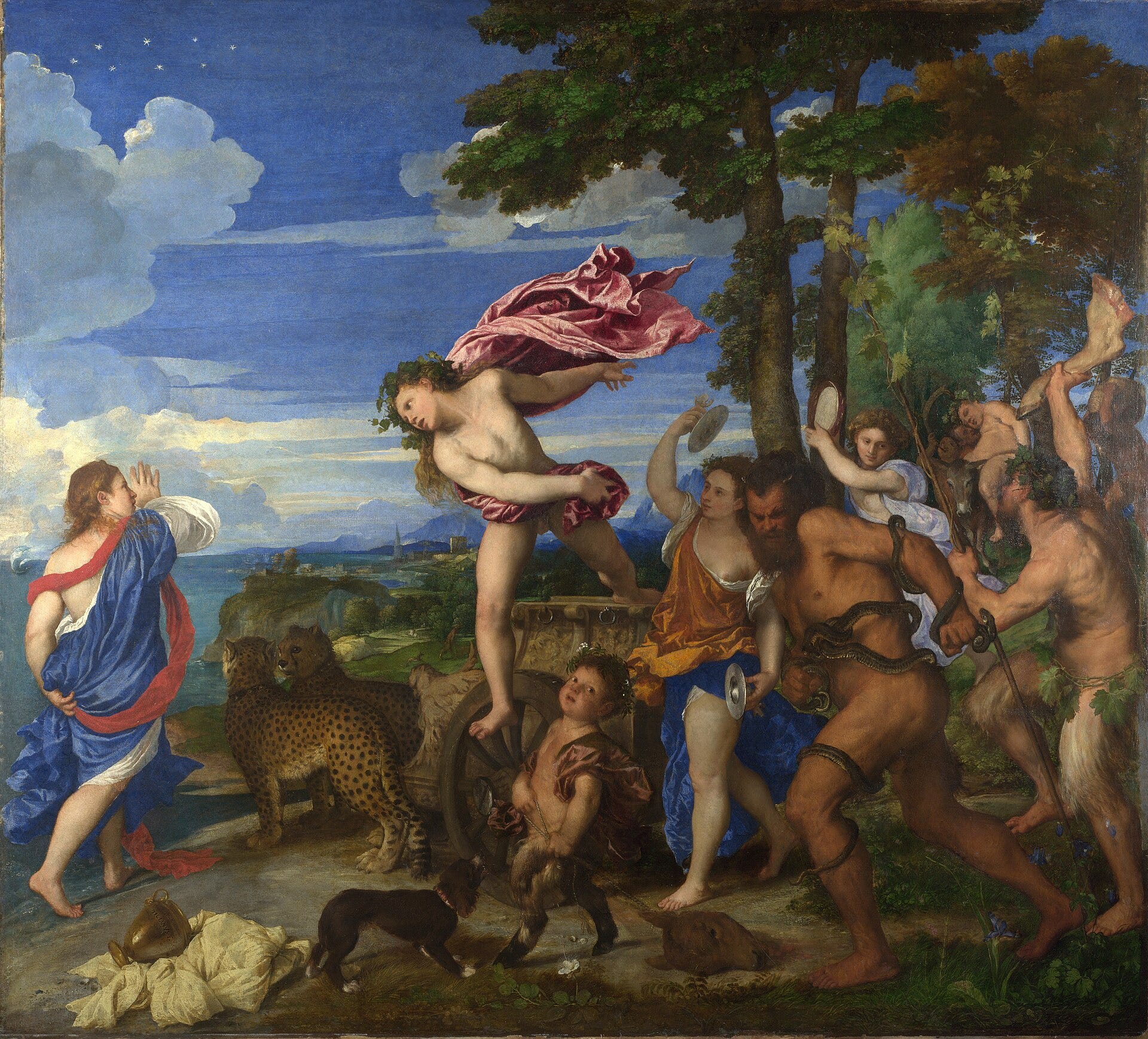
Titian's Bacchus and Ariadne freezes a god mid leap from his chariot, the instant he spots a woman just abandoned on a beach. Painted for a duke's private study, it was a substitute commission, ordered only after two other painters died before starting it.
Everything in the painting is caught mid motion: a leaping god, a startled woman, a chariot pulled by wild cats, a sky already rewriting itself into stars.
Date. Painted between 1520 and 1523 for Alfonso I d'Este, Duke of Ferrara.
Medium. Oil on canvas, about 176 by 191 centimeters.
Location. National Gallery, London.
More Titian, more myth
This is one half of a love story painted twice by the same hand, decades apart. Here is where to go next.
A woman just abandoned
Ariadne helped Theseus escape the labyrinth on Crete, using a thread to find his way back out, then sailed away with him as his new bride. He abandoned her instead, asleep, on the island of Naxos. His ship is still visible on the horizon, sailing off without her, leaving no trace of guilt on the water.
She wakes into the second half of the painting, twisting in surprise, unaware that a much larger arrival is already crashing toward her from the other side of the canvas.
Titian painted the same actress of Venetian myth more than once. His Venus of Urbino, finished about fifteen years later, shows a completely different register: a quiet bedroom instead of a beach full of noise.
A god frozen mid air
Bacchus, god of wine, spots Ariadne on the shore and leaps from his chariot before it has even come to a stop, one leg still airborne, cloak snapping behind him. His procession, a chaotic parade of satyrs, revelers, and one man wrestling a snake, pours out behind him across the canvas.
Few paintings from this period commit this hard to a single frozen instant. The whole right half of the canvas is still moving when the left half has already gone still with grief. What strikes me is that split. One half of the canvas has not caught up to the other yet, which is exactly how a shock like this actually feels.
Made for a room built to unsettle
Alfonso d'Este commissioned this for his camerino d'alabastro, a private study in his palazzo in Ferrara decorated with mythological paintings by several different artists working side by side, meant for an educated, adult audience of guests rather than a wide public display.
Seen in that context, the painting was less a public spectacle and more an object for close, repeated study by a small circle who already knew the myth.
A crown turned into stars
Above Ariadne, a ring of stars is already visible in the sky, a reference to the constellation Corona Borealis. Bacchus, according to the myth, throws her crown into the heavens the instant he falls for her, turning a single act of heartbreak into a fixed, permanent light that still bears her name.
Titian paints the transformation as already underway, so the viewer sees grief and its mythic reward in the same instant, rather than one following the other. To me, that collapsing of grief and reward into one instant is the smartest choice in the whole composition. Titian refuses to let you feel only one emotion at a time.
A commission that passed through two dead painters first
Alfonso I d'Este first asked Raphael to paint a Bacchic scene for his private studiolo around 1518, one panel in a planned cycle for the room. Raphael died in 1520 without starting it, and Fra Bartolommeo, approached next as a replacement, also died before delivering anything at all.
Titian inherited the commission only after both painters had failed to complete it, finishing Bacchus and Ariadne around 1523 as one piece in a small cycle of mythological paintings meant to hang together in the same room. I think inheriting a failed commission explains some of the ambition here. Titian was not just filling a gap, he was making sure nobody would ask why the first two painters gave up.
So the canvas hanging in London today exists because two more famous painters of the era never got past a sketch.
Borrowed from poets, and from stone
Titian built the scene from two ancient Roman poets, Catullus and Ovid, both of whom described Ariadne's abandonment on the shore and Bacchus's sudden, love struck arrival in closely related language that Renaissance readers with a classical education would have recognized immediately from their own schooling.
He also drew visual ideas from ancient Roman sarcophagi carved with Bacchic processions, a type of antique object collectors across Italy were digging up and buying at the time.
The result mixes literary sources most humanist visitors would have recognized with poses lifted almost directly from marble relief.
Real cheetahs pulled that chariot
The two spotted cats pulling Bacchus's chariot are cheetahs, not the leopards they are sometimes labeled today in casual descriptions of the painting. Alfonso d'Este kept live cheetahs in his own menagerie in Ferrara, animals imported at real expense for hunting parties and for court display.
Titian likely worked from those actual animals rather than an imagined big cat, which is part of why the anatomy reads as unusually correct for a painting made in the 1520s.
How it crossed from Ferrara to London
The painting stayed in Ferrara's Este collection until the papacy annexed the duchy in 1598, after which many Este artworks moved to Rome with the family rather than staying in the original camerino. It then passed through several private collections for more than two centuries before ever reaching England.
The National Gallery in London bought it in 1826, as part of a larger group purchase that also brought several other Old Master paintings into the museum's founding collection.
Nearly three centuries separate the private Ferrara study it was painted for and the public gallery wall it hangs on now.
The blue that still stuns conservators
Titian used an unusually saturated ultramarine for the sky, ground from lapis lazuli imported all the way from Afghanistan, one of the costliest pigments available to any sixteenth century painter and a material usually reserved for the most important commissions.
He set that blue directly against Ariadne's red drapery and Bacchus's golden skin, a contrast still used as a teaching example in painting courses today.
National Gallery conservators have noted that this passage of blue survives in unusually good condition, since the canvas has needed comparatively little restoration in that specific area.
The cost of the pigment alone signals how much status Alfonso d'Este attached to this single canvas, made for a room only his closest guests ever entered.
More gods, more mortals
Frequently asked questions
Who commissioned Bacchus and Ariadne?
Alfonso I d'Este, Duke of Ferrara, for his private study known as the camerino d'alabastro.
What story does the painting show?
The moment Bacchus, god of wine, discovers Ariadne abandoned on the island of Naxos by Theseus, whose departing ship is visible in the background.
What do the stars above Ariadne mean?
They reference the constellation Corona Borealis, tied to the myth that Bacchus turned Ariadne's crown into stars.
Why does the painting feel so full of motion?
Titian freezes Bacchus mid leap from his chariot, one leg still in the air, while his chaotic procession spills out behind him, creating a sense of arrested motion across the canvas.
How did the painting end up in London?
It left the Este collection in Ferrara after the papacy annexed the duchy in 1598, passed through private hands for over two centuries, then entered the National Gallery in a group purchase in 1826.
Where can I see Bacchus and Ariadne today?
At the National Gallery in London.