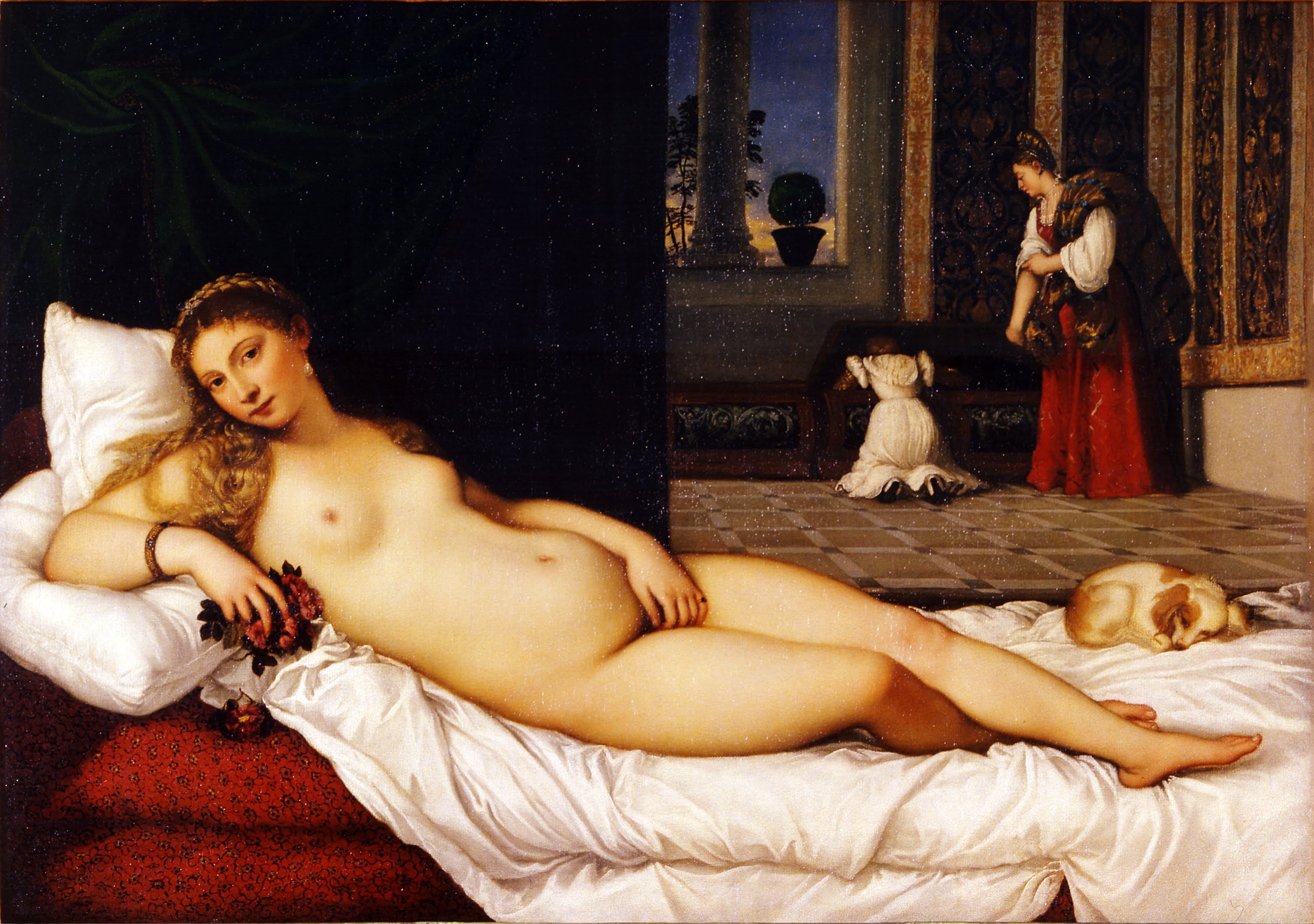
Titian's Venus of Urbino shows a nude woman staring straight at the viewer, with no goddess and no myth to hide behind. Painted in 1538, the panel later crossed to Florence as a bride's dowry, carrying its scandal along.
She is not called a goddess anywhere in the painting itself. No clouds, no Olympus, no attendant cupids. Just a bedroom, a small dog, and two maids searching through a chest in the background.
Date. Painted in 1538 for Guidobaldo II della Rovere, Duke of Urbino.
Medium. Oil on canvas, about 119 by 165 centimeters.
Location. Uffizi Gallery, Florence.
More painted women, more arguments
This is one of the most argued over nudes in Western art. Titian painted plenty of company for her.
A bedroom, not Olympus
Titian based the pose on Giorgione's Sleeping Venus, a mythological nude asleep in a distant landscape. He moved that same pose indoors, woke her up, and had her look straight out at whoever stood in the room. The myth disappeared. Only the woman and the viewer remained.
Giorgione painted his Venus around 1510, safely distant from the viewer, eyes closed, folded into a landscape. Titian keeps the pose but strips away every excuse a myth could offer.
There is no myth left to explain the nudity. She is simply a woman in a Venetian bedroom, aware that she is being looked at.
Giorgione died of the plague in 1510 with the Sleeping Venus unfinished, and Titian himself painted in the landscape behind her. Two decades later, he reused the same figure but placed her fully awake, in a room, not a field.
The gaze that unsettled Mark Twain
Centuries later, the American writer Mark Twain called the Venus of Urbino the foulest and most obscene picture the world possesses, in a travel book about touring European galleries. What bothered him was not the nudity itself, common enough in gallery after gallery, but the directness of her stare.
Earlier nudes looked away, or slept, or existed safely inside a story. This one looks back, and that single choice is what kept generations of viewers uneasy. What strikes me is how small that choice sounds and how much it changes. A closed eye asks nothing of you. An open gaze does.
Twain wrote that line in A Tramp Abroad, published in 1880, after touring the Uffizi as a tourist rather than an art historian. His reaction was not shared by the museum staff around him, who had displayed the panel for visitors for over a century by then.
It was not always called Venus
When the painting left Titian's workshop in 1538, contemporary letters referred to it simply as la donna nuda, the naked woman. No goddess, no myth, no title beyond a plain description of what the panel actually showed on a duke's commission.
The name Venus of Urbino was only attached in the nineteenth century, once the painting had become famous and cataloguers wanted a more respectable label for a work now seen by a wider public.
Titian himself never signed it with a subject. I think that gap between what the painting shows and what it was later called is exactly why it still gets argued over.
A dowry painting, twice over
The panel Titian delivered in 1538 stayed in Urbino for nearly a century. In 1631, Vittoria della Rovere, the last heir of the family, married into the Medici and brought it to Florence as part of her dowry, which is how the painting ended up permanently in the Uffizi.
Guidobaldo II della Rovere bought the panel from Titian directly, likely to mark his own marriage to Giulia Varano. The picture stayed inside the della Rovere household in Urbino through three more dukes.
The last of that line, Francesco Maria II, died in 1631 without a male heir. His granddaughter Vittoria della Rovere inherited the ducal collection and carried it into her marriage with Ferdinando II de Medici, Grand Duke of Tuscany.
So the painting crossed into a new city twice tied to marriage: first as a private commission for a duke's wedding, then a century later as part of another woman's dowry to a different ruling family.
The timing mattered. When Francesco Maria II died without a male heir, the Duchy of Urbino itself reverted to the Papal States. Vittoria della Rovere's private art collection escaped that fate only because it had already been folded into her marriage settlement with the Medici.
A wedding gift with a message
At the woman's feet, a small dog sleeps curled up, a standard symbol of marital fidelity in Renaissance portraiture. Behind her, two maids search through a cassone, the carved chest used to store a bride's trousseau, for something to dress her in.
Read together with the pose, the picture doubles as both an erotic object and a lesson for a new wife: devotion belongs to one household, even as the image was clearly built to please a male viewer. I read that double duty as the real tension in the picture. It is asking a young bride to be modest and asking a male viewer to look, at the same time.
Venus had already become a fashionable subject for cassoni painters by the 1530s, so a buyer commissioning a bedroom nude in this period was working inside a recognizable tradition, not inventing one.
Giorgio Vasari, writing decades later in his Lives of the Artists, praised Titian's skill in painting flesh and fabric in works like this one, treating the panel as a technical triumph rather than a moral problem.
The painting that made Olympia possible
In 1863, Edouard Manet painted Olympia, copying this composition almost pose for pose, then swapping the idealized goddess for a recognizable Parisian woman staring back with the same directness. Titian's version had three centuries of acceptance behind it. Manet's did not.
Manet's model was a real, identifiable woman rather than an invented ideal, and Paris reacted with outrage that Titian's original never had to survive.
Bigger than most visitors expect
Venus of Urbino is oil on canvas, measuring about 119 by 165 centimeters, roughly the size of a large dining table stood on its end. It hangs today in a room at the Uffizi shared with other major Venetian paintings, not isolated behind special glass.
Museum staff count it among the most photographed paintings in the building, competing for attention with Botticelli's Birth of Venus only a few rooms away.
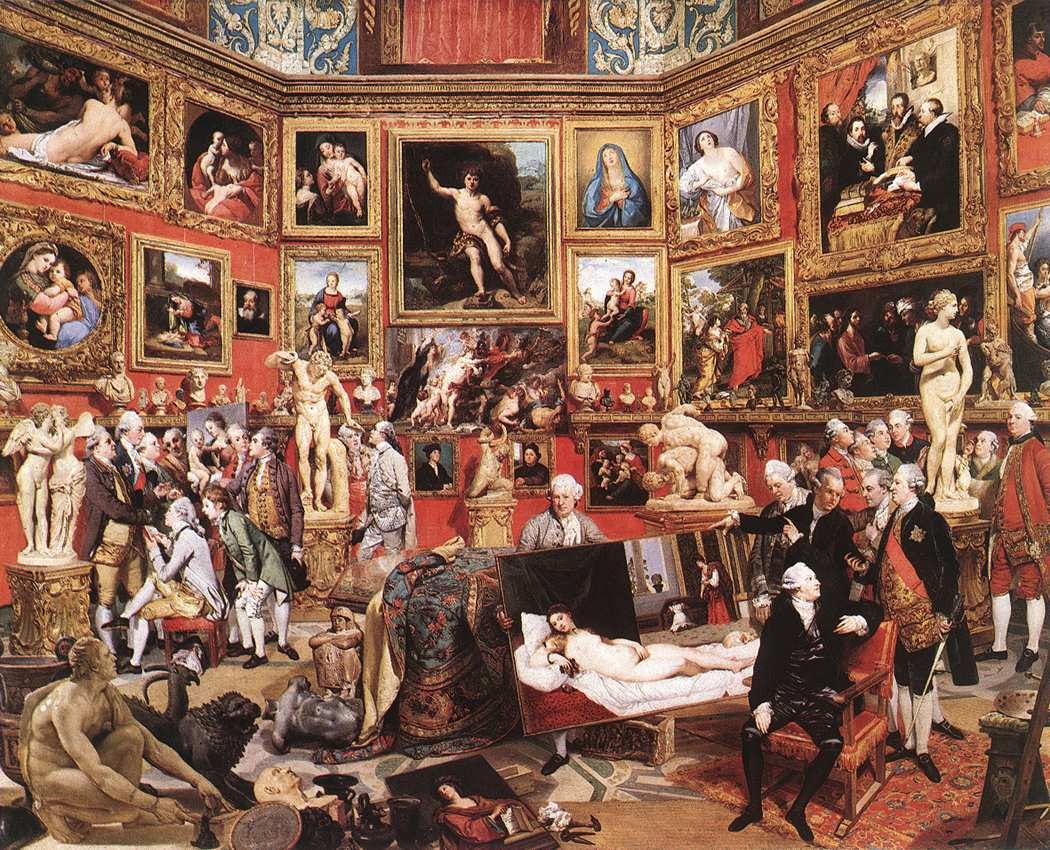
The canvas was placed in the Uffizi's Tribuna room in 1736, where it hung for years among the gallery's most prized holdings, long before the museum opened its doors to a general public.
More women, more painted arguments
Frequently asked questions
Who commissioned the Venus of Urbino?
Guidobaldo II della Rovere, Duke of Urbino, in 1538, likely for his own household.
Is the woman in the painting actually a goddess?
Nothing in the scene identifies her as Venus specifically. The title was applied later, in the nineteenth century. The setting is a contemporary bedroom, not a mythological landscape.
Why was the Venus of Urbino considered scandalous?
The nudity itself was not unusual in gallery painting. What set this apart was the directness of her gaze, which breaks from nudes traditionally shown asleep or distant inside a myth.
What inspired Manet's Olympia?
Manet based Olympia's pose almost directly on the Venus of Urbino, replacing the idealized figure with a recognizable contemporary woman, which caused far more controversy than Titian's original.
How did the painting travel from Urbino to Florence?
It stayed in the della Rovere family until 1631, when Vittoria della Rovere carried it to Florence as part of her dowry when she married into the Medici family.
Where can I see the Venus of Urbino today?
At the Uffizi Gallery in Florence.