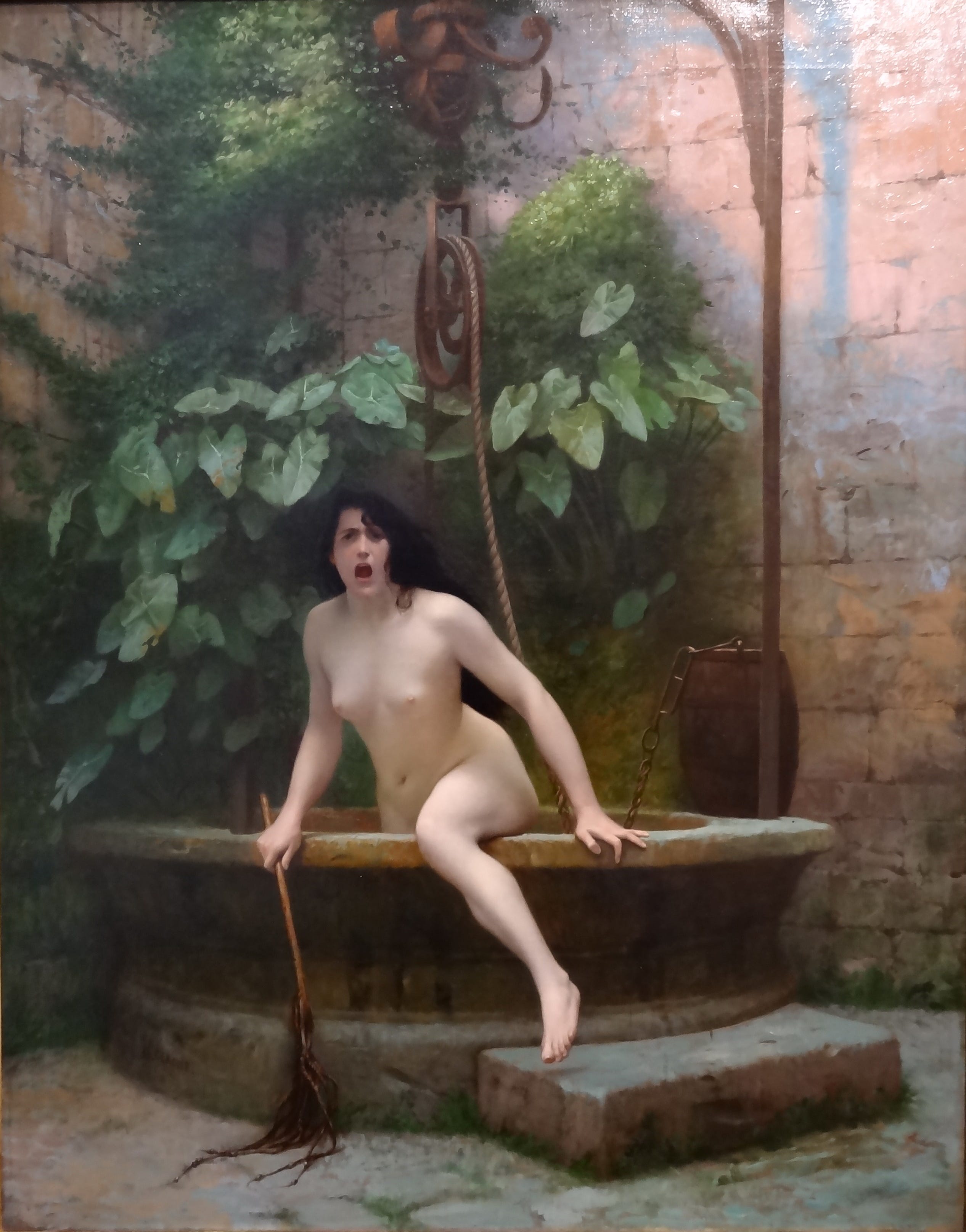
Truth Coming Out of Her Well shows a naked, furious woman climbing out of a stone well with a whip raised over her head, lit like she is about to punish everyone watching.
Jean Léon Gérôme painted her in 1896, and the full French title translates to Truth coming from the well armed with her whip to chastise humanity.
Artist: Jean Léon Gérôme, French, 1824 to 1904
Painted: 1896, shown that year at the Paris Salon
Now at: the Anne de Beaujeu museum, Moulins, France, since 1978
Three Paintings With Their Own Long Arguments
Truth Coming Out of Her Well is not the only 19th century painting still splitting scholars over what it actually means. These go just as deep.
The image comes from a much older line, a saying attributed to the philosopher Democritus that truth lies at the bottom of a well. Gérôme took that quiet old metaphor and turned it into something closer to a threat.
Gérôme was not some minor academic footnote when he painted this.
For most of his working life he was one of the most famous and successful painters alive, a professor at the École des Beaux Arts in Paris who trained a generation of students and sold his historical and orientalist scenes for the kind of prices that still turn up on lists of the most expensive paintings ever sold. By the 1890s, though, the art world was moving on without him, and that context matters more to this painting than most people realize.
Where the well saying actually comes from
The phrase behind the painting traces back to Democritus, by way of the ancient biographer Diogenes Laertius, who recorded the line that of truth we know nothing, for truth is in a well. In the original Greek it reads more like in reality we know nothing, for truth is in an abyss.
That is a philosophical statement about how hard truth is to reach, not a scene. Gérôme is the one who turned an abstract idea about human ignorance into a furious woman climbing out of a hole in the ground with a weapon in her hand.
Why she is naked, and why she is armed
The nudity has its own separate wordplay behind it. French has a set phrase, la vérité nue, the naked truth, and Gérôme leaned directly into it. Truth is not clothed because the expression for honesty itself already strips her bare.
The whip is Gérôme's own addition, and it is the part that turns the picture from a symbol into a scene. This is not truth patiently waiting to be found. This is truth arriving angry, ready to punish whoever put her there.
Look at the lighting too, because it is doing as much work as the whip. Gérôme lights her almost like a stage performer caught in a spotlight, harsh and theatrical, coming from below and behind her rather than from any natural source.
Whatever else this painting is arguing, it is staged like an accusation aimed straight at whoever is standing in front of it.
Gérôme painted this idea more than once
This was not a one off image for Gérôme. Starting in the mid 1890s, during the last decade of his life, he made at least four paintings built around Truth as a nude woman thrown into, lying at the bottom of, or climbing out of a well.
In 1895, a year before this canvas, he showed a darker version at the Paris Salon under a Latin title that translates roughly to Truth lies in a well, killed by liars and actors.
In that one, Truth is dead at the bottom of the well, her mirror shattered beside her, with flashes of light still escaping from the dark water. Only a year later he brought her back to life, angry, and climbing out.
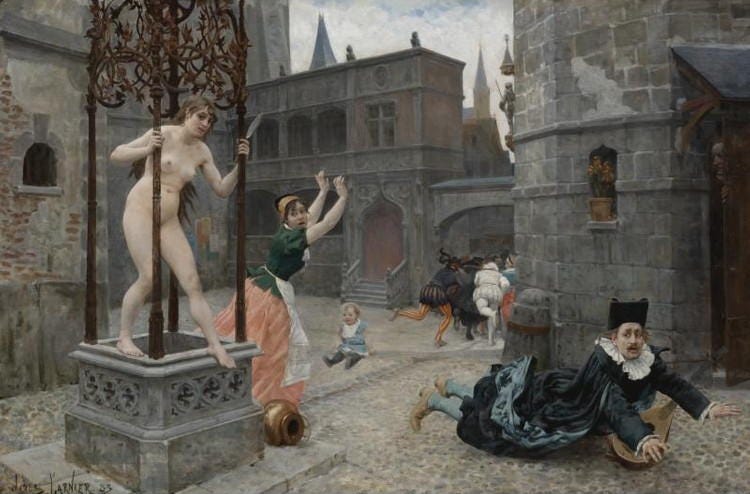
He was not even the first painter to use this image. An earlier version by his own student, Jules Arsène Garnier, had already shown a nude Truth emerging from a well while a crowd fled from her, exhibited at the Salon of 1883.
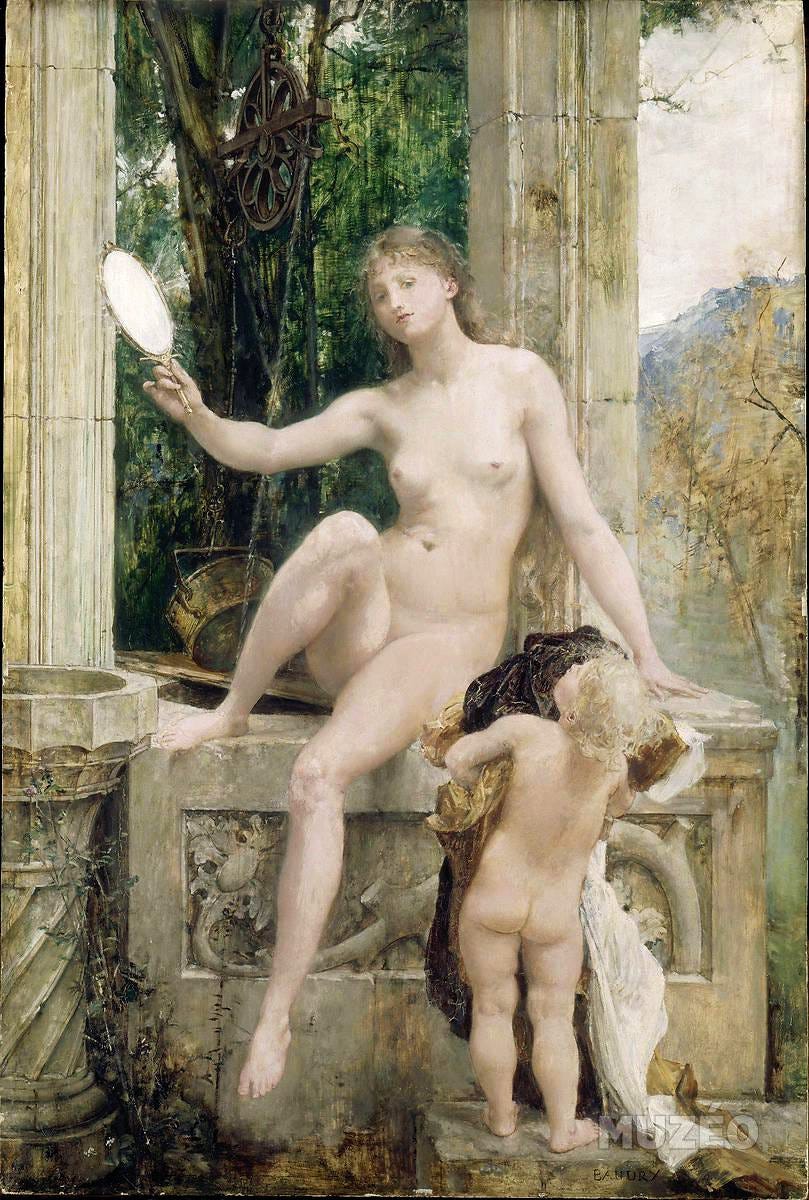
Around the same period, Paul Baudry painted a calmer Truth sitting placidly on the edge of a well with a mirror. Gérôme took a device that already existed in French Salon painting and pushed it as far as it could go.
Gérôme also worked through smaller studies before landing on the final composition, including a study now held at the Musée Georges Garret and a related canvas at the Musée des Beaux Arts de Lyon, both from 1895.
He kept circling the same image for years, refining the woman's pose and the angle of the light each time, until he arrived at the furious, fully emerged figure in the 1896 version.
Was it really about the Dreyfus affair
This is the theory most people reach for first, and it is easy to see why.
The painting appeared in 1896, right in the middle of the Dreyfus affair, the scandal that had already split France over the wrongful conviction of a Jewish army officer for treason, and a furious naked Truth armed with a whip fits that story almost too neatly.
But the timeline is a problem for that reading. Gérôme had already painted the earlier, related image of Truth dead in the well back in 1895, before the Dreyfus affair had become the national obsession it turned into over the following years.
The art historian Bertrand Tillier has argued instead that Gérôme's real target across these paintings was something closer to home for him: his own long running feud with Impressionism, the movement that had spent two decades making his own academic style look old fashioned.
Gérôme even wrote his own explanation of the image, years later, in a preface for a book on the nude.
He credited photography, not politics, with finally letting truth out of its well, saying it had forced painters to abandon old routines and see clearly for the first time, and that once truth had escaped, it would never go back in.
Where the painting lives now
Truth Coming Out of Her Well has hung at the Anne de Beaujeu museum in Moulins, France, since 1978.
In 2012, after touring to Los Angeles, Paris, and Madrid as part of a larger Gérôme retrospective, the museum built an entire exhibition around this one canvas, gathering the sketches, studies, and related works that fed into it.
One of the museum's own curators summed up the appeal of the piece by calling it their Mona Lisa, precisely because nobody can agree on what it actually means.
A painting that has kept scholars arguing for more than a century over politics, photography, and a rival art movement earns that comparison honestly.
Gérôme himself seems to have felt something similar about it. According to his own biographer, when he died in 1904, his maid found him slumped in the small room next to his studio, in front of a portrait of Rembrandt and at the foot of one of his own paintings of Truth.
The account does not say which version it was, but out of everything he painted across a very long career, it was one of these well paintings he apparently kept closest at the end.
If academic Salon painters like Gérôme are new territory for you, our list of the greatest painters of all time is a good place to see where he fits against the artists who eventually eclipsed him.
How a nineteenth century Salon painting became a meme
Here is the part that would have baffled Gérôme completely. In December 2012, someone posted his painting to Tumblr, and it took off, first as a straightforward piece of classical art appreciation, then as a template.
A post pairing the image with a photo of musician Laura Jane Grace, captioned as though she were the one coming out of a well, picked up more than a thousand notes within a few years.
From there, the format spread the way internet formats do: swap in a different face, keep the caption structure, let the joke reset itself for a new audience that has never heard of Jean Léon Gérôme.
The format is simple enough that almost anyone can use it.
Take the painting, take a photo of a person or a celebrity in some dramatic or over the top moment, caption it as though the painting itself were them, and let the contrast between the eighteen nineties and whatever modern chaos is in the second image do the joke for you.
It is now filed on meme tracking sites under Classical Art Memes, alongside other Salon and academic paintings that internet culture picked up and repurposed decades after the artists who made them died.
Gérôme spent his career defending traditional painting against everything modern. It is a strange kind of afterlife that the picture he made about truth finally escaping is the one still circulating today, stripped of its original argument and turned into a punchline.
If you want more artists whose reputations took unexpected turns after their own lifetimes, our roundup of ten artists you need to know covers a few more of them.
Three More Paintings Built on a Secret
Truth armed with a whip is not the only 19th century painting hiding more than it shows. Start here.
Frequently asked questions
What does Truth Coming Out of Her Well mean? It personifies an old philosophical saying that truth lies at the bottom of a well, showing Truth as a furious naked woman climbing out with a whip, ready to punish humanity for having buried her.
Who painted Truth Coming Out of Her Well? The French Salon painter Jean Léon Gérôme, in 1896, near the end of his career.
When was Truth Coming Out of Her Well painted? 1896, shown that year at the Paris Salon, a year after a related, darker painting of Truth dead at the bottom of a well.
Where is Truth Coming Out of Her Well today? At the Anne de Beaujeu museum in Moulins, France, part of its permanent collection since 1978.
Is Truth Coming Out of Her Well about the Dreyfus affair? It is often assumed to be, since it appeared during the scandal, but the timeline is shaky. At least one art historian argues Gérôme was really aiming at Impressionism, a movement he despised.
Why is the woman in the painting naked? It plays on the French expression la vérité nue, the naked truth, a wordplay Gérôme leaned into directly rather than just illustrating.
Why does Truth carry a whip in the painting? That detail is Gérôme's own invention, turning a calm old philosophical metaphor into a scene of Truth returning to punish the people who kept her buried.
Why did Truth Coming Out of Her Well become an internet meme? A Tumblr post from December 2012 paired the image with a modern photo using the same caption format, and the joke template spread from there, long after most people had forgotten who painted the original.