What Does Turner's Rain, Steam and Speed Mean?

Turner painted a train dissolving into rain, and hid a small joke about speed just ahead of its wheels.

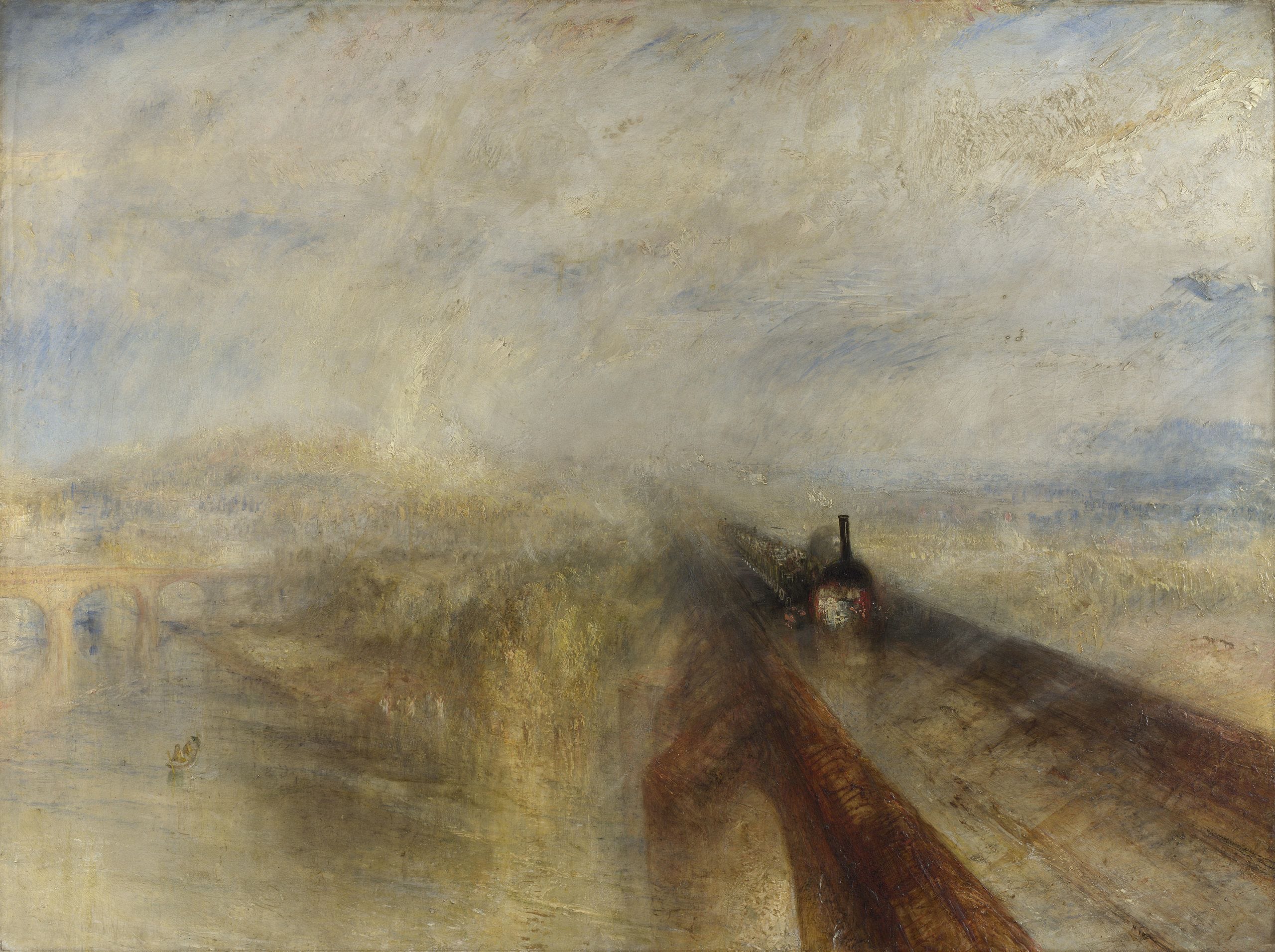
Turner's Rain, Steam and Speed shows a steam locomotive crossing a bridge through swirling rain, painted in 1844 at the height of Britain's railway boom. A hare appears to be racing it down the tracks.

Rain Steam and Speed Turner painting
J.M.W. Turner, Rain, Steam and Speed, 1844.

Landscape painters of the period favored timeless rivers and quiet fields. Turner pointed his brush at a machine instead, and let the weather nearly dissolve it.

  • Date. Painted in 1844, during Britain's railway building boom.

  • Medium. Oil on canvas, about 91 by 121.8 centimeters.

  • Location. National Gallery, London.


Learn art the fun way. Join 170,000 readers getting one painting and its story every week.


More weather, more Turner

Turner spent his final decades chasing effects nobody else was painting yet. Here is where that obsession goes next.


A bridge, a storm, and a train

The bridge is Maidenhead Railway Bridge, carrying the Great Western Railway across the Thames near Slough. Turner paints the locomotive already half swallowed by rain and steam, its outline barely holding together against the weather.

Everything solid nearby, the bridge, a small boat below, a distant plough team in a field, gets softer the closer it sits to the machine barreling through the storm. What strikes me is that softening. The train stays sharp while everything old around it starts to blur, like the rest of the world cannot quite keep up.

Slave Ship Turner painting
J.M.W. Turner, The Slave Ship, 1840.

The woman behind the window story

The often repeated account of Turner leaning out of a train window comes from one witness, a young woman named Jane O'Meara, later Mrs John Simon. She told John Ruskin she shared a carriage with an elderly gentleman who lowered the window and leaned into the rain for close to nine minutes.

Ruskin trusted her enough to publish her account in 1886, more than forty years after the painting was finished. Simon described a night journey in heavy rain, while Turner's painting shows a daytime scene, a mismatch historians still point out. I think that mismatch matters less than people assume. Turner was not illustrating one specific night, he was painting what speed felt like in general.

Whether or not she really watched Turner at work, the story fits how he painted in his later years, chasing real weather in person rather than inventing it from memory.

The Fighting Temeraire Turner painting
J.M.W. Turner, The Fighting Temeraire, 1839.

One painting. One story. Every week. Free, with 170,000 readers who never sat through an art history lecture.


The hare on the tracks

Just ahead of the locomotive, barely visible, a hare runs down the rails. Hares were a traditional symbol of speed, and the animal is either about to be overtaken by the train or still, for one more second, outrunning it.

Turner leaves the outcome unresolved, a small joke about which kind of speed was about to win the argument. To me, that unresolved ending is the whole joke. Turner refuses to tell you whether the hare gets away.

Snow Storm Steamboat Turner painting
J.M.W. Turner, Snow Storm, Steam Boat off a Harbour's Mouth, 1842.

More storms, more speed


The bridge was itself a feat of engineering

The bridge in the painting is Isambard Kingdom Brunel's Maidenhead Railway Bridge, completed in 1838 for the Great Western Railway. Its two brick arches were the flattest and widest built anywhere at the time, each spanning about 39 meters with a rise of only about 7 meters.

Several engineers publicly doubted the arches would hold weight. Brunel left the temporary wooden supports in place for months after construction to counter the criticism. The bridge never needed them and has carried trains ever since.

Why painting a train was radical

Serious landscape painting in the 1840s still leaned on idealized, timeless nature, rivers and quiet fields untouched by industry. Turner instead gave a new, noisy, coal burning machine the same grandeur previously reserved for storms and ancient ruins, treating a piece of engineering as a subject worth the sublime.

The choice mattered more to the next generation. Monet, painting steam and locomotives at Gare Saint Lazare decades later, was working a path Turner had already cleared.

How the Royal Academy first reacted

When Turner showed the painting at the Royal Academy in 1844, several critics dismissed its blurred, loosely brushed handling as unfinished or simply incompetent, calling the locomotive a smudge rather than a machine worth admiring on canvas.

Others recognized something genuinely new, an attempt to paint speed, steam and weather together rather than a static, sharply outlined machine.

John Ruskin, already championing Turner in his early writing, pointed to paintings like this one as proof that Turner had pushed further into pure atmosphere than any painter working in Britain at the time.

Turner self portrait
J.M.W. Turner, self portrait, circa 1799.

See art differently. 170,000 people read these free stories. Come find out why.


Older Britain, still visible beside the railway

Look past the locomotive and the bridge, and the painting keeps at least one much older scene going at the same time, a small boat drifting on the Thames just below the tracks, and a distant plough team working a field on the far bank, both slower forms of movement Turner chose to paint beside the fastest machine in Britain.

The boat is easy to miss against the blurred water. Turner placed this trace of slower, older river life directly beside the newest form of transport in Britain, a contrast easy to overlook on a first glance but clearly deliberate.

How it reached the National Gallery

Rain, Steam and Speed stayed in Turner's own possession until his death in 1851, one of many late paintings he refused to sell during his lifetime. Under the terms of the Turner Bequest of 1856, it passed to the British nation.

It has hung in the National Gallery, London, ever since, oil on canvas, about 91 by 122 centimeters.

Which train, which line

The train runs on the Great Western Railway's line between London and Bristol, a route Brunel had engineered with a deliberately gentle, nearly level gradient, designed to let trains hold their speed over long stretches without the steep climbs that slowed other early railways across Britain.

Turner is thought to have based the locomotive on one of the GWR's early broad gauge engines, built to the wider track width Brunel championed over the more common standard gauge. That wider gauge let GWR trains run faster than most rivals at the time.

Frequently asked questions

  • What bridge is shown in Rain, Steam and Speed?

    Maidenhead Railway Bridge, which carries the Great Western Railway across the River Thames near Slough.

  • Who is the witness behind the story of Turner at the train window?

    A young woman named Jane O'Meara, later Mrs John Simon. She gave her account to John Ruskin, who published it in 1886. Her story describes a night journey, while the painting shows daytime, a detail that raises doubt.

  • What does the hare in the painting mean?

    Hares symbolized speed. Positioned just ahead of the train, it leaves open whether the animal or the machine is winning the race.

  • Why was painting a train unusual for 1844?

    Serious landscape painting at the time favored timeless, idealized nature. Turner gave a modern, industrial machine the same grandeur usually reserved for storms and ruins.

  • How wide were the arches of Maidenhead Bridge?

    About 39 meters each, with a rise of only about 7 meters, making them the flattest and widest brick arches built anywhere at the time.

  • Where can I see Rain, Steam and Speed today?

    At the National Gallery in London.


No boring lectures, ever. Join 170,000 readers learning art the fun way, free.