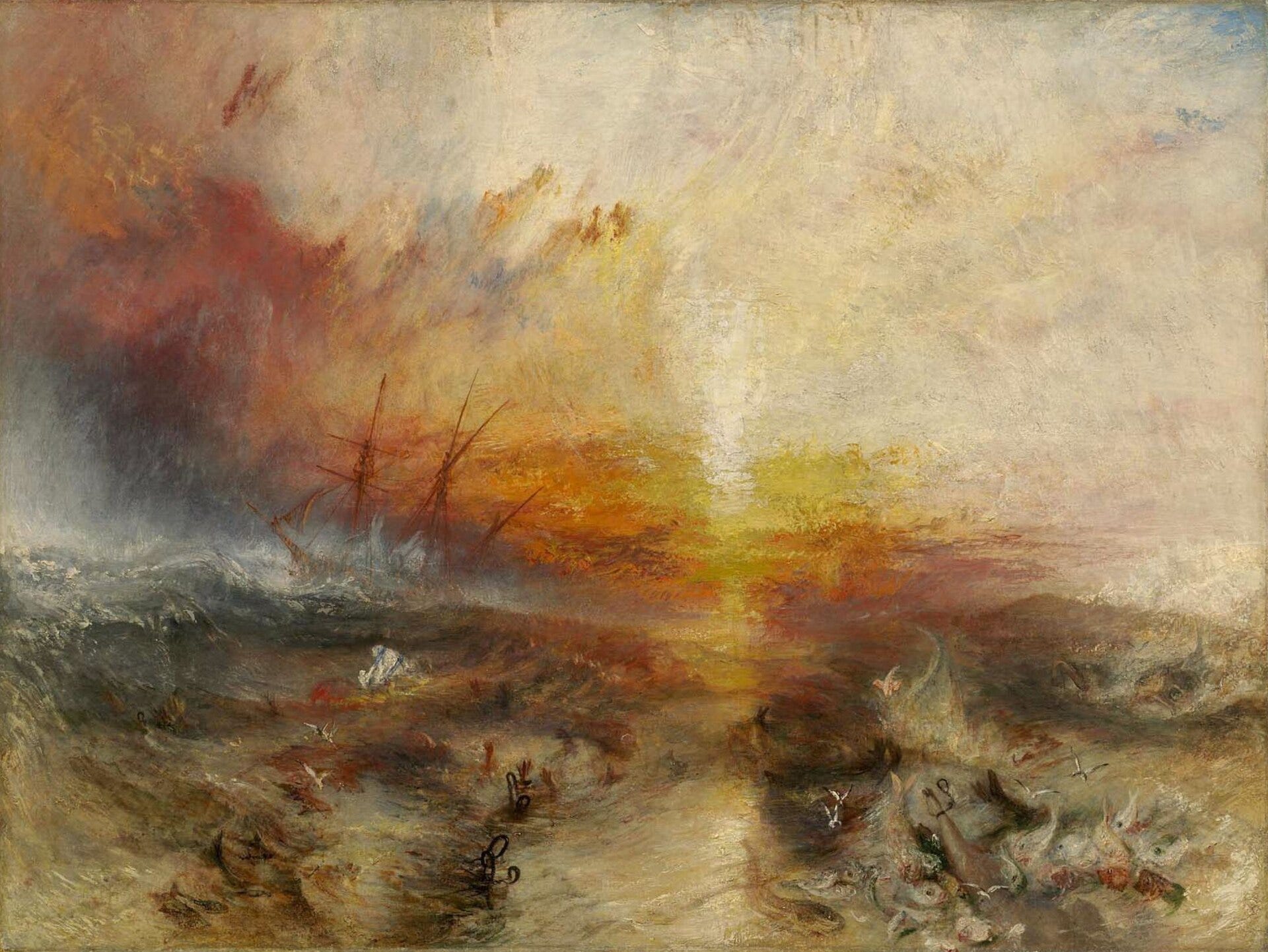
What Does Turner's The Slave Ship Mean?

Turner painted a real insurance fraud disguised as a storm, timed to land during London's biggest anti slavery convention.

Turner's The Slave Ship shows a storm swallowing a vessel that has just thrown its dying captives overboard, painted in 1840 to coincide with an anti slavery convention in London. It is based on a real insurance fraud.

Slave Ship Turner painting
J.M.W. Turner, The Slave Ship, 1840.

At a distance it reads as a blazing sunset over rough water. Look into the foreground and shackled limbs are visible, already being pulled under by fish, in water Turner painted the color of blood.

  • Date. Painted in 1840 and shown that year in London.

  • Medium. Oil on canvas, about 91 by 138 centimeters.

  • Location. Museum of Fine Arts, Boston.


Learn art the fun way. Join 170,000 readers getting one painting and its story every week.


More paintings with a conscience

Turner rarely painted a message this direct. Here is where the same instinct shows up elsewhere.


The real ship behind the painting

In 1781, the crew of the slave ship Zong killed more than 130 enslaved Africans by throwing them overboard, then filed an insurance claim for the lost cargo. Insurance covered captives lost at sea but not deaths from illness, which gave the captain a financial reason to kill. The court case that followed exposed how the trade priced human lives as cargo.

Turner most likely knew the case through Thomas Clarkson's history of the abolition movement, republished in 1839, which retold the Zong killings in detail.

Since 1959, art historians have read The Slave Ship almost without exception as Turner's response to that case, even though the ship in the painting is never named.

Painted for a political moment

Turner exhibited the painting in 1840, the same year London hosted two international anti slavery gatherings. He paired it with lines from his own poem about the dead and dying, ruling out any reading of the scene as a simple seascape.

Britain had abolished slavery in its own colonies in 1833, only seven years earlier. The argument for abolishing it everywhere else was still being made in public that summer, and Turner's painting went on view while that argument was on everyone's mind.

Rain Steam and Speed Turner painting
J.M.W. Turner, Rain, Steam and Speed, 1844.

A storm that eats the evidence

The typhoon in the background is already swallowing the ship, as though the sea itself were erasing what happened. The foreground is thick with paint, closer to abstraction than anything else Turner had painted by 1840, and it forces the viewer to look directly at the water instead of away from it.

Turner painted the water the color of a sunset, so that from a distance the canvas reads as a blazing seascape rather than a crime scene. Only up close do the chains and limbs surface, pulled under by fish rendered in the same loose, wet brushwork as the waves around them. What strikes me is that delay. The painting lets you admire it for a moment before it makes you look at what is actually happening in the water.

The Fighting Temeraire Turner painting
J.M.W. Turner, The Fighting Temeraire, 1839.

One painting. One story. Every week. Free, with 170,000 readers who never sat through an art history lecture.


Ruskin's painting he could not keep

The critic John Ruskin received The Slave Ship as a New Year's gift from his father in January 1844 and called it the noblest work Turner ever painted. He sold it in 1872, later saying the subject was too harrowing to live with.

Ruskin wrote in his diary on New Year's Day that he was grateful for the gift and doubted he would ever want another Turner oil. That devotion helped build the painting's reputation for decades before it ever left England. To me, that diary line says something about how the painting was received for a long time, as a beautiful object first and a record of atrocity second.

Snow Storm Steamboat Turner painting
J.M.W. Turner, Snow Storm, Steam Boat off a Harbour's Mouth, 1842.

More sea, more history


A title almost as long as a poem

At the Royal Academy in 1840, Turner exhibited the picture under a title far longer than the one it carries today: Slavers Throwing overboard the Dead and Dying, Typhoon coming on. The catalogue printed lines from his own unpublished poem, The Fallacies of Hope, so visitors read the verse before reaching the gallery wall.

The poem ends on a bitter question aimed at the traders themselves, asking what their fallacious hope of profit was worth once the storm arrived. Turner used the same device, pairing a painting with his own verse, for several of his most morally charged pictures.

Where it went after Ruskin sold it

Ruskin first offered the painting at Christie's in April 1869, where it went unsold. He sold it privately in 1872, for about 4,000 pounds, to the American collector John Taylor Johnston in New York, arranged through the dealer William T. Blodgett.

From Johnston's collection it passed to Alice Sturgis Hooper of Boston in 1876, then by descent to her nephew William Sturgis Hooper Lothrop.

The Museum of Fine Arts, Boston, purchased the painting from Lothrop in 1899 using its Henry Lillie Pierce Fund, and it has hung there ever since.

A painting that started falling apart in his own lifetime

Turner worked with thin, experimental layers of pigment and often skipped the slower drying methods other painters used, chasing a particular translucency in the water and sky. Some passages were already cracking and changing color while Turner was still alive.

Conservators at the Museum of Fine Arts have since carried out several treatments to stabilize paint that was structurally unstable from the moment it left Turner's brush.

Turner self portrait
J.M.W. Turner, self portrait, circa 1799.

See art differently. 170,000 people read these free stories. Come find out why.


Oil on canvas, smaller than the horror suggests

Despite its epic subject, The Slave Ship measures about 91 by 138 centimeters, modest for a history painting of this ambition. The scale forces the viewer close, near enough to make out the single shackled limb breaking the surface of the water in the foreground.

Turner painted the fish and gulls circling that limb with the same loose, storm soaked brushwork as the sky, refusing to separate the horror from the weather around it.

A public defense in print, years before the sale

When Turner first exhibited the painting in 1840, several critics focused only on its violent color and called the subject unfit for art. A young John Ruskin defended it in his book Modern Painters, calling it the noblest example of Turner's work he knew of.

Decades later the writer Mark Twain mocked that very devotion in a travel book, joking that Ruskin's trained eye could find truth in what Twain still saw as an impossible tangle of mud colored water and floating chains.

Ruskin's defense helped cement the painting's reputation long before it crossed the Atlantic, even though he himself eventually found it too heavy to keep in his own house.

Frequently asked questions

  • What real event inspired The Slave Ship?

    The 1781 case of the slave ship Zong, whose captain threw more than 130 sick and dying enslaved people overboard to file an insurance claim for lost cargo rather than absorb losses from deaths by illness.

  • Why did Turner paint The Slave Ship in 1840?

    London hosted two international anti slavery gatherings that year. Turner exhibited the painting alongside his own verse about the dead and dying, tying it directly to the abolitionist movement of the moment.

  • Who owned The Slave Ship after Turner?

    The critic John Ruskin, who received it as a gift from his father in 1844 and called it Turner's noblest work, then sold it in 1872 because he found it too disturbing to keep looking at.

  • What can be seen in the water in the foreground?

    A chained limb, already being pulled under by fish, painted in water colored like blood beneath the storm.

  • How did the painting reach Boston?

    It passed through American collectors after Ruskin's 1872 sale, then the Museum of Fine Arts, Boston, purchased it in 1899 using its Henry Lillie Pierce Fund.

  • Where can I see The Slave Ship today?

    At the Museum of Fine Arts, Boston.


No boring lectures, ever. Join 170,000 readers learning art the fun way, free.