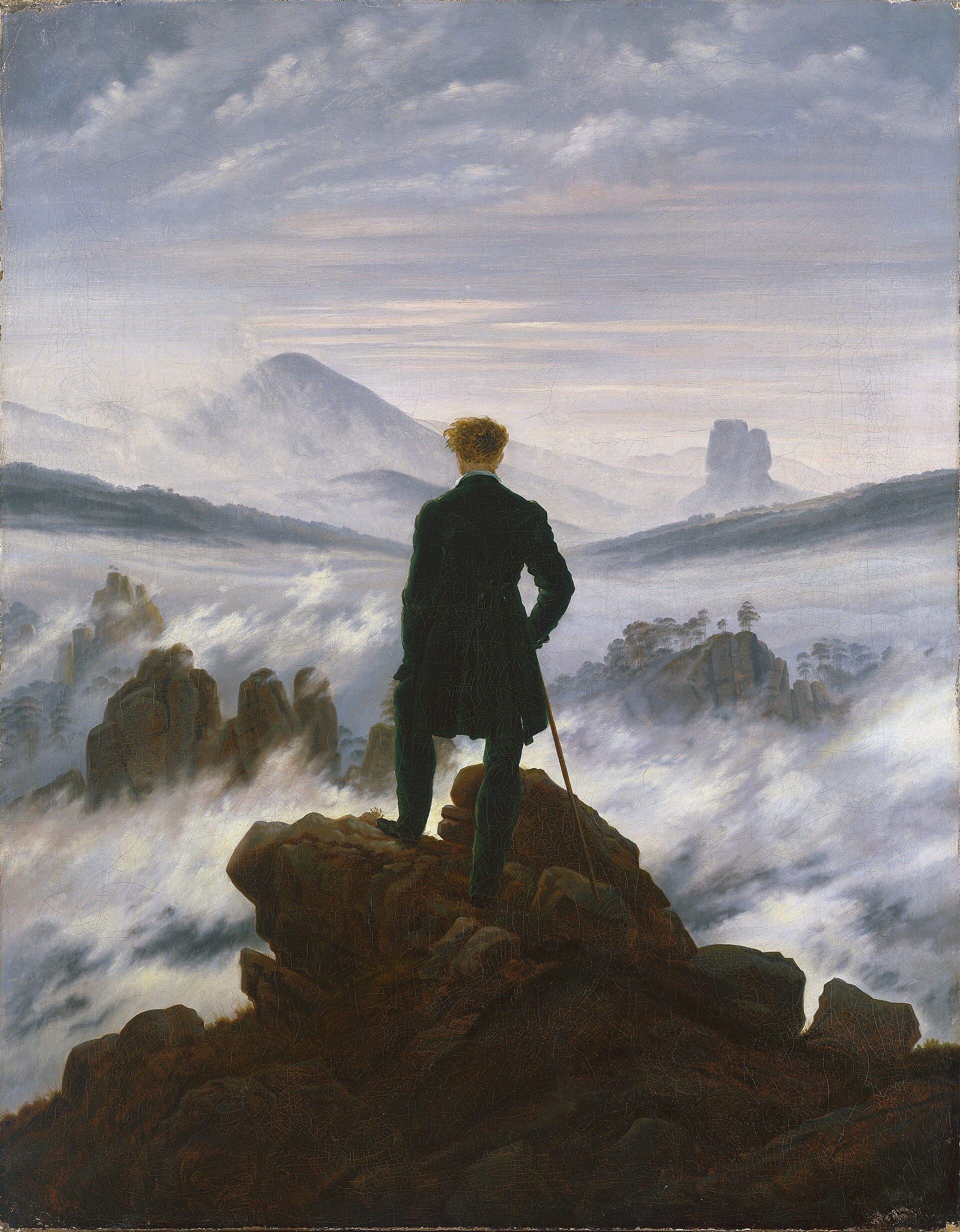
Wanderer above the Sea of Fog shows a man seen from behind, standing on a rocky ledge above rolling mist. Caspar David Friedrich used this Ruckenfigur so viewers step into the scene rather than watch it.
The painting explores the Romantic sublime, not personal triumph, and its meaning stays deliberately open.
People love turning this image into a hustle poster, a lone figure who conquered the mountain. I do not think that is what is happening. Friedrich hides the face on purpose. The point was never one man winning. It was making you feel how small you are in front of something you cannot fully see.
A Man With No Face
The painting shows a single figure standing on a rocky outcrop, back turned to us, a walking stick planted in one hand.
Below him, fog rolls across a valley of half hidden peaks, and we never see his expression or his eyes.
That missing face is not an accident. Friedrich wants you looking with the man, not at him, so the mystery becomes yours rather than his.
The Trick Behind the Pose
German painters called this device a Ruckenfigur, a figure placed with its back to the viewer inside the scene.
Friedrich used it in several paintings, but never as effectively as here, where the figure fills the center of the composition.
The device turns the viewer into a participant. You are not watching someone else's moment on the mountain, you are placed inside it, looking where he looks.
The Sublime, Not the Scenic
This is not a postcard view of the Alps. It belongs to the philosophy of the sublime, developed by writers such as Edmund Burke and Immanuel Kant in the late 1700s.
The sublime describes a mix of awe and fear in front of something too large or too powerful to fully take in.
Friedrich paints that feeling directly. The fog hides more of the landscape than it reveals, and the man stands at the exact edge of what he can understand.
More Stories Like Wanderer above the Sea of Fog
Who Is the Wanderer?
The man's identity has never been confirmed. Some historians read him as a generic figure representing any traveler, others as a stand in for Friedrich himself.
His clothing has sometimes been linked to old German dress associated with nationalist sentiment during the Napoleonic era, though this reading is debated among historians.
Friedrich left no written explanation of who the figure was meant to be, which most scholars take as a deliberate choice rather than an oversight.
Triumph or Something Else
Read quickly, the pose looks like victory, a man standing above the clouds with the world spread out beneath him.
Look longer and the reading gets less comfortable. His footing sits close to a drop, and the fog blocks any clear path forward from where he stands.
German Romantic painting rarely settles for simple triumph. It prefers ambiguity between mastery over nature and real exposure to it.
Why It Became a Motivational Image
The composition travels well outside its original context. A solitary figure facing a vast view fits easily onto a poster or a slide in a business presentation.
Stripped of its philosophy, it reads as pure ambition, a symbol of one person conquering an obstacle.
That reading drops the uncertainty Friedrich built into the image, and turns a genuine question about man and nature into a simple slogan about success.
German Romanticism in One Frame
Friedrich painted this around 1818, near the height of German Romantic landscape painting.
The movement pushed back against industrial cities and strict rationalism, searching instead for meaning in wild, unfiltered nature.
The wanderer, alone in front of the fog, became the clearest single image the movement produced, reproduced far more than any other German Romantic painting.
What the Fog Actually Hides
Friedrich painted this scene from memory and sketches made in the Elbe Sandstone Mountains, not from a single real vantage point.
The peaks in the distance do not match any exact location, which supports the idea that the landscape is constructed rather than documentary.
The fog itself does the real work of the painting. It removes certainty about scale, distance, and what actually lies ahead of the man on the rock.
Keep the stories coming
Questions About Wanderer above the Sea of Fog
What does Wanderer above the Sea of Fog mean?
It shows a solitary figure facing a sea of fog and distant peaks, built around the Romantic idea of the sublime rather than a simple statement of personal victory.Who is the man in Wanderer above the Sea of Fog?
His identity was never confirmed by Friedrich. Readings range from a generic traveler to a self portrait of the artist, and neither has been proven.What is a Ruckenfigur?
A Ruckenfigur is a figure painted from behind so the viewer looks past it into the scene instead of at the person's face, a device Friedrich used often.Is Wanderer above the Sea of Fog about triumph?
Not simply. The pose reads as confident, but the fog, the nearby drop, and the hidden face keep the meaning open between mastery and exposure.When was Wanderer above the Sea of Fog painted?
Around 1818, by the German Romantic painter Caspar David Friedrich, during the height of the German Romantic landscape movement.Where is Wanderer above the Sea of Fog located today?
It hangs in the Kunsthalle Hamburg in Germany, where it remains one of the museum's most reproduced works.Why is Wanderer above the Sea of Fog used as a motivational image?
Its composition, a single figure facing a vast view, reads well as a symbol of ambition once separated from the Romantic philosophy behind it.What movement does Wanderer above the Sea of Fog belong to?
German Romanticism, a movement that treated wild, unfiltered nature as a source of meaning against industrial cities and strict rationalism.