
A veduta is a detailed picture of a real place, most often a city, painted or engraved so precisely that someone who knows the place can recognize its streets, churches and bridges. The subject is the place itself, not a story set in it. Canaletto's views of Venice, painted in the eighteenth century for foreign visitors, are the best-known examples.
The word is Italian for "view." Its plural is vedute, and the painters who specialized in these pictures are called vedutisti. Italian also has a name for the strictest form, the veduta esatta, or exact view, which shows a place as it stood when the painter saw it.
Cool Stories About Art is a newsletter to learn art the fun way.
Join 200,000+ readers and get:
10 new art stories / month
The entire archive of content (1,000+ articles)
Comment, ask questions, and chat with other readers
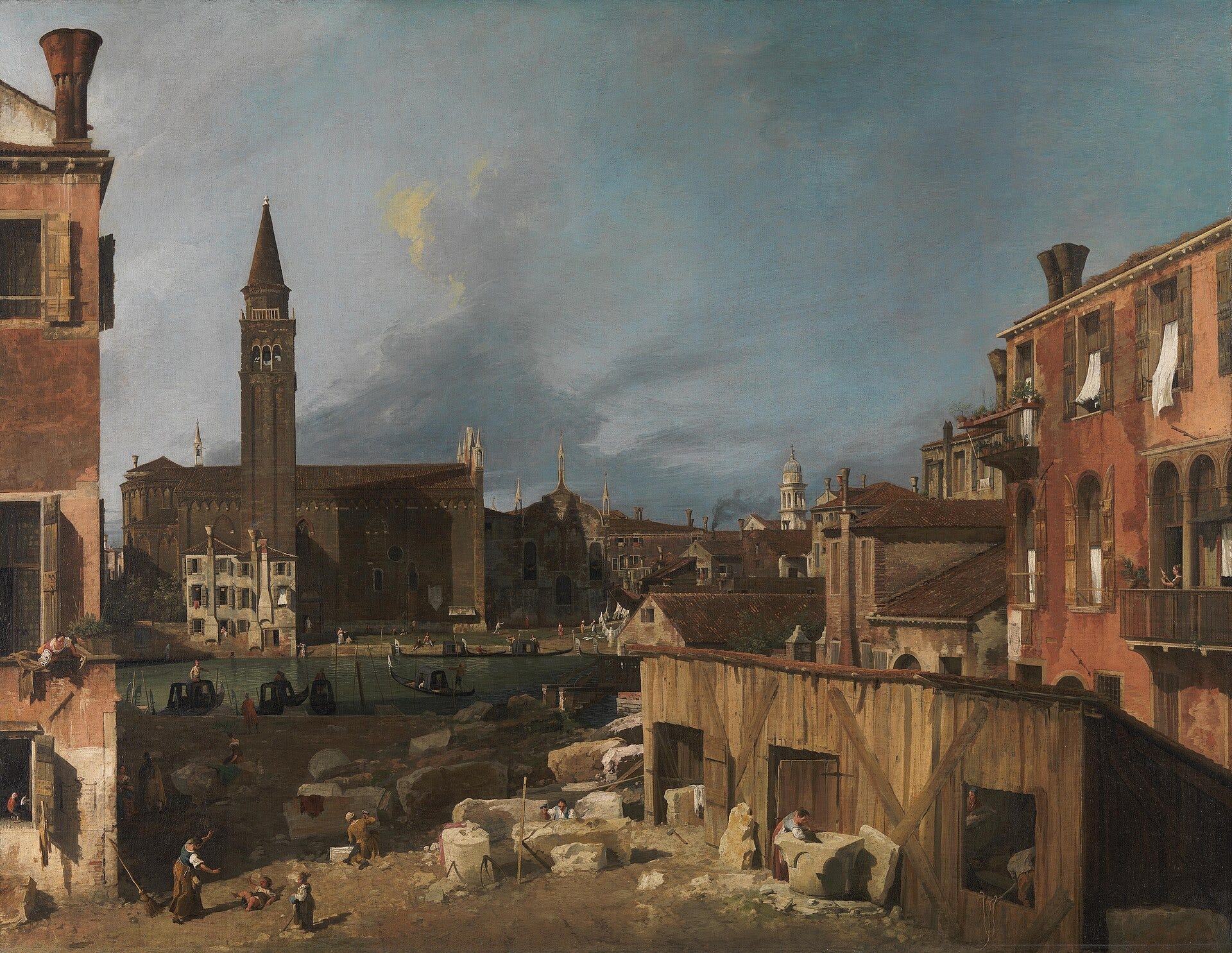
An exact view also records what is about to disappear. In The Stonemason's Yard, painted about 1725, Canaletto shows a small Venetian square, the Campo San Vidal, turned into a workshop. Blocks of Istrian stone have been brought in by water to repair a nearby church. Across the Grand Canal rises the bell tower of another church, Santa Maria della Carità.
That tower collapsed in 1744, and it was never rebuilt. A picture made to show Venice exactly as it was now shows a Venice that no longer exists.
Two centuries later, in Warsaw, the views painted by Canaletto's nephew were put to a far more practical use.
Gaspar van Wittel's Rome
The veduta did not start in Venice. It took shape in Rome, in the hands of a painter from the Netherlands. Gaspar van Wittel settled in Rome, where he was known as Vanvitelli, and by 1685 he was painting precise views of the city.
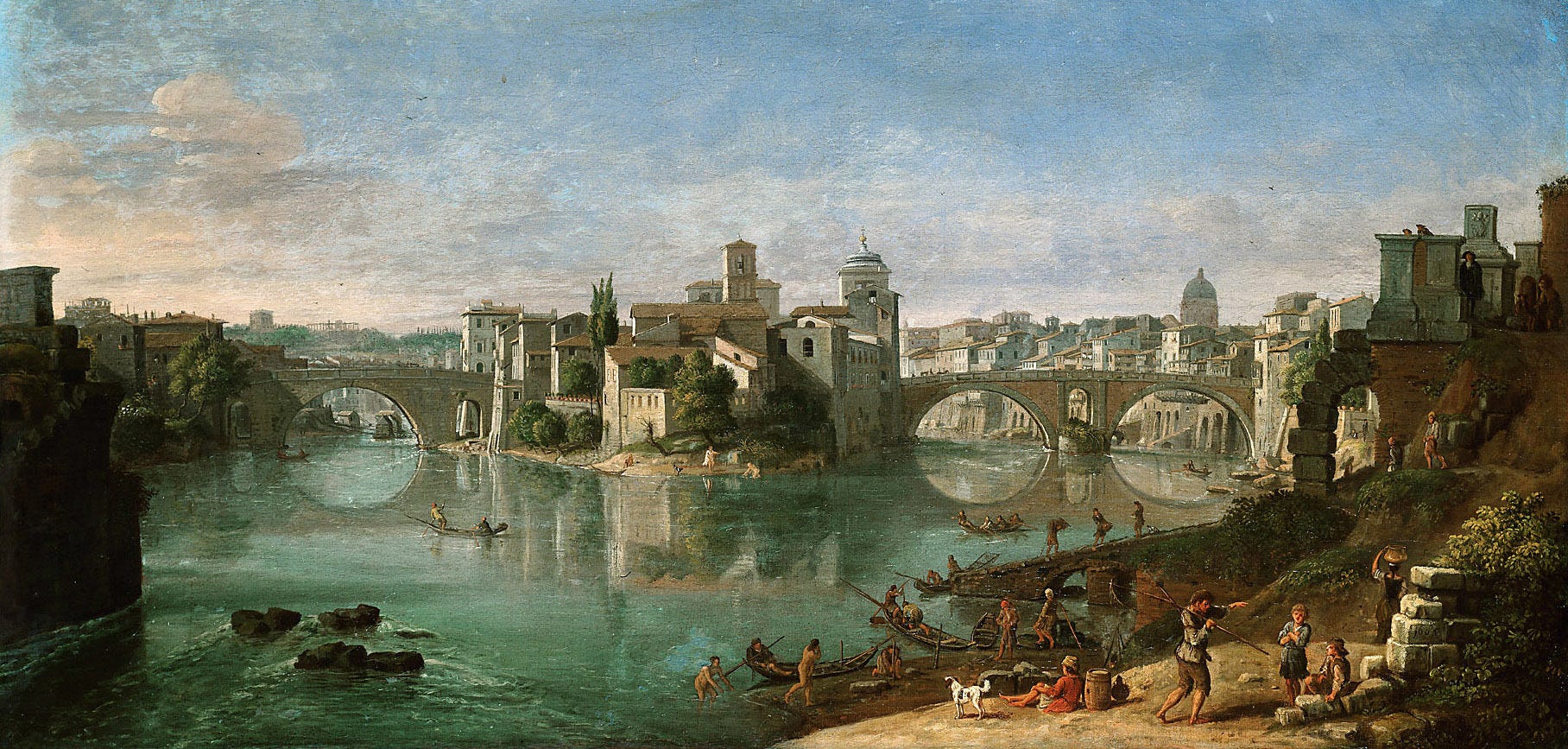
His Tiber Island in Rome shows the island that sits in the middle of the river, with the city around it. The painting carries its date, 1685, written on a block of masonry in the lower right corner.
Venice was the next city to have its own painters of views. Luca Carlevarijs was among the first there to sell views of the city to foreign visitors. He used a camera ottica, a box that projected the view onto paper through a small hole, but mostly to take notes. The finished pictures were painted afterward.
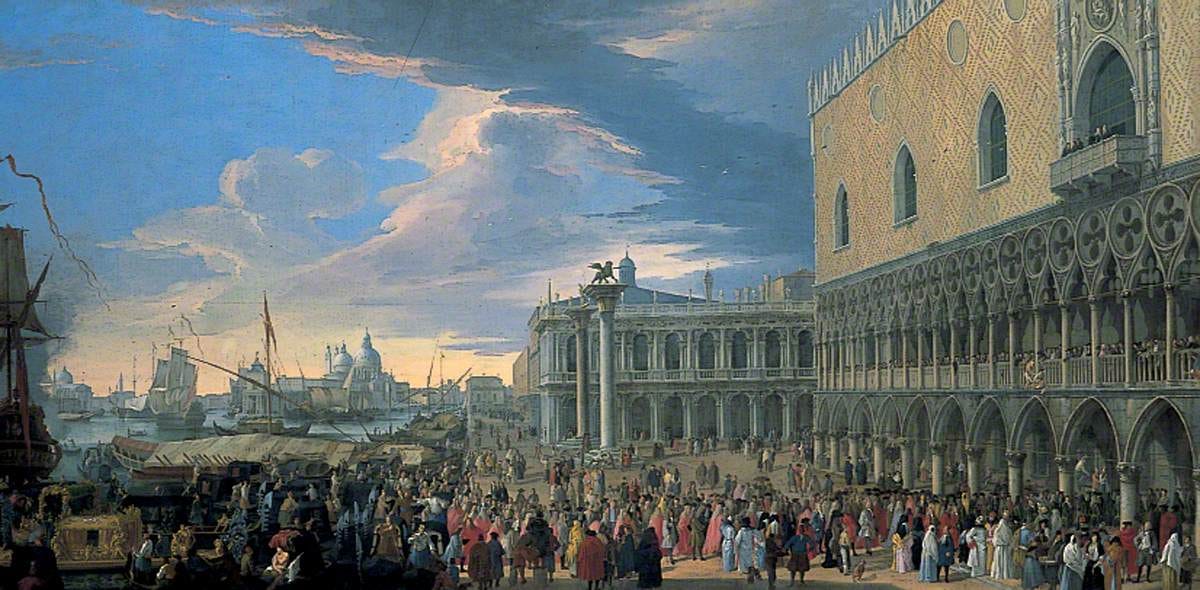
His Arrival of the 4th Earl of Manchester in Venice in 1707, painted between 1707 and 1710, shows how a veduta could record an event as well as a place. In 1707 Charles Montagu, the British ambassador, stepped off a gondola to be welcomed in Venice.
Carlevarijs painted the scene where it happened, with the earl in a blue coat almost lost among the boatmen, the onlookers and the revelers in carnival costume.
What You'll Discover
Why Grand Tour travelers paid for accuracy.
How Canaletto built an exact view.
The line between a veduta and a capriccio.
Why Guardi's Venice looks so different.
The church Warsaw rebuilt from a painting.