
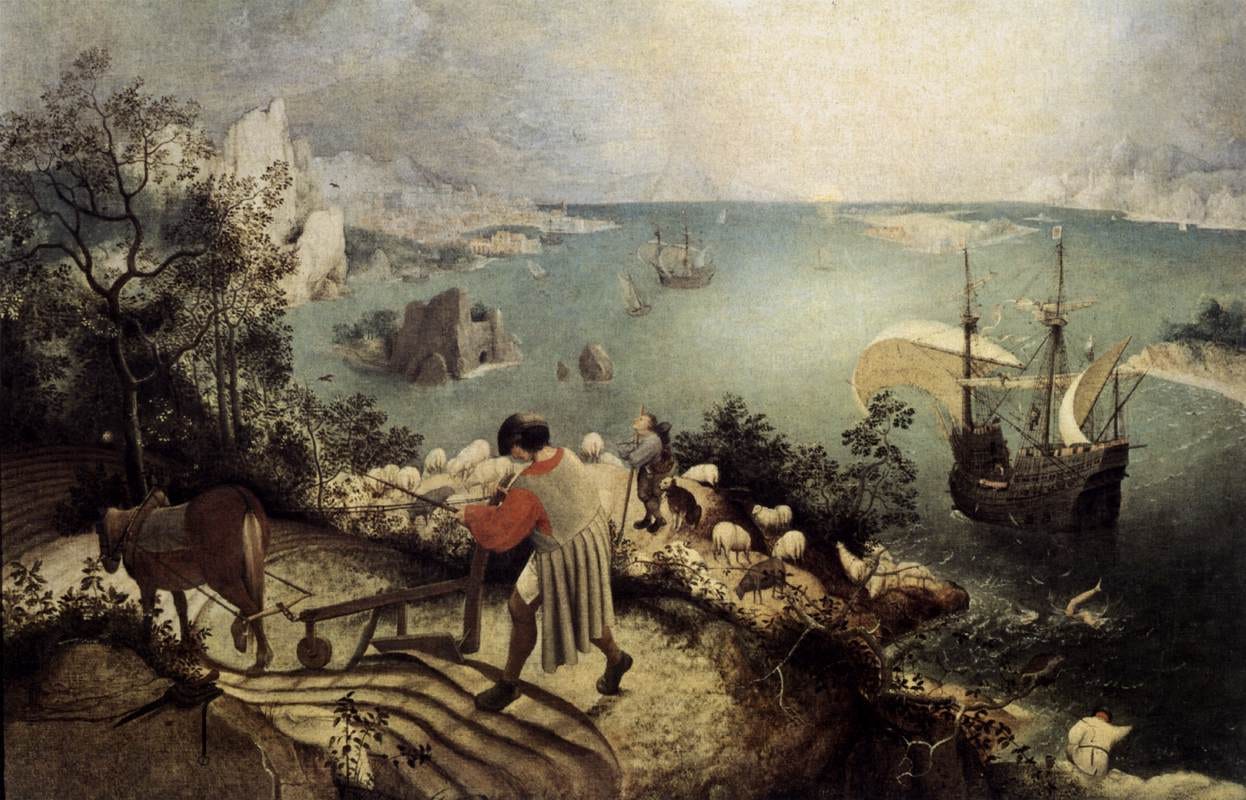
Ekphrasis is a piece of writing that describes a work of art so closely that a reader can picture it without ever seeing it. Most often it is a poem about a painting or a statue. A famous modern example is W. H. Auden's poem "Musée des Beaux-Arts," which describes a painting of the fall of Icarus.
The word comes from Greek. Ek means "out" and phrasis means "speaking," so ekphrasis is the act of speaking a thing out, telling it in full. The writer looks at an image and turns it into sentences. A reader of Auden's poem can follow the whole scene, the ploughman, the ship and the boy in the water, without the painting in front of him.
Cool Stories About Art is a newsletter to learn art the fun way.
Join 200,000+ readers and get:
10 new art stories / month
The entire archive of content (1,000+ articles)
Comment, ask questions, and chat with other readers
That is the modern meaning, and it is much narrower than the first one. For the teachers of rhetoric in ancient Greece and Rome, ekphrasis was a school exercise. A student had to describe something so vividly that his listeners seemed to see it. The subject could be a person, a place, a battle or even a crocodile. A painting was only one possibility among many.
The most famous early example is not a painting either. In the Iliad, Homer describes, scene by scene, a shield that the god Hephaestus forges for the hero Achilles. No such shield ever existed. Homer invented the object, and readers have only ever met it in words.
A school exercise in making people see
Ekphrasis started as a classroom skill. The ancient handbooks of rhetoric listed it among the progymnasmata, the graded exercises that trained young speakers, and defined it as a descriptive speech that brings its subject before the eyes.
The rhetorician Hermogenes named the two qualities a good description needed. The first was enargeia, the power to make a thing seem present. The second was sapheneia, clarity. The teacher Aphthonius left a model exercise to show what that looked like, and his subject was a building rather than a picture, the acropolis of Alexandria.
The word itself came late. The classicist Michael Squire notes that it is not attested until much later in antiquity, so Homer described his shield with no name for what he was doing.
Modern critics then narrowed the word to works of art. In his book Museum of Words, published in 1993, the literary scholar James Heffernan defined ekphrasis as "the verbal representation of visual representation." A poem about a painting fits that definition. A speech about a crocodile does not, because the crocodile is not itself an image.
Ekphrasis is also different from iconography, which asks what the symbols in a picture mean. Ekphrasis has a simpler job: to make the reader see what is there. Homer showed that it can do this even for an object that never existed.
What You'll Discover
How Homer described a shield being forged.
Which lost painting Botticelli rebuilt from words.
Which urn Keats really had in mind.
What a headless statue told Rilke.
Why two poets saw Icarus so differently.