The bright light Van Gogh watched from his window before sunrise in June 1889, the one he called "the morning star," was the planet Venus. Astronomers who studied the sky over Provence that month found it unusually bright, exactly where he said it was.
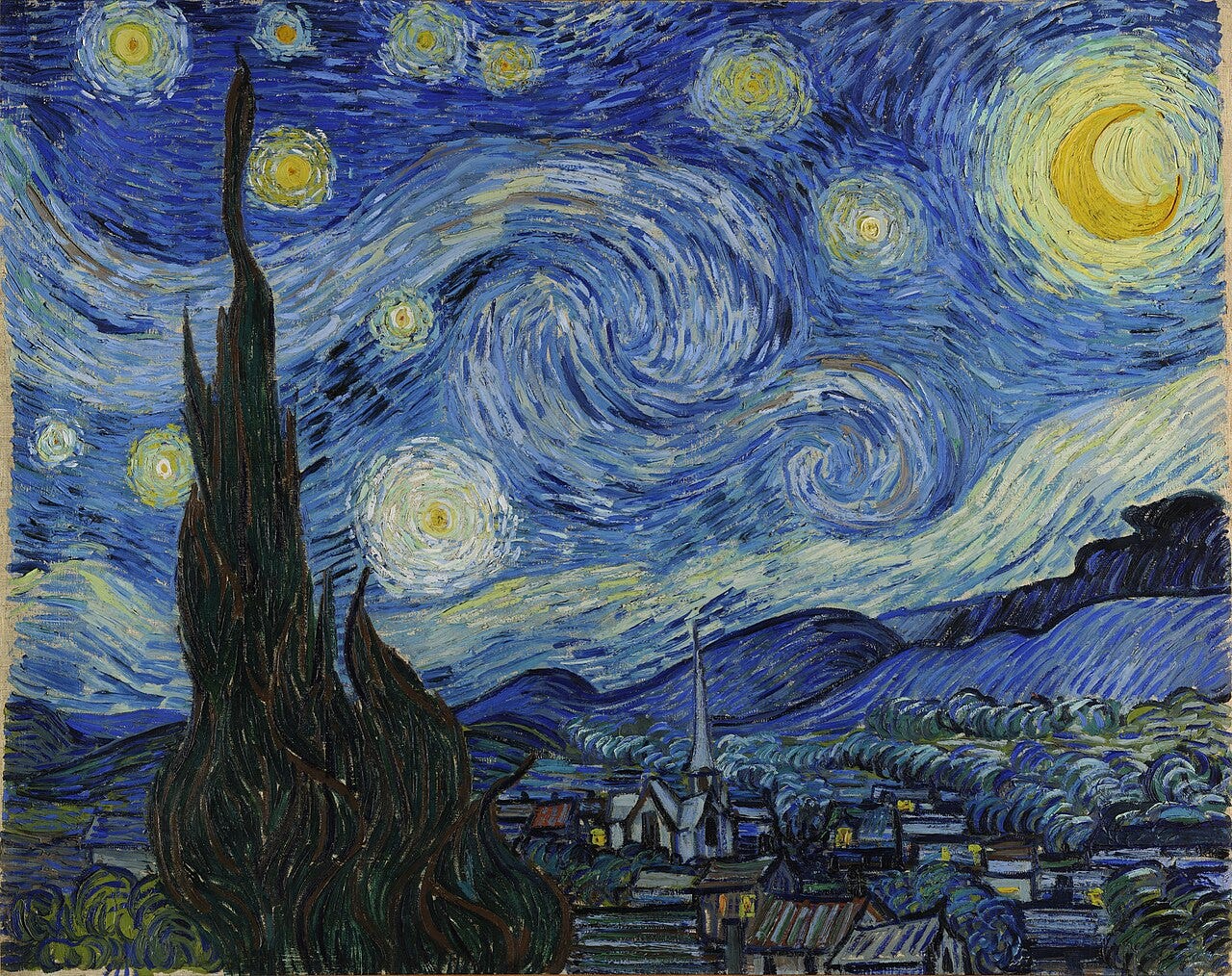
So what is the true story behind The Starry Night? Van Gogh painted it in June 1889 as a voluntary patient at an asylum in southern France. He combined a real sky, a real cypress, and an invented village, working from memory during daytime studio sessions.
A view from an asylum window
In May 1889, months after the ear incident in Arles the previous December, Van Gogh admitted himself to the Saint Paul de Mausole asylum in Saint Remy de Provence. His brother Theo paid for the stay.
He had two rooms there. A bedroom on the second floor, with a barred window facing east, and a small studio on the first floor where he was allowed to work.
From that bedroom window he wrote to Theo: "This morning I saw the countryside from my window a long time before sunrise, with nothing but the morning star, which looked very big."
That very big star was Venus. Art historians and astronomers matched his description to the planet's position and brightness in June 1889.
What was real and what was invented
Start with what the window actually showed. The cypress tree in the foreground was real and visible from his room. In the painting, its size is dramatically exaggerated compared to its actual scale and distance.
The village below the hills is invented. Nothing like it was visible from his window in Provence. Van Gogh drew it from memory of his native Netherlands.
The sky is the biggest transformation of all. By his own description, the actual night was calm. On the canvas it churns and spirals from edge to edge.
Painted by day, from memory
There is a persistent image of Van Gogh standing outside at night, painting under the actual stars. For this canvas, that image is wrong.
He worked on The Starry Night during daytime sessions in his studio, building the picture from memory and from sketches. The famous night sky was assembled in daylight.
He had already told Theo, in a separate letter, that he found the night "more alive and richly colored than the day." That comment is often connected to his broader interest in night scenes, and The Starry Night is the best known result of it.
The painter who shrugged at his masterpiece
Here is the part that surprises most people. Van Gogh was unimpressed with the finished painting.
He rarely mentioned it in his letters. The evidence suggests he considered it a lesser effort next to other canvases from the same period.
The painting entered the collection of the Museum of Modern Art in New York in 1941, and it has hung there ever since. It has since become one of the most reproduced images in the world, printed on posters, mugs, socks, and phone cases in quantities no one can count.
FAQ
Where did Van Gogh paint The Starry Night? At the Saint Paul de Mausole asylum in Saint Remy de Provence, southern France, where he was a voluntary patient. He painted it in June 1889, in his first floor studio.
Is The Starry Night what he actually saw from his window? Partly. The cypress was real, and the very bright morning star he described was Venus. The village is invented, drawn from his memory of the Netherlands, and the calm night became a churning sky.
Did Van Gogh paint The Starry Night at night? No. He worked on it during daytime sessions in his studio, from memory and sketches. He did write to Theo that he found the night "more alive and richly colored than the day."
What did Van Gogh think of The Starry Night? Very little, as far as his letters show. He rarely mentioned it and seems to have considered it a lesser work compared to other paintings from the same period.
Where is The Starry Night today? At the Museum of Modern Art (MoMA) in New York, where it has been in the collection since 1941.
The painting Van Gogh barely mentioned in his letters, the one he seems to have written off as a lesser effort, now hangs at MoMA as one of the most reproduced images on Earth. He sold almost nothing while he was alive.