Where Is Guernica?

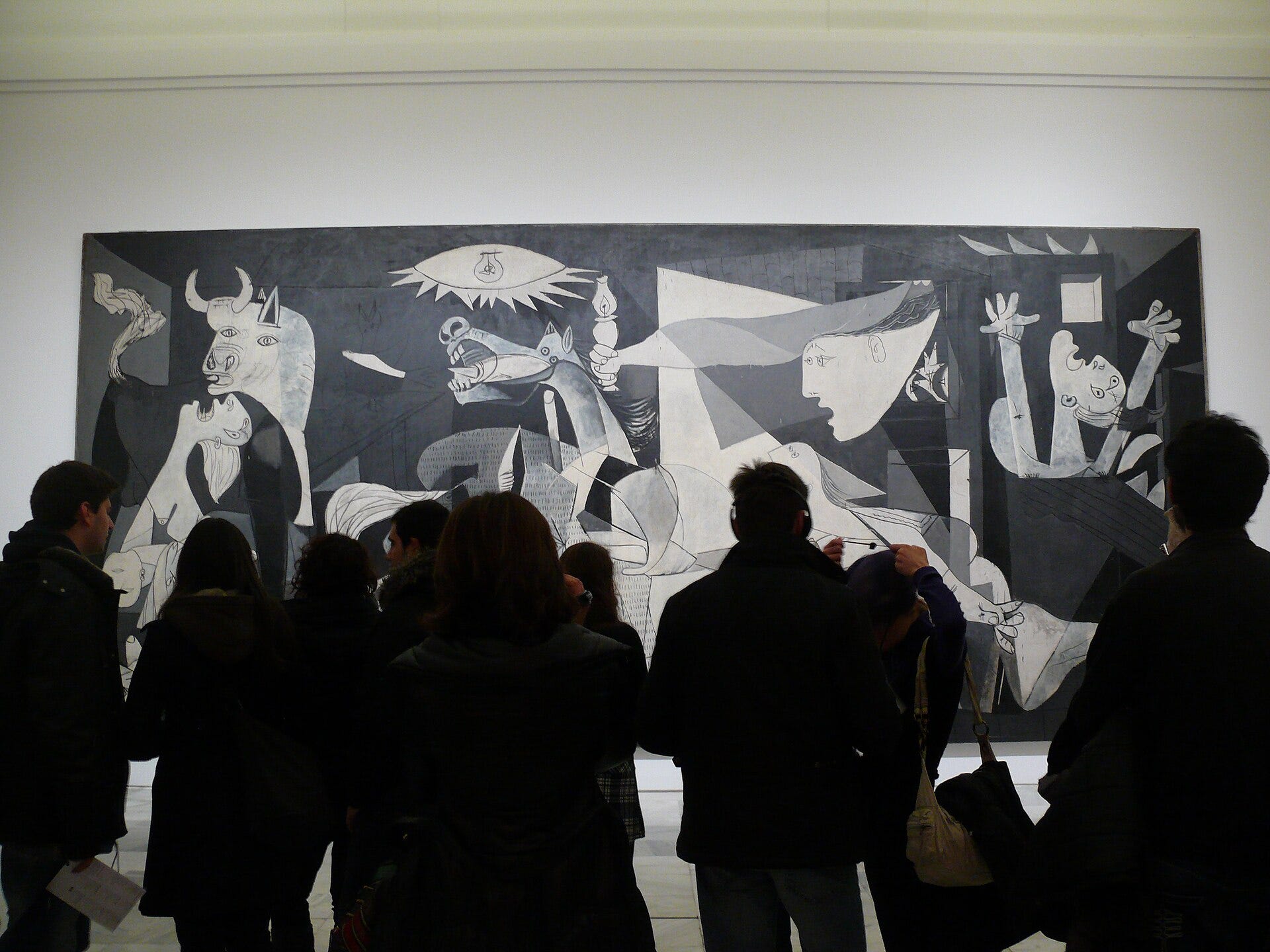
Picasso's Guernica hangs in the Reina Sofia museum in Madrid, in its own room on the second floor. It arrived in Spain in 1981, then moved from a Prado annex to the Reina Sofia in 1992.

Photography is banned inside the room, and the canvas has no protective glass.

People assume Guernica is at the Prado, since that is Madrid's most famous museum, and I get why. It actually hangs a ten minute walk away, at the Reina Sofia, in a room built around it. The move from the Prado annex to the Reina Sofia in 1992 was not random, it matches Picasso's own wishes about when the painting should return to Spain. Honestly the plain white room it gets now suits the picture better than a room full of gilt frames would.

Exterior facade of the Museo Reina Sofia in Madrid, the Sabatini building where Guernica is displayed
The Sabatini building of the Museo Reina Sofia in Madrid, home to Guernica since 1992.

Learn art the fun way. Free stories every week, no boring lectures.


Not the Prado: Where Guernica Actually Hangs

Guernica is not at the Prado. It hangs at the Reina Sofia museum, in room 205.10 on the second floor of the Sabatini building.

The Reina Sofia sits a short walk south of the Prado, near Atocha train station. Both museums are part of Madrid's so called Golden Triangle of art, along with the Thyssen Bornemisza.

Guernica gets a room built around its scale. At roughly 3.5 meters tall and nearly 7.8 meters wide, it needs a wall few museums could offer without a purpose made space.

Why It Is Not at the Prado

Picasso painted Guernica in 1937 for the Spanish Republic's pavilion at the Paris World's Fair, more than two decades after he had already reinvented painting through Cubism. He set one condition before it could ever go to Spain, that the country had to become a democracy first.

Franco ruled Spain until his death in 1975. Guernica stayed in New York, on loan to the Museum of Modern Art, for over forty years while Picasso's condition went unmet.

Spain held its first democratic elections in 1977. The painting finally arrived in Madrid in 1981, six years after Franco's death and two years after Picasso himself had already died.

The 1981 Journey Home

When Guernica reached Spain, it first went to the Cason del Buen Retiro, an annex of the Prado, not the main Prado building itself.

It was shown behind bulletproof glass and under armed guard, a reflection of how politically sensitive the painting still was just a few years after Franco's rule ended.

In 1992, when the Reina Sofia opened as Spain's national museum of modern and contemporary art, Guernica moved there permanently. That is the move people usually miss when they assume it never left the Prado family of buildings.


More on Picasso and 20th Century Art


Why There Is No Glass and No Photos

The bulletproof glass came off in the late 1980s. Curators found it altered how the painting looked and made cleaning and monitoring harder, not easier.

Today the painting hangs unprotected by glass, which is part of why the Reina Sofia enforces a strict no photography rule in that room.

The rule also keeps foot traffic moving in a gallery that gets crowded fast, since Guernica is the single most visited work in the museum.

Interior gallery space at the Museo Reina Sofia
The gallery devoted to Guernica also displays Picasso's preparatory sketches for the painting.

The Room It Lives In Today

Room 205.10 does not hang Guernica alone. The Reina Sofia surrounds it with Picasso's preparatory sketches and studies for the painting, dozens of them, made in the weeks before he started the final canvas.

Seeing the studies next to the finished work is arguably the best reason to visit in person rather than just look up a photo. You can trace how the bull, the horse, and the screaming mother changed from sketch to sketch before Picasso settled on the final composition.

The room also includes period photographs and documents about the Basque town of Guernica, bombed by German and Italian air forces on 26 April 1937, the event that gave the painting its subject and its name.

Exterior of the United Nations Headquarters building in New York, where a woven copy of Guernica has hung
The United Nations Headquarters in New York, where a woven copy of Guernica has hung near the Security Council chamber since the 1980s.

Cool Stories About Art is a free newsletter. The stories behind the paintings, straight to your inbox.


The Woven Copy at the United Nations

A second Guernica, woven rather than painted, has its own story. Nelson Rockefeller commissioned a wool copy in 1955 and later lent it to the United Nations in New York.

It hung outside the Security Council chamber from the 1980s onward, a backdrop for decades of press conferences on war and peace. In February 2003, UN staff covered it with a blue curtain during a press appearance tied to the Iraq war debate, since a giant image of bombing victims made an awkward backdrop.

The Rockefeller family removed the woven copy in 2021, then returned it to the UN in February 2022 after conservation work. It remains a copy only. The original has never left Madrid since 1992.

Exterior of the Guggenheim Museum in Bilbao, which has asked to display Guernica
The Guggenheim Bilbao has asked to host Guernica over the years, a request the Reina Sofia has turned down on conservation grounds.

Could Guernica Ever Move Again

Basque politicians and museums, including the Guggenheim Bilbao, have asked for Guernica over the years, arguing the painting's name and subject belong closer to the Basque Country.

The Reina Sofia and Spain's Culture Ministry have consistently said no. Their stated reason is the painting's fragility, not politics, since Guernica has already been restretched and touched up several times since 1937.

Conservators consider a move too risky given the canvas's age and past damage. Barring a change in that assessment, Madrid is where Guernica stays.

Planning Your Visit to See Guernica

The Reina Sofia is closed on Tuesdays. Entry is free during specific evening hours several days a week, which is when the Guernica room gets busiest.

Book a timed ticket online if you want to avoid the queue at the Sabatini building entrance on Calle Santa Isabel. Early morning on a weekday is the quietest time to actually stand in front of the painting.

Give yourself at least twenty minutes in room 205.10 alone. Between the painting, the surrounding sketches, and the documentary material on the bombing, it rewards more time than a quick walk through.


A few more stories for you


Common Questions About Where to See Guernica

  • Is Guernica at the Prado Museum?
    No. It hangs at the Reina Sofia, a separate museum a short walk from the Prado.

  • Why did Guernica move from the Prado to the Reina Sofia?
    It arrived in Spain in 1981 and first went to a Prado annex. It moved permanently to the Reina Sofia when that museum opened in 1992.

  • Can I take photos of Guernica?
    No. Photography is banned in the room, partly because the canvas now hangs without protective glass.

  • Is there a copy of Guernica in New York?
    Yes. A woven wool copy has hung near the United Nations Security Council chamber since the 1980s, aside from a brief removal in 2021.

  • Why is Guernica not allowed to travel?
    The Reina Sofia and Spain's Culture Ministry consider the canvas too fragile to move safely after past damage and restretching.

  • How big is Guernica?
    About 3.5 meters tall and 7.8 meters wide.

  • What room is Guernica in at the Reina Sofia?
    Room 205.10, on the second floor of the Sabatini building.

  • Does the Reina Sofia charge admission to see Guernica?
    Generally yes, with free entry during specific evening hours on several days of the week.


Join 170,000 readers learning art the fun way. Free stories every week, no boring lectures.