Where Is The Garden of Earthly Delights?

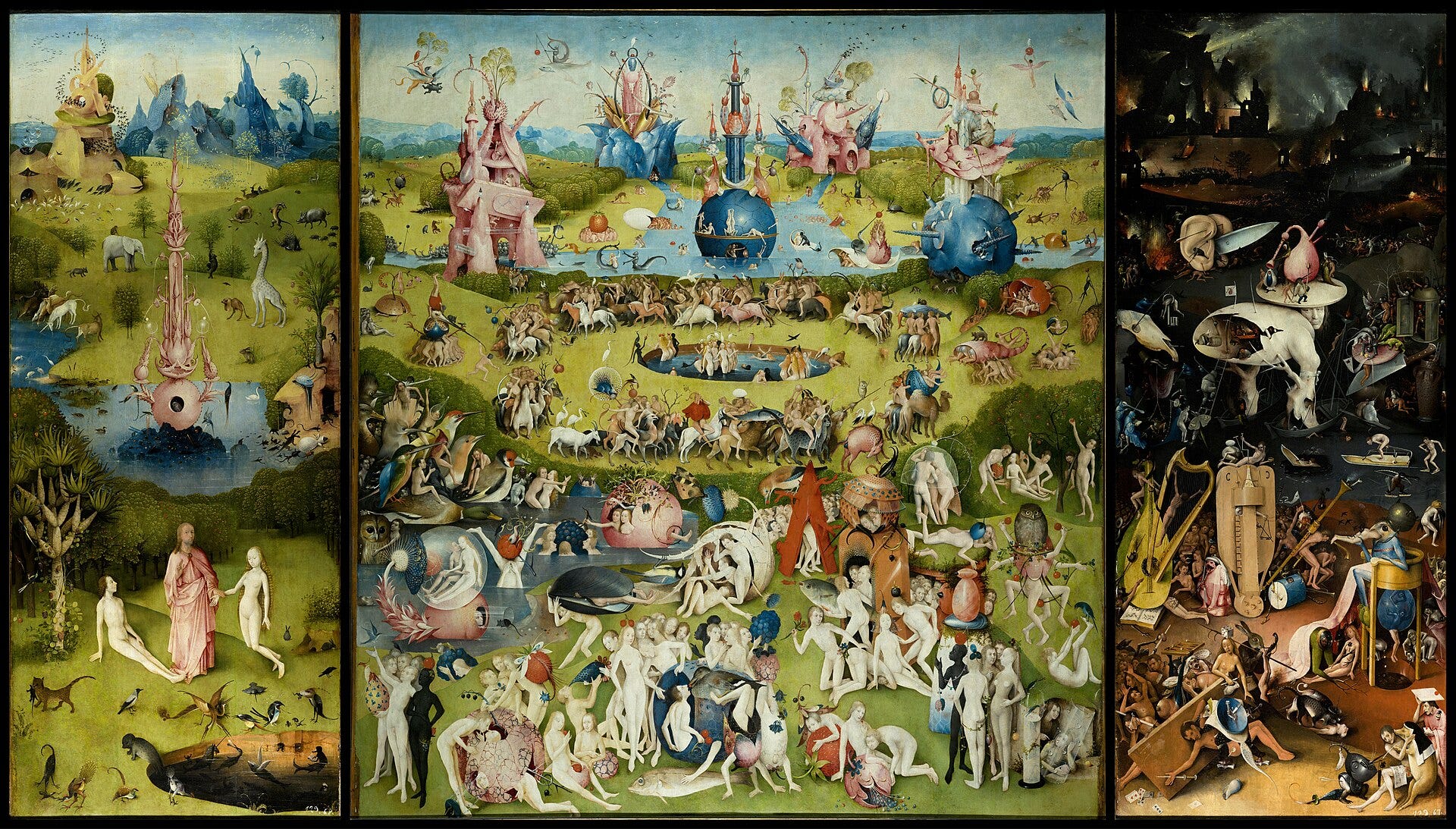
The Garden of Earthly Delights hangs in the Museo del Prado in Madrid. It is a triptych, three hinged panels, that entered the Spanish royal collection through King Philip II.

The outer wings show the world in grisaille, on the third day of creation. Inside the museum it is displayed open, the full color scene visible.

People assume this one is scattered across a few museums because it looks like three separate paintings. It is not. The Garden of Earthly Delights has stayed in one place, the Prado in Madrid, since Philip II brought it into the royal collection in the late 1500s. If you go, look at the back of the panels too. When they were built to close, the outside told its own quiet story before you ever saw the chaos inside.

The Garden of Earthly Delights triptych by Hieronymus Bosch fully open
The Garden of Earthly Delights, painted by Hieronymus Bosch around 1490 to 1510, has hung in the Prado since 1939.

Learn art the fun way. Free stories every week, no boring lectures.


The Short Answer: The Prado in Madrid

The Garden of Earthly Delights is in the Museo Nacional del Prado in Madrid, Spain.

It has been part of the Prado's collection since 1939, when it was transferred there after the Spanish Civil War.

The museum displays it in a gallery dedicated to Hieronymus Bosch and other early Netherlandish painters.

The fuller account of how he built this reputation is covered in the complete Bosch story on this site.

How It Reached the Spanish Royal Collection

The painting did not start in Spain. Bosch made it in the Netherlands, most likely between 1490 and 1510.

It entered the Spanish royal collection through King Philip II, who acquired it in the late 16th century, decades after Bosch died.

Philip II admired Bosch's work enough to hang his paintings inside his own residence, the monastery palace of El Escorial, before they eventually moved to the Prado.

Why It Never Travels

The triptych does not go out on loan to other museums.

Its age, its fragile wood panels, and its status as one of the Prado's signature works keep it fixed in Madrid.

Paintings this valuable rarely leave secure walls, a pattern covered in part 2 of Grand Theft Museum, the biggest art heists on record.


More Bosch Stories Worth Your Time


A Triptych, Not One Painting

Calling it a single painting undersells what it actually is. The Garden of Earthly Delights is a triptych, three wood panels joined by hinges.

The two outer panels fold inward like doors and can close completely over the center panel.

That hinge mechanism is not decorative. It was built to be opened and closed, the way altarpieces of that period usually worked.

The grisaille exterior of the Garden of Earthly Delights showing the earth during creation
With the panels closed, the triptych shows the earth on the third day of creation, painted in grisaille.

What the Closed Panels Show

With the panels closed, visitors see a single scene painted in grisaille, shades of gray rather than full color.

It shows the earth on the third day of creation, a transparent globe with plants and water already formed but no animals or people yet.

A tiny figure of God appears in the upper corner, watching over the scene from outside the sphere.

Detail of the crowded central panel of The Garden of Earthly Delights
The center panel gives the triptych its name, a crowded landscape of figures that art historians still debate.

Cool Stories About Art is a free newsletter. The stories behind the paintings, straight to your inbox.


Inside the Three Open Panels

Open the panels and the scene shifts completely. The left panel shows the Garden of Eden, the center shows a crowded landscape of figures, and the right panel shows a dark vision of punishment.

The Prado displays the triptych open, so visitors see the full color composition rather than the muted exterior.

Placards near the piece explain the closed version for anyone who might otherwise miss that the outside exists at all.

Finding It Inside the Museum

Bosch's work sits in the same wing as other major Netherlandish and Northern European paintings in the Prado.

Museum maps point visitors toward the gallery from the ground floor, and it sits close enough to Las Meninas that many people see both on the same visit.

Expect it to be busy. This triptych draws a steady crowd throughout the day.

The exterior of the Museo del Prado in Madrid
The Museo del Prado in Madrid, the only place to see the full triptych in one room.

Why the Prado Is the Only Place to See It Whole

Reproductions circulate everywhere, on posters, book covers, and phone cases, but they almost always show only the open, colorful version.

Seeing it in Madrid means seeing the object as Bosch built it, a piece meant to be closed as often as it was open.

The Prado is the only place where that full object, hinges and all, still exists in one room.


Keep the stories coming


Garden of Earthly Delights Location Questions People Actually Ask

  • Where is The Garden of Earthly Delights located?
    In the Museo Nacional del Prado in Madrid, Spain, in the galleries dedicated to Hieronymus Bosch.

  • How did a Bosch painting end up in Spain?
    King Philip II acquired it in the late 16th century and it eventually passed into the Prado's collection.

  • Is it one painting or several?
    It is a triptych, three hinged wood panels that can open and close like doors.

  • What do the closed panels show?
    A grisaille scene of the earth on the third day of creation, painted in shades of gray.

  • Does the Prado display it open or closed?
    Open. Visitors see the full color scenes across all three panels, with information nearby about the closed exterior.

  • Can this painting be seen anywhere outside Madrid?
    No. It does not travel for loans and has remained in the Prado since 1939.

  • Is it near Las Meninas inside the museum?
    Yes. Both are major draws in the Prado and sit close enough that most visitors see them on the same walk.

  • When was it painted?
    Most historians date it to roughly 1490 to 1510, during Hieronymus Bosch's later working years.


Join 170,000 readers learning art the fun way. Free stories every week, no boring lectures.