
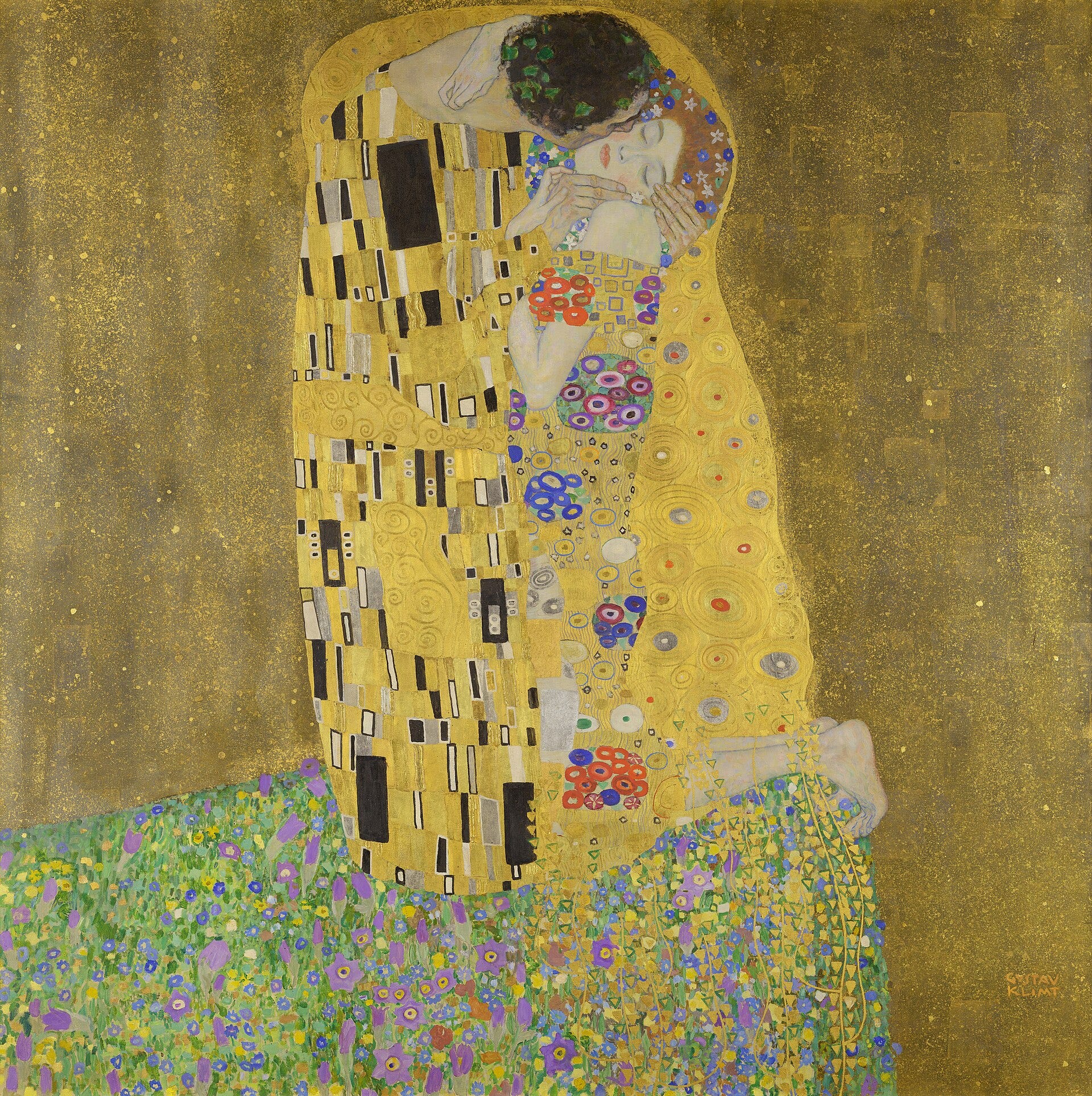
The Kiss hangs in the Upper Belvedere in Vienna. Austria decided to buy it in July 1908, while Klimt was still exhibiting it, and the Belvedere has owned it ever since.
Vienna is the only place to see it. The square canvas, about 180 by 180 centimeters, was painted between 1907 and 1908, and anyone who wants the real thing has to go to the museum that holds it.
Cool Stories About Art is a newsletter to learn art the fun way.
Join 200,000+ readers and get:
10 new art stories / month
The entire archive of content (1,000+ articles)
Comment, ask questions, and chat with other readers
Many guides add that the Kiss never leaves Vienna, and it sounds right. The painting is square, covered in metal leaf, and the Belvedere's best-known work. But the museum keeps a record of every exhibition the canvas has been in, and that record does not describe a painting that stays home.
The same record raises other problems. The name on the museum's website is not the name Vienna first saw, and the state paid for the picture before Klimt had finished it. Neither detail fits a work that was always meant to be a monument.
Has the Kiss ever left Vienna?
Yes, many times. The Belvedere's online catalogue lists the first foreign loan in 1911, when the canvas went to the International Exhibition in Rome, hung in the Austrian pavilion for the fiftieth anniversary of Italian unification. In 1912 it was in Dresden, at the Great Art Exhibition.
After the Second World War it toured again. In 1956 and 1957 it was shown in Amsterdam, Eindhoven and Bern, and in 1959 and 1960 in Luxembourg and Mechelen. Klimt had been dead for almost forty years, and his painting was still on the road.
The last loans came late in the twentieth century: the Museum of Modern Art in New York in 1986, Karuizawa in Japan in 1989, the Kunsthaus Zürich in 1992 and Rome again in October 1997. According to the Belvedere, the Kiss has not left since. The canvas had started out under a different name.
What You'll Discover
What Vienna first called it.
How the state bought it early.
What the gold is made of.
What the woman's feet are doing.