
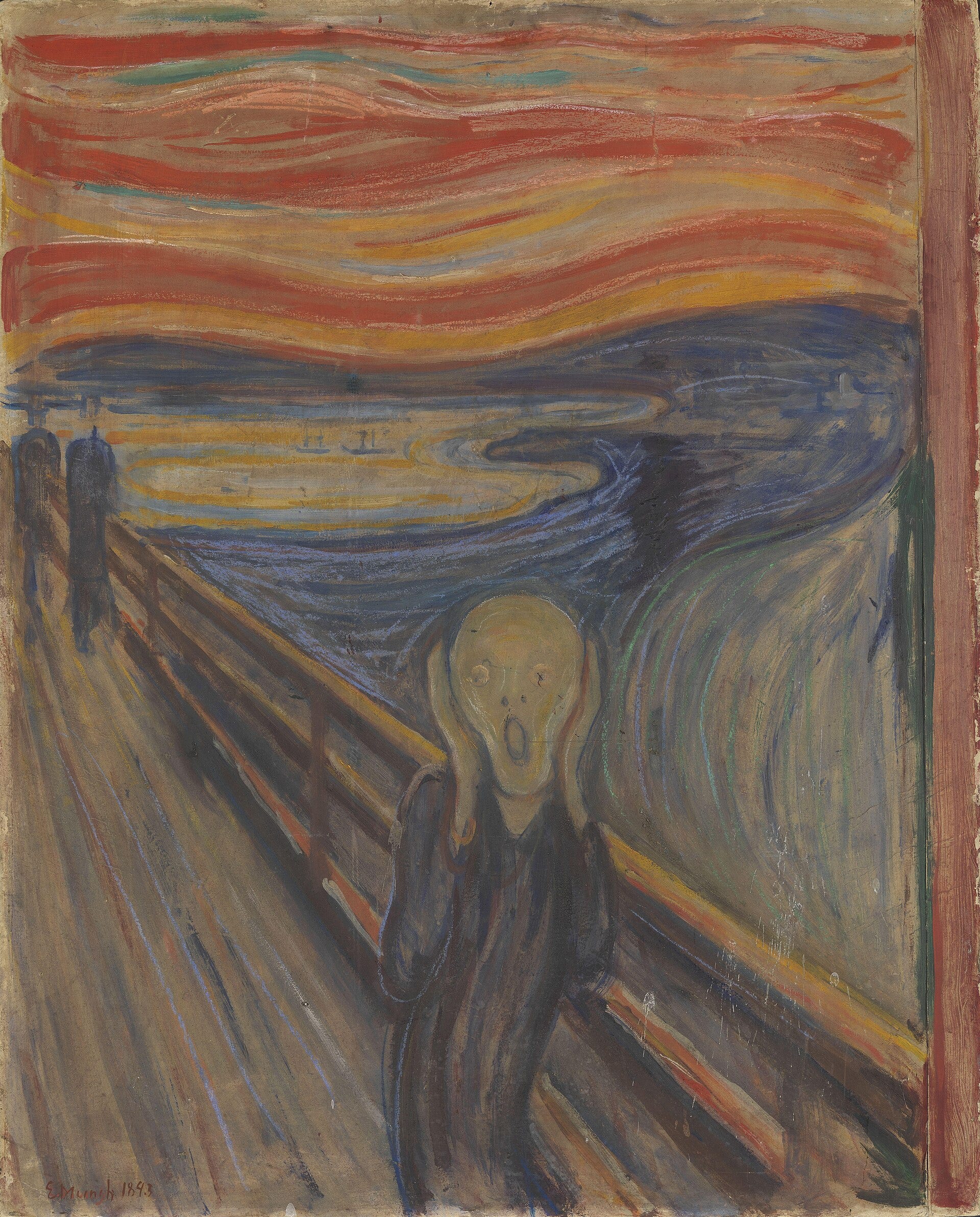
The Scream does not hang in one place. The best-known version, painted in 1893, is in the National Museum in Oslo. The MUNCH museum, also in Oslo, holds three more, a painting, a drawing and a lithograph (a print made from a drawing on stone), and shows only one of them at a time. A fifth, a pastel from 1895, belongs to a private owner.
The 1893 painting hangs in Room 60 of the National Museum, in the galleries devoted to Edvard Munch. The museum opened its new building in Oslo on 11 June 2022.
The picture is tempera (a water-based paint) and a waxy grease crayon on cardboard, about 36 by 29 inches. It entered the national collection in 1910 as a gift from the collector Olaf Schou, after a purchase proposed in 1901 fell through.
Cool Stories About Art is a newsletter to learn art the fun way.
Join 200,000+ readers and get:
10 new art stories / month
The entire archive of content (1,000+ articles)
Comment, ask questions, and chat with other readers
Finding the painting is the easy part. Reading it is harder, because someone has written on it.
High in the sky, at the top left, far from the figure on the bridge, a line of pencil runs across the paint. It is faint, and a conservator, the museum specialist who looks after a painting's condition, says you have to get quite close to read it. The words are Norwegian: Kan kun være malet af en gal Mand! "Can only have been painted by a madman!"
A Danish critic recorded the line in 1904 and assumed a visitor had scribbled it. The pencil lies on top of the paint, so it was added after the picture was finished: whoever wrote it had seen the work complete and decided what to say about it. That makes the writer matter. If a visitor wrote it, it is a footnote. If Munch or someone close to him wrote it, it says something about the painting.
Who wrote on the cardboard?
Edvard Munch himself. The National Museum announced it on 22 February 2021, after its curators photographed the painting in infrared light, which makes pencil stand out from the paint around it, and compared the handwriting with Munch's notes and letters.
"There is no doubt that the inscription is Munch's," said the curator Mai Britt Guleng. A microscope examination by the museum's paintings conservator, Thierry Ford, had shown that the pencil sits on top of the paint.
The date is an inference, not a document. Munch first showed the painting in Kristiania, as Oslo was then called, in 1895.
Around that exhibition the question of his sanity went public: at a debate at the Students' Association in Kristiania, a medical student named Johan Scharffenberg questioned Munch's mental health. The curators place the line in 1895 or soon after, in the middle of that argument. The museum does not claim to know what Munch meant by it.
What they do draw from it is a fact about the way he worked. "Writing on the finished painting shows that creating for Munch was a continuous process," Guleng said. "We seldom find such inscriptions on paintings, particularly not on one of the world's most famous ones."
Long before the curators read that line, the painting had been cut off a gallery wall.
What You'll Discover
The Scream that left through a window.
The Scream no museum owns.
The Scream taken at gunpoint.
Why MUNCH never shows them all at once.