The most famous white paintings run from a queen in a scandalous muslin dress and a drowned Shakespearean heroine to a lamb bound for sacrifice and a square painted on a square, both entirely white.
White reads as purity, mourning, and emptiness depending on the century, and these twelve pictures move through all three.
White is not really a color the way red or blue are, and for centuries painters treated it as the hardest tone to get right, since even small shifts in white paint change how every other color around it reads. I have picked twelve paintings where white carries the whole picture, from a Spanish altar to a Suprematist canvas that is almost nothing else.
Why white is the hardest color to paint:
The trap. Pure white paint next to any other color makes that color look duller by comparison, so painters had to place it with real care.
The scandal. A plain white dress could ruin a reputation in the 1780s, when formal portraits called for structured silk, not undyed muslin.
The endpoint. Some 20th century painters used white to strip a canvas down to almost nothing, treating it as the last color left standing.
The danger. Lead white, the standard white pigment for centuries, was toxic enough that painters who used it heavily risked real lead poisoning.
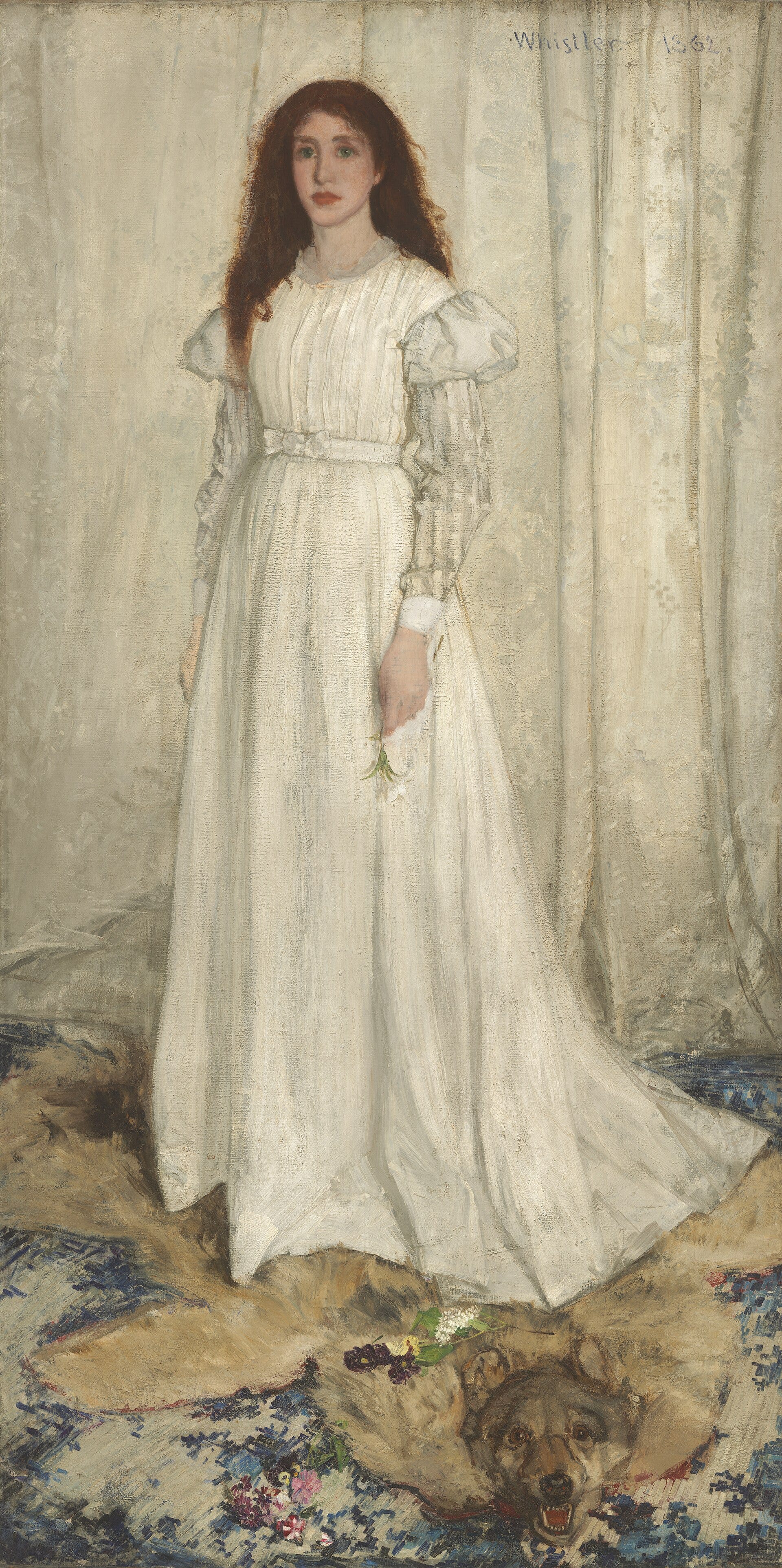
1. James McNeill Whistler, Symphony in White, No. 1: The White Girl (1862)

Whistler painted his mistress Joanna Hiffernan standing on a wolf skin rug in a plain white dress against a white curtain, testing how many different whites he could fit into a single canvas without any of them reading as boring.
The Paris Salon rejected it in 1863, so Whistler showed it instead at the Salon des Refuses, the same rejected exhibition where Manet's Luncheon on the Grass caused its own scandal that year.
2. James McNeill Whistler, Symphony in White, No. 2: The Little White Girl (1864)
Whistler painted the same model, Joanna Hiffernan, again two years later, standing at a mirror in a white dress with a fan and a spray of azaleas, deliberately built around the challenge of painting white on white on white.
The poet Algernon Charles Swinburne wrote a poem in response to the painting the same year it was exhibited, and Whistler later printed the poem alongside the picture in exhibition catalogs.
3. Elisabeth Vigee Le Brun, Marie Antoinette in a Muslin Dress (1783)
Vigee Le Brun painted the queen of France in a simple white muslin dress and a straw hat, informal clothing normally worn only in private. The portrait was meant to show Marie Antoinette as approachable and natural.
The public reaction was the opposite of what was intended. Critics accused the queen of dressing like a servant or worse, appearing in public in her underclothes, and the portrait had to be withdrawn from its first exhibition and repainted in a formal gown instead.
4. Francisco Goya, The White Duchess (1795)
Goya painted the Duchess of Alba in a white dress with a red sash, pointing down at the ground where the words solo Goya, only Goya, are written in the dirt beside her feet and her own name on her ring.
Historians have argued for two centuries over whether the inscription proves Goya and the Duchess were lovers. No letters between them have ever surfaced to settle the question either way.
5. John Everett Millais, Ophelia (1851 to 1852)
Millais painted Ophelia floating in a stream in a pale dress after her death in Hamlet, a scene Shakespeare only describes secondhand and never actually stages. His model Elizabeth Siddal posed for months in a bathtub of water kept warm by lamps underneath.
The lamps went out once during a long sitting and nobody noticed for hours. Siddal caught a severe cold, and her father later sent Millais a doctor's bill, which Millais paid without argument.
6. Edouard Manet, The Fifer (1866)
Manet painted a boy soldier in a red and blue uniform against a flat background with no shadow at all, stripped of the depth and setting that Salon juries expected from a serious painting. His white belt straps and gaiters read almost like cutouts pasted onto the void behind him.
The official Salon rejected the picture in 1866. Manet's friend Emile Zola defended it in print, comparing its flat simplicity to a Japanese print, years before Impressionist painters made that comparison fashionable.
7. Francisco de Zurbaran, Agnus Dei (about 1635 to 1640)
Zurbaran painted a single lamb, legs bound, lying on a bare table against a black background, its wool rendered in dense white paint applied almost like sculpture. The subject is the Lamb of God, a stand in for Christ's sacrifice, though nothing in the picture states that directly.
Zurbaran painted several versions of this same lamb over his career for private devotional use rather than public display, and this one carries no crown of thorns or halo at all, only the bound legs to suggest what is coming.
8. Franz Xaver Winterhalter, Empress Elisabeth of Austria in a Ball Gown (1865)

Winterhalter painted Empress Elisabeth of Austria, known as Sisi, in a white gown scattered with diamond star pins in her hair, commissioned by her husband Emperor Franz Joseph for his own private study.
Sisi was known for her obsessive beauty routines, reportedly lacing her corset to a waist near sixteen inches and spending hours each day on her hair. She refused nearly all official portraits after this one, so it remains one of the last that shows her at ease.
9. Utagawa Hiroshige, Kanbara, Night Snow (about 1833 to 1834)
Hiroshige printed a snow covered village on the Tokaido road at night, travelers bent against invisible cold, made almost entirely from unprinted white paper and a few thin black lines.
Kanbara, the real station this print is named for, rarely if ever saw snow that heavy, since it sits in a mild coastal part of Japan. Hiroshige is thought to have invented the snowfall for effect rather than recorded it.
10. Camille Corot, Ville d'Avray (about 1865)
Corot painted the pond near his family's country house outside Paris dozens of times over three decades, the water and sky rendered in soft silvery whites and greys he became known for across Europe.
Corot never married and left most of his estate to support other artists who had fallen on hard times, including buying a house for the blind and impoverished widow of the painter Honore Daumier.
11. Piet Mondrian, Composition No. 10, Pier and Ocean (1915)
Mondrian reduced a pier stretching into the sea at the Dutch coastal town of Domburg to a grid of short black lines on a white ground, one of the last steps before he dropped recognizable subjects from his work completely.
He was staying in the Netherlands when the outbreak of the First World War trapped him there, unable to return to Paris. He would not go back for another five years.
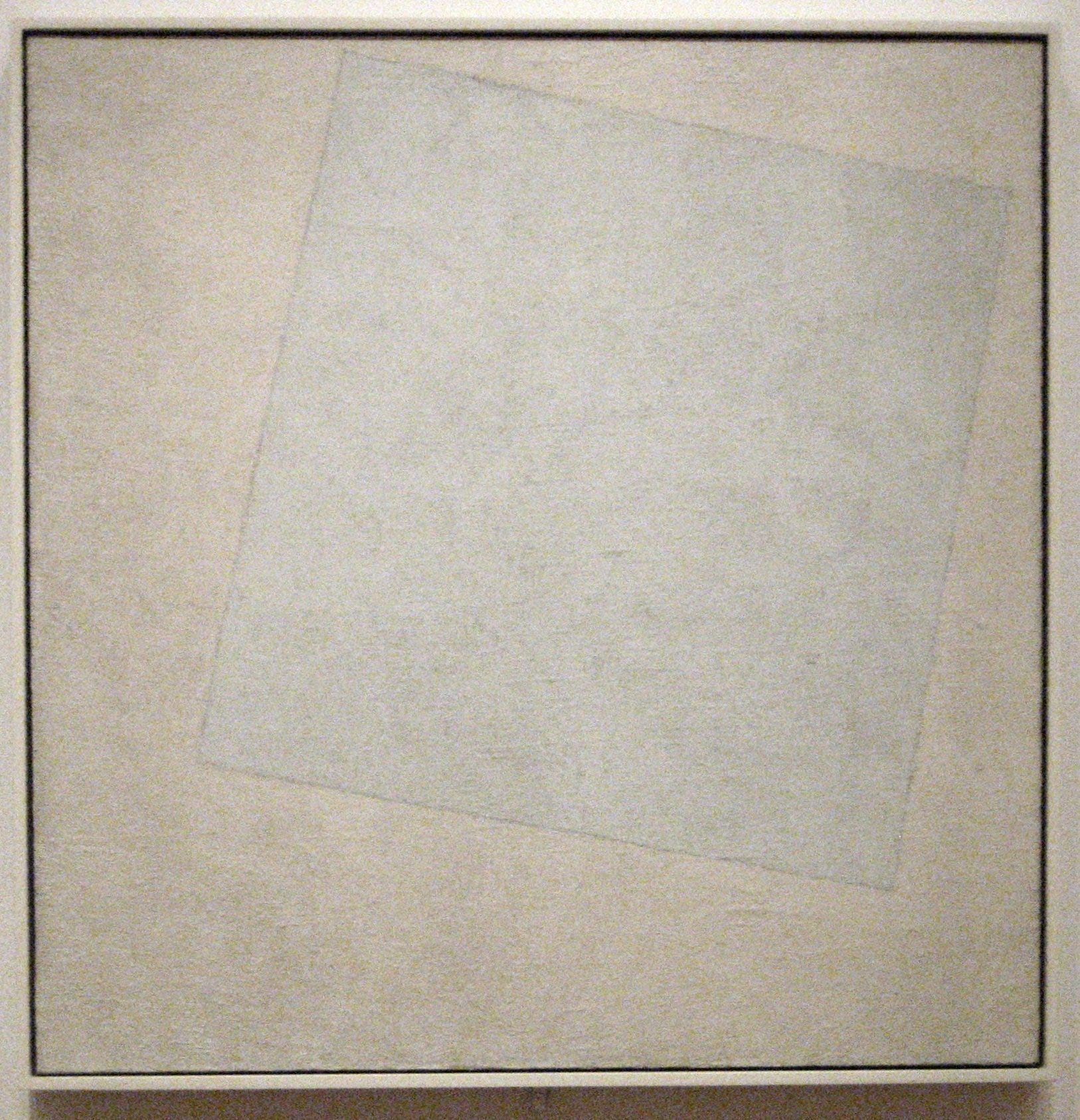
12. Kazimir Malevich, Suprematist Composition, White on White (1918)
Malevich painted a white square tilted slightly against a white background, the endpoint of a movement he called Suprematism, which he built around basic shapes with no reference to the outside world at all.
He first showed the painting in Moscow in 1919, at an exhibition where he declared painting itself had reached its limit. He spent much of his later career under Soviet pressure to abandon abstraction and paint in a realist style instead.
Where the whites hang today
Whistler, Symphony in White, No. 1: the National Gallery of Art, Washington.
Millais, Ophelia: Tate, London.
Goya, The White Duchess: the Palacio de Liria, Madrid.
Zurbaran, Agnus Dei: the Museo del Prado, Madrid.
Malevich, White on White: the Museum of Modern Art, New York.
White without the confusion
Why was lead white dangerous? Lead white was the standard white pigment for centuries, and painters who ground and applied it constantly faced real lead poisoning risk.
Why did Marie Antoinette's white dress cause a scandal? Formal royal portraits called for structured silk gowns, so a queen shown in plain white muslin looked to critics like she was dressed in underclothes or servant's clothing.
What is Suprematism? An early 20th century movement started by Kazimir Malevich that reduced painting to basic shapes like squares and circles, with no attempt to represent the real world.
What is the most famous white painting? Millais' Ophelia and Whistler's Symphony in White series are the two most recognized, though Malevich's White on White is the most famous painting that is almost entirely one color.
Why do old white paintings sometimes look yellow now? Oil based varnish yellows with age, which is why many historic white paintings look warmer today than the painter originally intended.
If these white paintings pulled you in, you will love these too:
The color that ends up meaning almost anything
White moves through these twelve pictures as scandal, mourning, sacrifice, and finally nothing at all, a canvas reduced to one shade with nowhere left to go.
Kazimir Malevich died in 1935. Soviet authorities, by then hostile to abstract art, allowed a small funeral procession topped with a white cube in his honor. He was buried under an oak tree outside Moscow marked with that same cube, a grave site later paved over by Soviet era construction and marked again only decades afterward.