

170 000+ readers. Learn art the fun way.
This is a preview. Paid subscribers get the full story.
You’ll also get:
10 new stories every month
The full archive (130+ Art stories)
Your personal art guide. Comment, ask questions, DM me anytime
iPhone user? Subscribe at coolstoriesabout.art, not via the app. Apple adds 30% to the price.
Ask the people around you: who invented Cubism?
You will hear one name, always the same one.
And yet, on the day Cubism got its name, it was not in front of a painting by Picasso.
The critic who thought he was mocking
Paris, November 1908.
A small gallery at 28 rue Vignon, behind the church of the Madeleine.
A single room. A beginner dealer of 24, Daniel Henry Kahnweiler.
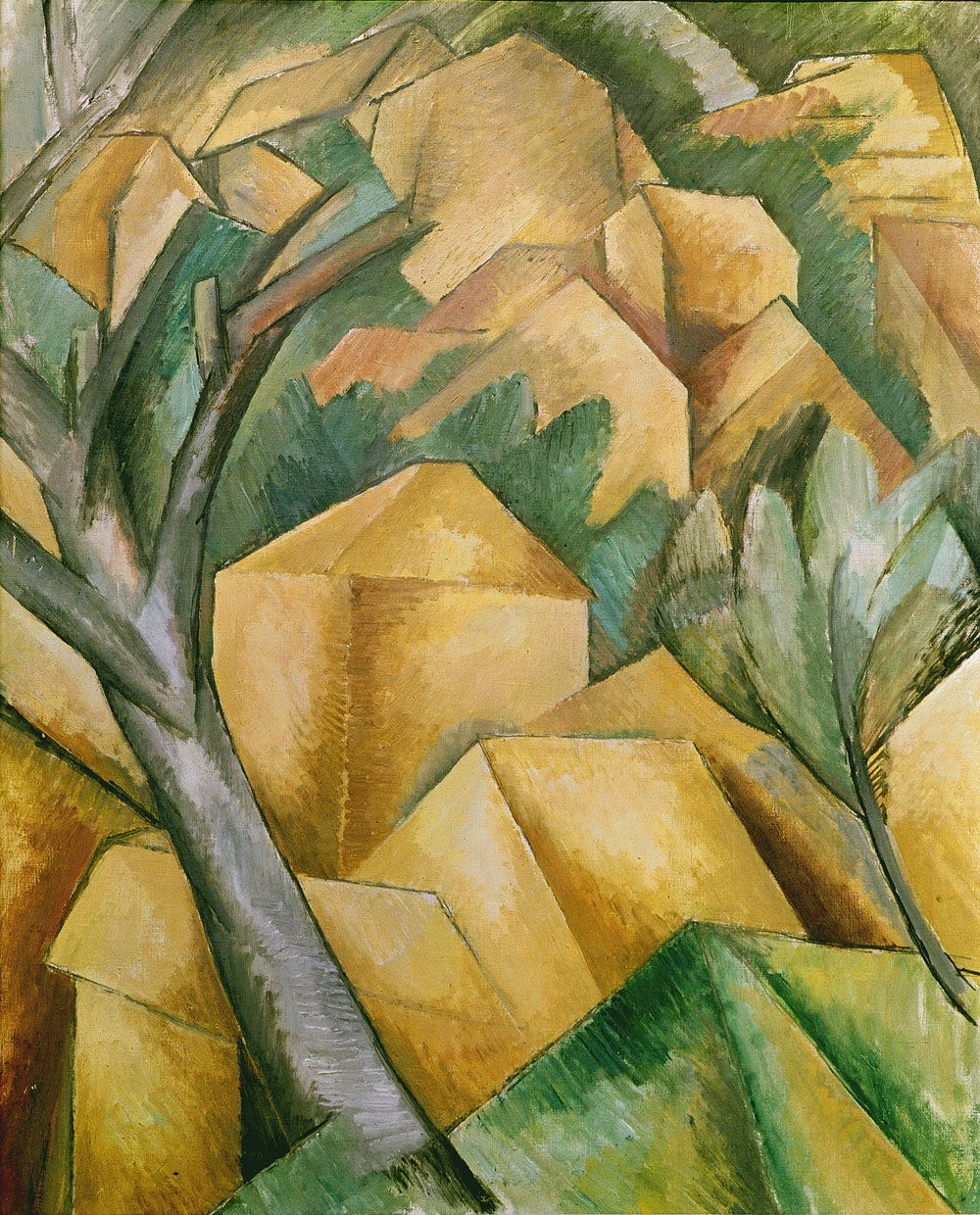
And on the walls, a whole exhibition of landscapes from the south of France, turned down a few weeks earlier by the jury of the Salon d'Automne, the great annual show of new painting.
In front of these canvases, a visitor frowns. Louis Vauxcelles, one of the most widely read art critics in Paris.
He looks at these hills where the houses have become ochre blocks, stacked one on top of the other, without a door, without a windowpane.
As if a giant child had built a village out of wooden cubes.
On 14 November, in the newspaper Gil Blas, his column lands:
He despises form, reduces everything, sites and figures and houses, to geometric schemas, to cubes.
Vauxcelles thinks he is burying a fashion in three lines. He has just given its name to the movement that will dominate the twentieth century.
The whole world has forgotten one detail: the painter of those canvases is not called Picasso.
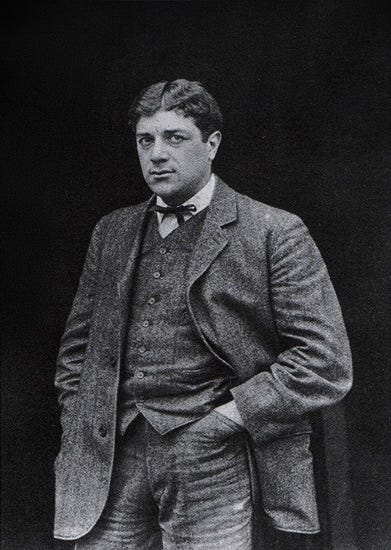
He is a big strapping fellow of 26, broad in the shoulders, come up from Le Havre, a port in Normandy. Son and grandson of house painters.
He learned to imitate fake wood and fake marble before he ever touched an easel. In the evening, he boxes.
His name is Georges Braque.
Cézanne's lesson
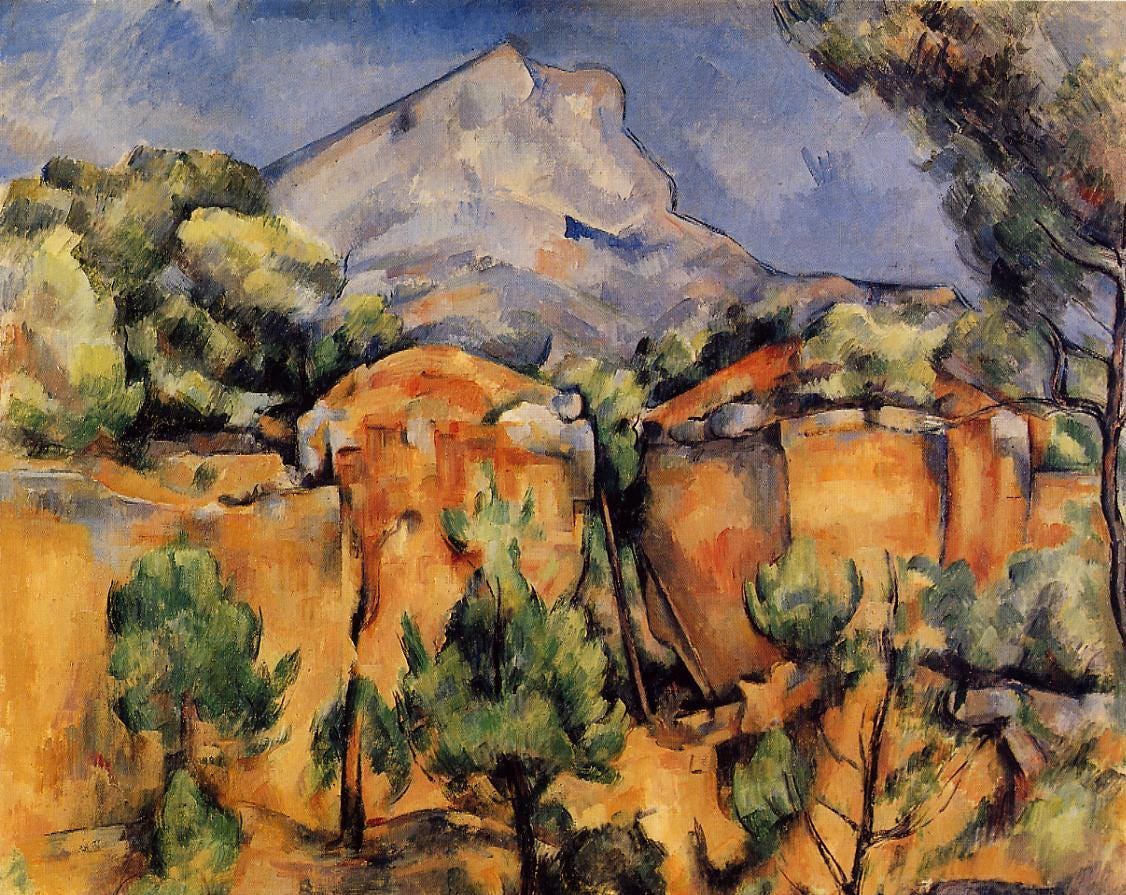
A year before the mockery, in October 1907, the same Salon d'Automne devotes two rooms to a painter who had died the year before, Paul Cézanne. 56 canvases.
In those rooms of the Grand Palais, where the Salon is held every autumn, one visitor comes back day after day. The big fellow from Le Havre.
Braque moves slowly, stops, steps back.
In front of him, the Sainte Victoire mountain painted and repainted, turned into a play of facets. A white tablecloth that seems carved out of rock.
Cézanne's letters to a young painter have just been published in a review. Braque learns passages of them by heart.
One sentence above all:
Treat nature by the cylinder, the sphere, the cone.
Most visitors read it as an old master's advice. Braque takes it literally.
In the summer of 1908, he leaves Paris for the south. He sets up his easel at L'Estaque, a fishing village near Marseille, where Cézanne used to paint.
He pushes the sentence all the way. The houses become blocks, the trees volumes, the village a stack of cubes.
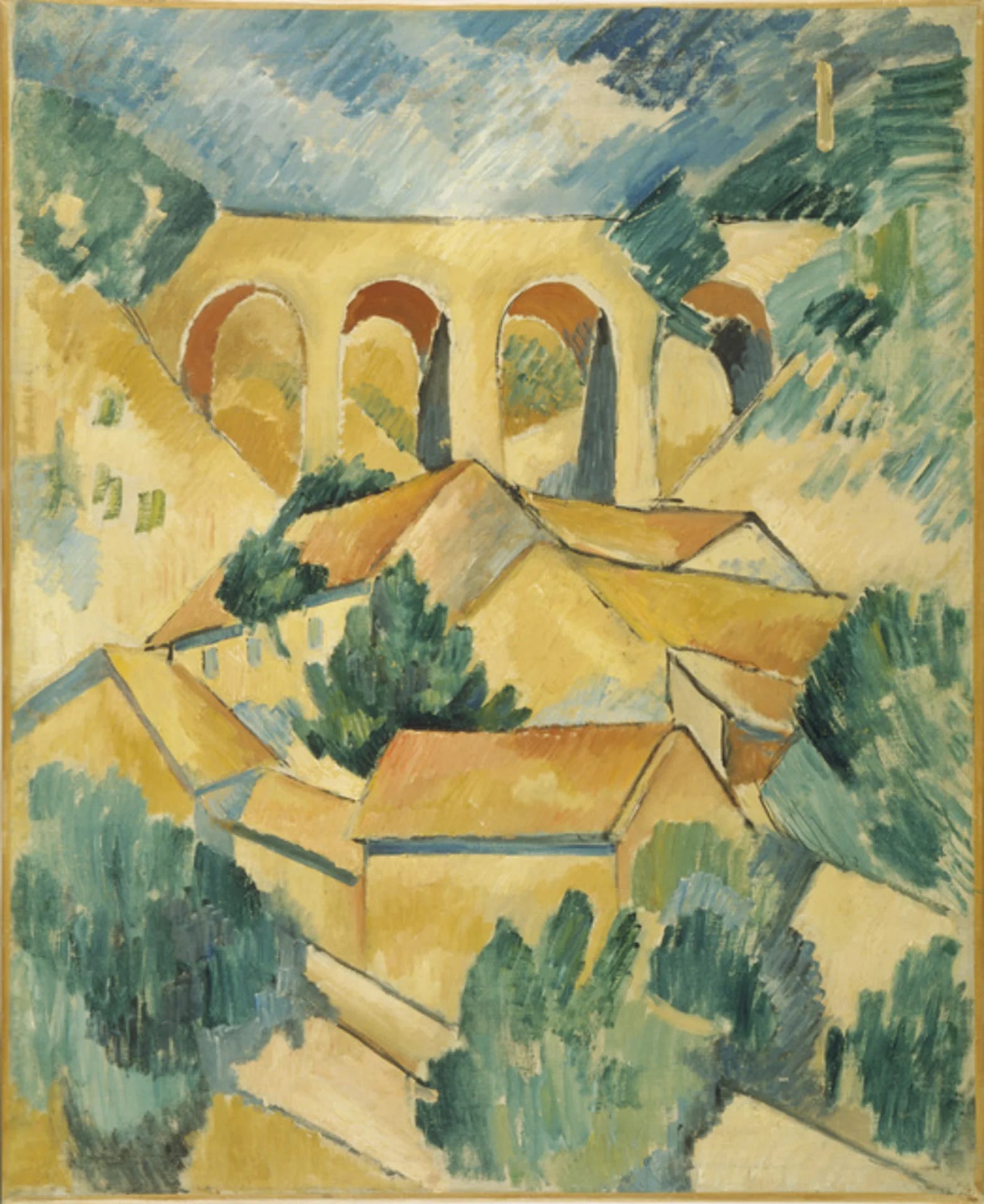
In the autumn, he returns to Paris with his canvases. The Salon d'Automne jury turns them down. Kahnweiler hangs them. Vauxcelles mocks them.
Cubism has just been born there, exactly there: with Braque, in Cézanne's footsteps.
But in Montmartre, another painter has taken the retrospective full in the face.
Discover my new newsletter !

Roped together
A few streets from Braque's studio lives a Spaniard of the same age, small, black eyes, as loud as the Norman is silent. His name is Pablo Picasso.
The poet Guillaume Apollinaire, a friend of both, introduced them a few months earlier.
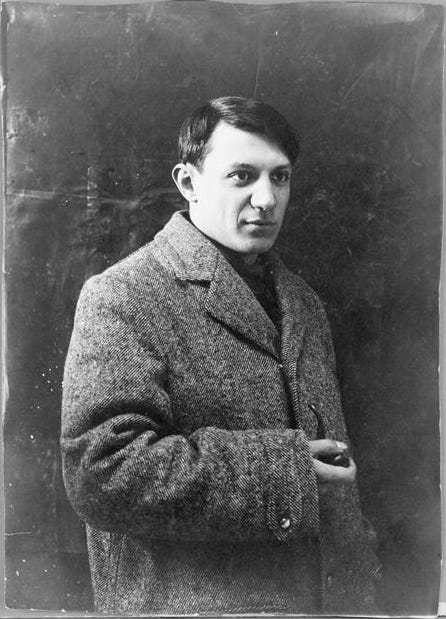
Everything sets them apart. Braque moves forward like a craftsman, step by step. Picasso charges, smashes, starts again.
He too has walked the Cézanne rooms of the Grand Palais. He too is looking for the way out. But he attacks through another door: Spanish sculpture, African masks.
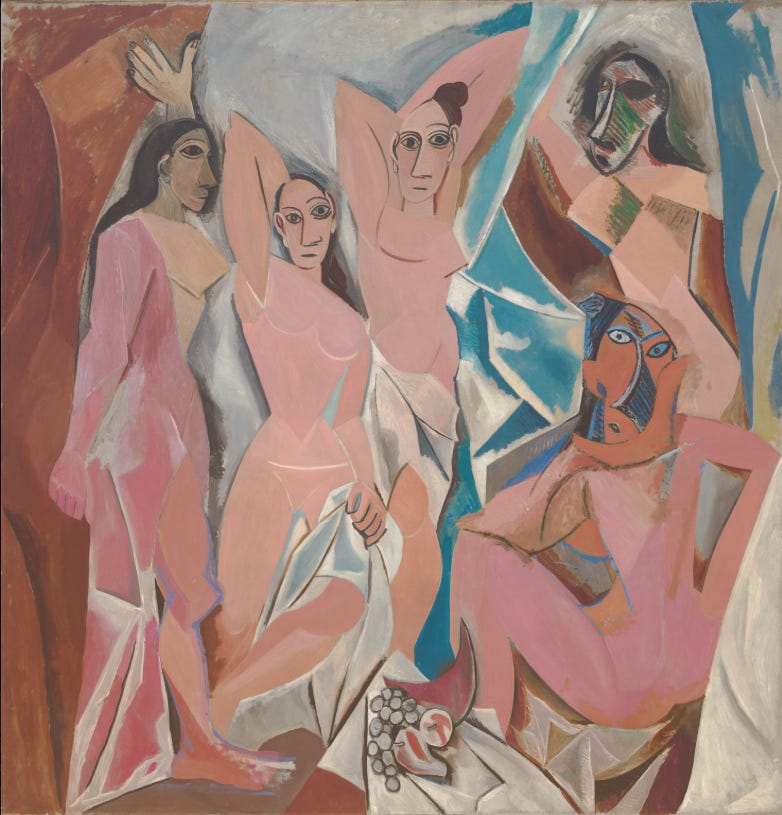
In his studio, an immense canvas that almost nobody has seen: five naked women with mask faces, Les Demoiselles d'Avignon.
From the winter of 1908, the two men become inseparable.
Almost every evening, they meet in one studio or the other. Each shows the day's canvas, the other passes judgment.
In the summer of 1909, Picasso leaves in his turn for the south, to Horta, a village in Spain. He brings back hills in blocks, like Braque a year earlier.
There they are, on the same road.
Together, they take the old master's idea further still. No longer painting the object as you see it from one single position, but as you know it: the violin from the front, from the side and from above, on the same canvas.
That is Cubism.
They even drain out the colour, browns, greys, so that nothing distracts from the form.
Their paintings end up looking so alike that the two men, on certain days, hesitate in front of their own canvases.
So they take a step no painter takes: they stop signing. No more name on the front, the signature moves to the back, hidden.
Two anonymous inventors of a shared machine.
From those years, one image will remain, and it is Braque's: “It was a little like being roped together on a mountain.”
Two men at either end of the same rope. When one climbs, the other climbs with him.
And then it all stops.
One August morning, on the platform of a station in Provence, the rope is cut. Braque says goodbye to Picasso and boards a train.
Picasso will become the most famous artist in the world. Braque will disappear from his own story.
Two and a half years will be enough. By the time Braque comes back, Cubism will have changed fathers.