

200 000+ readers learn art the fun way.
This is a preview. Paid subscribers get the full story.
You’ll also get:
10 new stories / month
The full archive (140+ Art stories)
Your personal art guide. Comment, ask questions, DM me anytime
Apple user? Subscribe at coolstoriesabout.art, not via the app. Apple adds 30% to the price.

Late October. The leaves are turning orange, pumpkins and plastic cobwebs are filling store windows, and in a few days children in costume will be ringing doorbells, trick-or-treat bags in hand.
Among the witches and skeletons there will be a long white face, drawn downward inside a black hood, with two black teardrops for eyes and a black mouth gaping all the way down to the chin: the killer’s mask from “Scream,” Wes Craven’s horror movie.
Nobody designed it for the movie. Before “Scream,” it was an ordinary ghost mask, sold at novelty stores with a white sheet. Then the crew stumbled on it by chance while scouting locations. Craven looked at it and said:
“This is like the famous Scream painting.”
The same face shows up on every phone, in yellow: two wide white eyes, a long open mouth, a pale blue forehead drained of blood, two hands pressed to the cheeks. The 😱 emoji has an official name, “Face Screaming in Fear,” and people send it to react to bad news, a scare, anything horrifying. Each time, without knowing it, they are quoting a painting.
Cardboard in Oslo
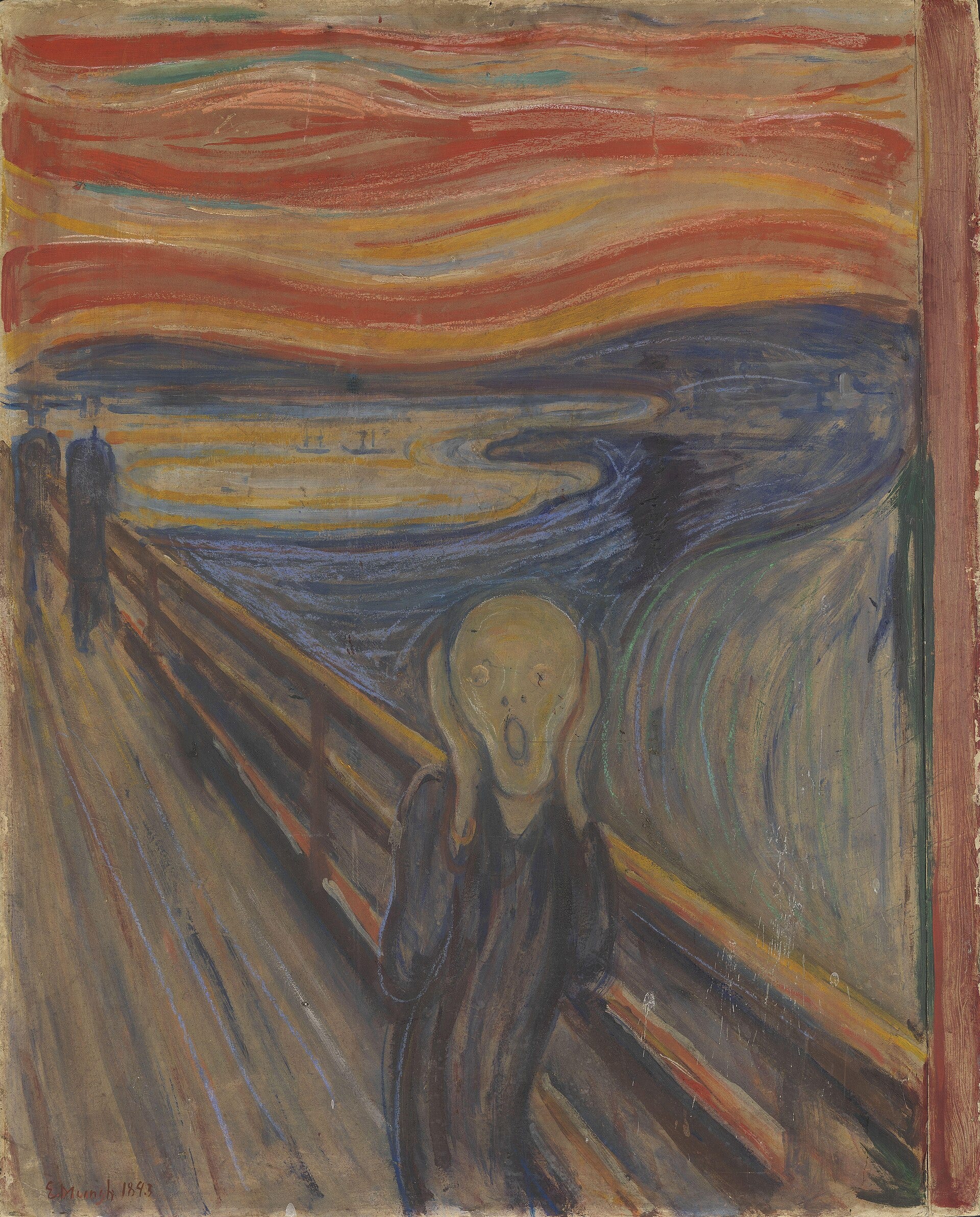
That painting hangs in the National Museum of Norway, in Oslo, and it is called “The Scream.” Edvard Munch, a young Norwegian painter, painted it in 1893 on a plain sheet of cardboard just under three feet tall, and he has been counted among the founders of Expressionism, a style of painting that distorts what it shows in order to convey what the artist feels, ever since.
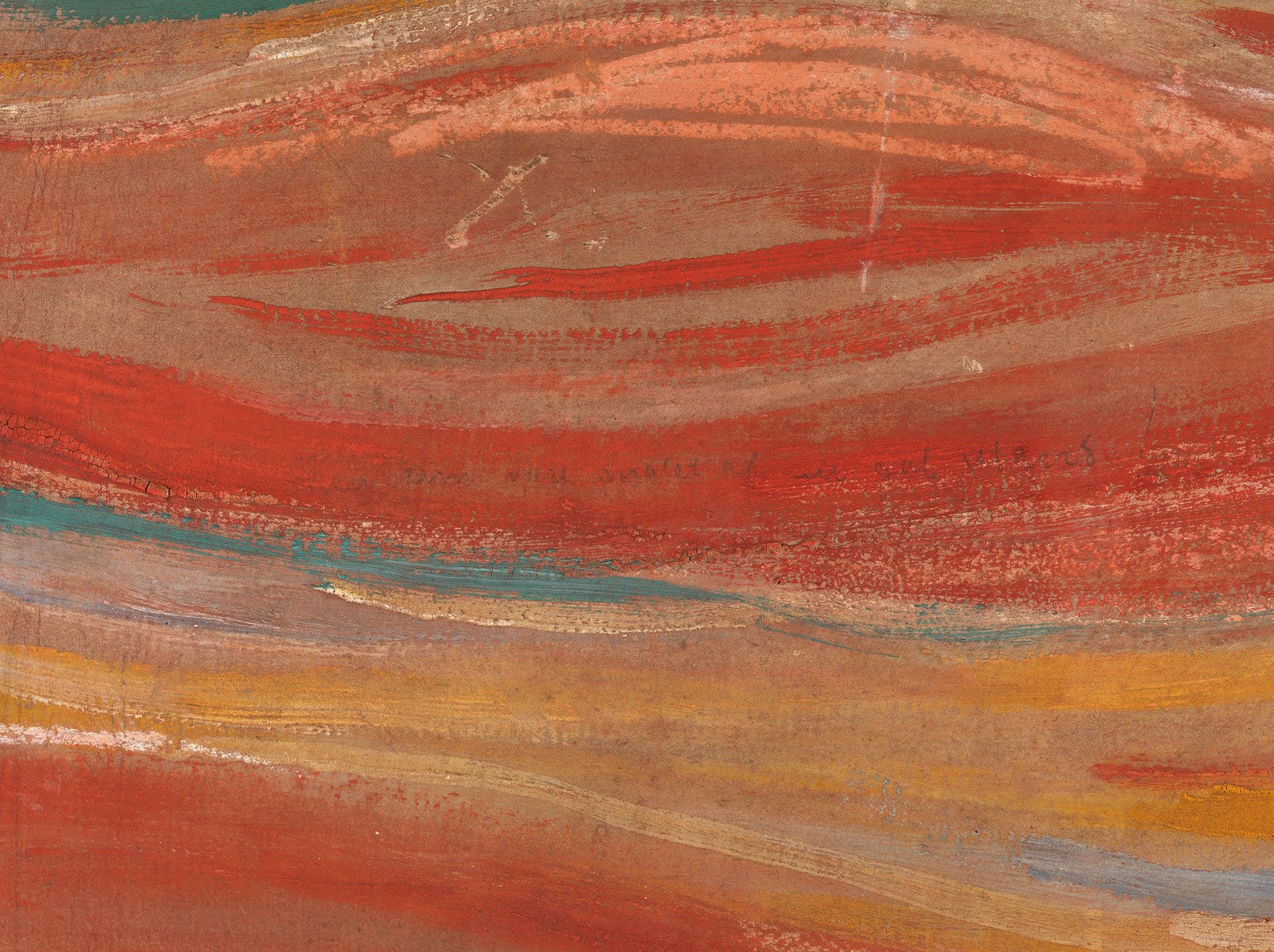
The sky fills the whole top of the picture, blood red, in long bands that undulate from one edge to the other. In one of those bands, in the upper left, a line of writing runs across the red, so faint and so small that a viewer has to lean in, nose nearly touching the cardboard, to make out the words. Eight words, a whole sentence, written in pencil and ending in an exclamation point.
Beneath the sky, a railing starts at the bottom edge of the picture and runs diagonally to the left, back into the distance, where two men in black stand with their backs to the viewer. Farther down lies the blue-black water of a fjord.
And at the very bottom, in the foreground, the figure. A smooth, hairless skull, two round eyes, two holes where a nose should be, an oval mouth gaping open, no ears; a dark robe with no shoulders that runs down to the bottom edge of the cardboard, rippling like a flame; two hands pressed to the head.
Nothing about the figure suggests how old it is, or whether it is a man or a woman.
The figure is Munch at 29, a man who grew up with death in the house.
The White Pillow
His mother dies of tuberculosis between Christmas and New Year’s; he is barely 5. He grows up with his sister, who is a year older, until the day she too starts to cough and stays in bed for months, and he is 13 when the illness that took their mother claims her as well.
From then on, he lives in dread of catching the same disease that took them both.
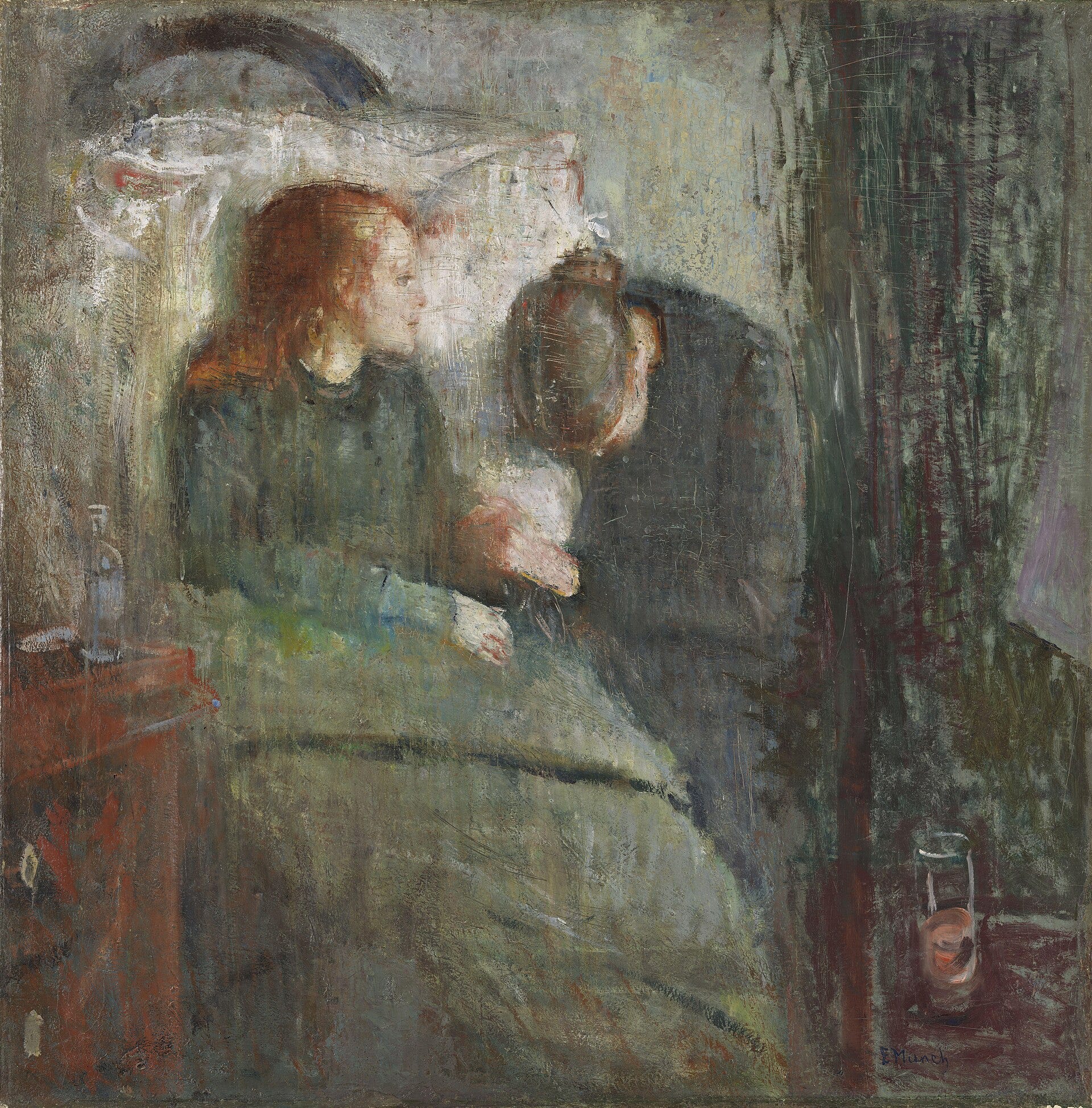
At 22, a painter by now, he puts his sister back on her deathbed. She is in profile, her back propped against a large white pillow, her eyes turned toward a dark curtain, and at her bedside a woman in black bows her head so low that only her hair can be seen; their hands are clasped at the center of the picture.
It is known today as “The Sick Child.”
“Sickness, madness, and death,” he writes, “were the black angels that stood beside my cradle.”
They do not leave him as he grows up. “The anxiety of living has raged in me ever since I was old enough to think,” he writes elsewhere, and he sees it as an inheritance, like the disease. The years leading up to “The Scream” are dark ones, stretches of terror and despondency in which he loses even the desire to paint.
This is the man shown in the painting in Oslo, emerging from those dark years, mouth open under a sky of blood, both hands against his head, overwhelmed by a terror that has followed him since childhood.
His hands, though, do not cup his cheeks the way the emoji’s hands do. They rise higher, to eye level, and press against both sides of the skull, exactly where Munch painted no ears.
Those hands are not on the cheeks.
They are covering the ears.
Munch is not the one screaming.
What You’ll Discover
Who the two men in the background are.
Why Munch painted this picture.
What the faint pencil line tucked into the sky says.
The painting’s hidden message.
Who screams, in “The Scream.”