Who Is the Woman in Raphael's La Fornarina?

For centuries it looked like a simple portrait of a baker's daughter. A 2001 X ray found a wedding ring Raphael's own students tried to hide.

The woman in Raphael's La Fornarina is most likely Margarita Luti, a baker's daughter and, by most accounts, his lover during the final years of his life. Raphael signed her arm. A hidden ring, found in 2001, may say more.

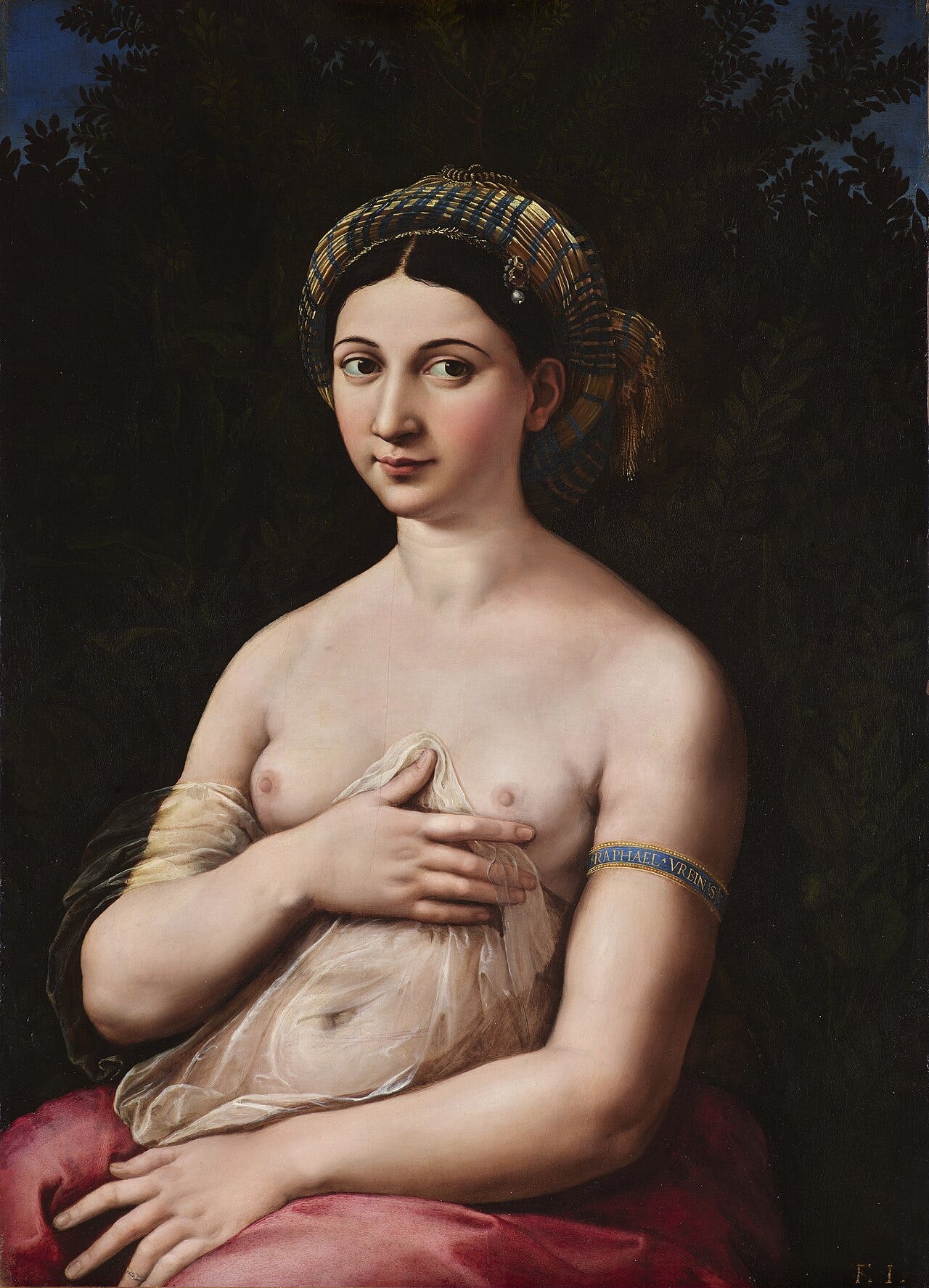
La Fornarina painting by Raphael
Raphael, La Fornarina, circa 1518 to 1519.
  • Painted: circa 1518 to 1519, in Raphael's final years

  • Subject: likely Margarita Luti, a baker's daughter and Raphael's lover

  • Housed: Galleria Nazionale d'Arte Antica, Palazzo Barberini, Rome


See art differently. 170,000 people read these free stories. Come find out why.


More Secrets Hidden Inside Famous Portraits

The ones I would send you to next.


Raphael self portrait
Raphael, Self Portrait, circa 1506.

The Baker's Daughter From Trastevere

Fornarina is not a name. It means the little baker girl, or the baker's daughter, in Italian, and it stuck to Margarita Luti so completely that most people today know the painting's title before they know the woman existed.

The story goes that Margarita's father ran a bakery near the Tiber, in the working class quarter of Trastevere. Raphael allegedly spotted her while walking by the river, fell hard, and could not get her out of his mind while working nearby.

According to Giorgio Vasari, writing decades later in his Lives of the Artists, Raphael was a very amorous man with a weakness for women.

When Agostino Chigi, his wealthy patron, commissioned him to fresco the Villa Farnesina, Raphael reportedly could not concentrate on the job because he kept slipping away to see her.

Chigi's solution, according to the story, was practical rather than romantic. He had Margarita moved into the villa itself so Raphael could finish the frescoes without leaving her side.

Whether that detail is true or an embellishment added later, it tells you how thoroughly this romance became part of Raphael's biography.

Raphael is routinely ranked among the greatest painters of all time, alongside Michelangelo and Leonardo, which is part of why a single portrait like this one still carries so much weight five centuries later.

What Actually Ties Her to Raphael

Here is where I have to be honest with you. There is no birth certificate, no marriage record, and no letter in Raphael's own hand that names Margarita Luti as his lover.

Most of what we know comes from Vasari, writing roughly thirty years after Raphael died, and Vasari loved a good story as much as he loved documenting facts.

What does hold up is the visual evidence inside the painting itself. The sitter in La Fornarina bears a strong resemblance to women in other confirmed Raphael works, including the Sistine Madonna and the Galatea fresco in the Villa Farnesina, which suggests he painted the same model more than once.

Historians have also traced a woman named Margarita, daughter of a baker, in Roman parish records from the period, living in Trastevere near where the story places her.

It is not proof she is the woman in this specific portrait, but it confirms a real woman matching the legend existed in Raphael's Rome.

I think the honest answer is that the Margarita Luti identification is probably right, but probably is doing real work in that sentence. Art historians still argue about it, and I would be lying to you if I said this was settled the way the identity of the Mona Lisa's sitter is settled.

Triumph of Galatea fresco by Raphael
Raphael, The Triumph of Galatea, circa 1512, Villa Farnesina.

The Armband That Signs the Painting

The clearest fact in this entire mystery sits right on the woman's arm. She wears a narrow gold armband on her left arm, and painted into that armband, in tiny letters, is the inscription RAPHAEL VRBINAS, Raphael of Urbino.

Artists signed their work all the time, but they rarely signed it on the body of the person they were painting. Raphael chose her left arm specifically, the arm nearest the heart in the symbolism of the period, which is not a detail that reads as accidental.

Think about what that means for a second. He did not sign the canvas edge or a scrap of paper in the scene, the way a portraitist normally would. He put his name directly on her skin, inside the painting's own reality, as if he were marking her as his.


Ten minutes, one masterpiece. That is the deal. 170,000 readers already took it, free.


La Donna Velata painting by Raphael
Raphael, La Donna Velata, circa 1512 to 1515.

The Ring Nobody Was Supposed to See

In 2001, conservators studying La Fornarina with X ray and infrared imaging found something that was not visible to the naked eye. On the third finger of her left hand, hidden under layers of overpaint, was a small ring set with a square cut ruby.

That finger matters. In Renaissance Italy, as in much of Europe today, the third finger of the left hand was the wedding finger. A ring there was not decoration, it was a declaration.

The imaging also revealed that the entire background of the painting had been changed. Raphael originally painted a landscape behind Margarita, something closer to the soft, hazy style Leonardo da Vinci had made famous.

At some point after Raphael's death, someone painted over that landscape with a dense screen of myrtle and quince branches, plants tied in Renaissance symbolism to Venus, marriage, and fertility.

So somebody, probably one of Raphael's own students finishing or altering the work after he died, painted out a ring that looked like a wedding band and painted in a screen of marriage symbolism instead. That is not a small editorial choice.

That is someone actively managing what this painting was allowed to say about Raphael's private life.

The leading theory is that Raphael and Margarita were secretly married, or at least secretly engaged, and that his students covered the ring after his sudden death to protect his reputation, or to protect the interests of the family he was contractually engaged to marry into instead.

Nobody has found a marriage document to confirm it. But the ring was real, someone hid it on purpose, and that is hard to explain any other way.

Here is my honest reaction to that discovery. A hidden wedding ring, covered up right after the man's death, is exactly the kind of detail that would get buried in a footnote if it were not sitting in a national museum today.

To me it is one of the strongest pieces of circumstantial evidence anywhere in Renaissance art for a scandal nobody was ever supposed to know about.

A Death That Fed the Legend

Raphael died on April 6, 1520, in Rome. He was thirty seven years old, and by most accounts, in good health just days earlier.

Vasari's version of events, written decades later, is the one that stuck. He claimed Raphael fell ill after a night with Margarita, tried to hide the reason for his fever from his doctors out of embarrassment, and was then treated for the wrong illness entirely.

Modern historians are skeptical of the details, but the core claim, that his death was somehow tangled up with his love life, has never fully gone away.

There is also a strange symmetry to the date. Vasari claimed Raphael was born on Good Friday and died on Good Friday, exactly on his birthday, which in 1520 fell on April 6.

Historians dispute the birth date, but the coincidence, real or invented, made his death read like the closing line of a story rather than a medical event.

At the time of his death, Raphael was formally engaged to Maria Bibbiena, the niece of a powerful cardinal, a match that would have secured his social standing for life. He had postponed the wedding for roughly six years.

He never married her, and some historians read that delay as its own kind of evidence about where his heart actually was.

It is worth remembering Raphael was no stranger to hiding himself in plain sight either. He painted his own face into the crowd of his fresco The School of Athens, a habit shared by plenty of other Renaissance painters who left themselves inside their own crowd scenes.

Portrait of Baldassare Castiglione by Raphael
Raphael, Portrait of Baldassare Castiglione, circa 1514 to 1515.

From Raphael's Studio to a Roman Palace

When Raphael died, La Fornarina was reportedly still in his studio, unfinished or at least unclaimed. His assistant Giulio Romano, who inherited much of his workshop, is generally credited with completing or altering the painting before it left Raphael's hands entirely.

The painting passed through private collections for centuries before it reached the Italian state.

Today it hangs in the Galleria Nazionale d'Arte Antica, inside the Palazzo Barberini in Rome, a seventeenth century palace that now functions as one of the city's major museums of pre modern Italian art.

It is not the most visited painting in Rome, not by a long stretch. But it has had an outsized influence on how later generations imagined Raphael the man rather than Raphael the painter.


One painting. One story. Every week. Free, with 170,000 readers who never sat through an art history lecture.


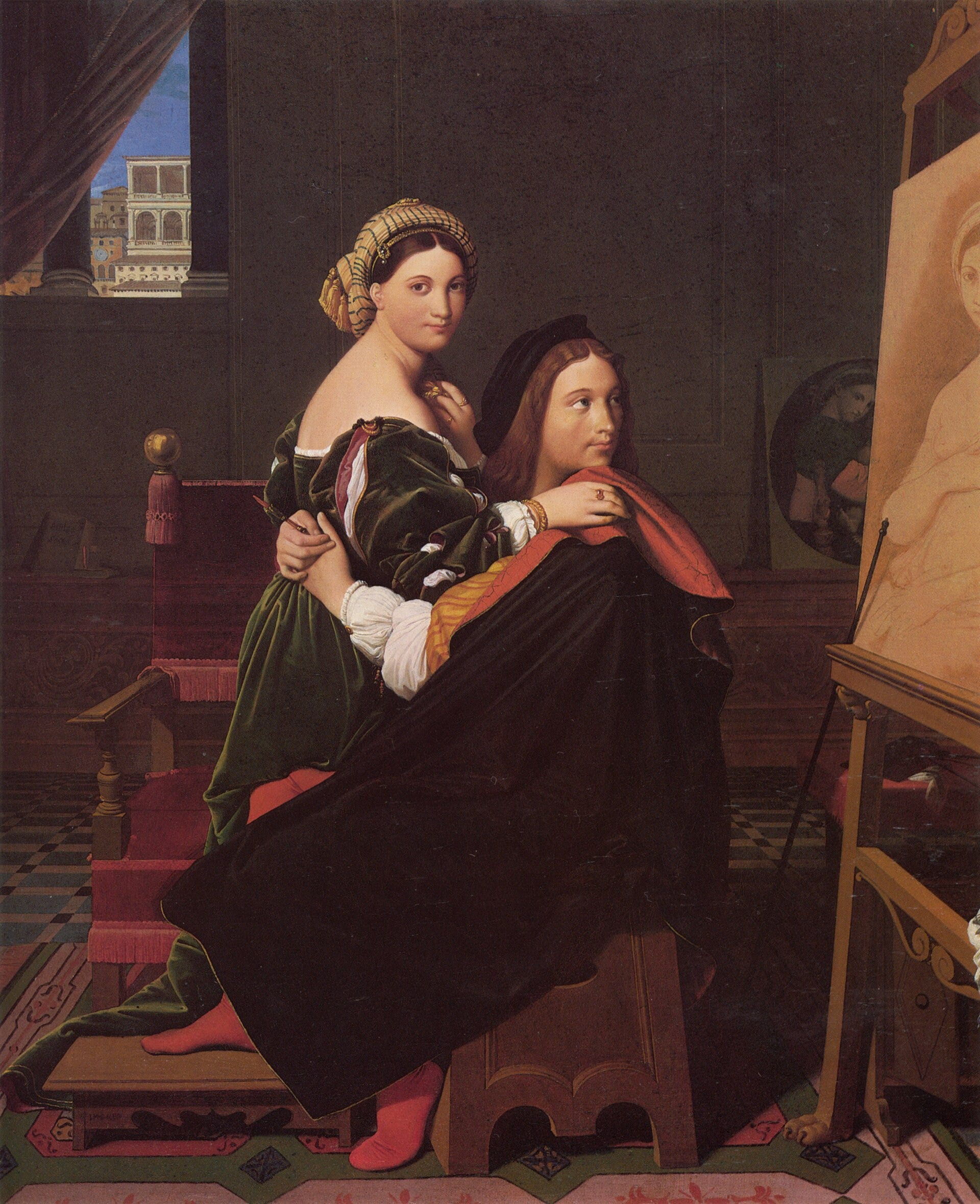
The French painter Jean Auguste Dominique Ingres painted Raphael and La Fornarina in 1814, showing the artist with Margarita seated on his lap while he works, turning the rumor into a full romantic scene for a nineteenth century audience that loved a tragic genius story.

Composers, novelists, and filmmakers have returned to the pairing ever since, most of it built on Vasari's account rather than anything Raphael documented himself.

If you are building out your own mental map of art history, Raphael is a good place to start, and he is one of the names on our list of 10 artists you need to know.

What Most Articles Get Wrong

Most quick summaries of this painting stop at mystery woman, secret ring, dead painter. A few things get flattened along the way that are worth knowing.

First, the landscape swap gets almost no attention, even though it might be the single strangest fact in the whole story. Someone did not just paint over a ring, they replaced an entire Leonardo style background with a wall of symbolic plants.

That is a much bigger intervention than most articles let on.

Second, a lot of coverage treats the Margarita Luti identification as settled fact, full stop, when serious art historians still debate it. The resemblance to other Raphael sitters is suggestive, not conclusive, and I would rather tell you that plainly than pretend this is closed.

Third, almost nobody mentions that the 2001 imaging study did not just find the ring, it dated the overpainting to shortly after Raphael's death, based on the materials used. That timing is what makes the cover up theory so compelling.

It was not touched up a century later by a random restorer. It happened close to the moment Raphael died, by someone with access to his own studio.

For the rest of his career, from apprentice to the Vatican's favorite painter, read Raphael: The Complete Story.


More Secrets to Unlock

Three more women whose stories rarely get told straight.


No boring lectures, ever. Join 170,000 readers learning art the fun way, free.


FAQ

  • Who is the woman in La Fornarina?

    Most art historians believe she is Margarita Luti, the daughter of a Roman baker, said to have been Raphael's lover during the last years of his life. The identification rests on later biographical sources and visual resemblance to other Raphael sitters, not on a document that names her directly.

  • What does Fornarina mean?

    Fornarina means the little baker girl or the baker's daughter in Italian. It is a nickname tied to Margarita's father's trade, not the woman's real name, and it eventually became the painting's title.

  • Is the ring in La Fornarina real?

    Yes. Conservators using X ray and infrared imaging in 2001 found a square cut ruby ring painted on the third finger of the sitter's left hand, later covered up with skin tone paint.

  • Did Raphael really marry Margarita Luti?

    There is no surviving marriage record, so it cannot be confirmed. The hidden wedding finger ring has fueled a theory of a secret marriage or engagement, but historians treat it as compelling circumstantial evidence rather than proof.

  • Why did Raphael sign the painting on her arm?

    Raphael painted his signature, RAPHAEL VRBINAS, directly onto an armband on the sitter's left arm, the arm associated with the heart in Renaissance symbolism. Signing a person rather than the canvas itself is unusual and is often read as a personal statement rather than a routine mark of authorship.

  • When did Raphael paint La Fornarina?

    Most historians date the painting to around 1518 to 1519, in the final two years of Raphael's life. It may have been left unfinished or altered in his studio at the time of his death in 1520.

  • Where can I see La Fornarina today?

    The painting hangs in the Galleria Nazionale d'Arte Antica, inside the Palazzo Barberini in Rome. It remains one of the more debated portraits from the Italian Renaissance on public display anywhere.

  • How did Raphael die?

    Raphael died on April 6, 1520, in Rome at thirty seven years old, after a sudden illness. Giorgio Vasari's account links his death to a night spent with Margarita and a fever he allegedly hid from his doctors, though modern historians treat the story with some skepticism.


Never miss a story. 170,000 readers get one painting explained every week, free.