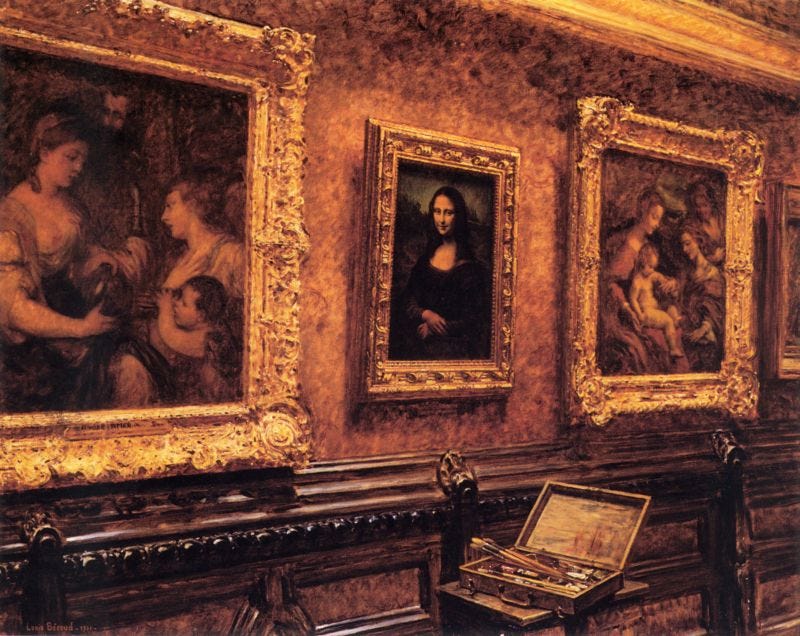
The Mona Lisa was stolen from the Louvre on 21 August 1911 by Vincenzo Peruggia, an Italian handyman who had worked at the museum. He hid overnight, walked out with the panel under his coat, and kept it hidden for two years.
He was caught in 1913 after contacting a Florence art dealer, and the theft is what turned the painting into a global icon.
The detail that gets buried in most retellings is how boring the theft actually was. Peruggia did not scale a wall or crack a vault, he just knew the museum's routine because he had worked there, and he walked out through an unlocked door while carrying a painting most staff did not even notice was missing until the next day. I think that gap, more than a year of the Louvre not registering the empty wall, says more about 1911 museum security than anything Peruggia did.
The Theft on 21 August 1911
On the morning of 21 August 1911, staff at the Louvre discovered that the Mona Lisa was gone from its usual spot in the Salon Carre.
The thief was Vincenzo Peruggia, an Italian immigrant who had previously worked for a contractor building protective glass cases for paintings in the museum.
He knew the layout, the routines and the gaps in the museum's security better than most visitors ever could.
How Peruggia Walked Out With the Painting
Peruggia hid inside the Louvre, most likely overnight or in an early morning service area, dressed like the other workmen employed there.
He took the painting off the wall, removed it from its frame and glass case in a stairwell, and hid it under his smock.
He then walked out through a door normally used by staff, on a day the museum was closed to the public.
Why the Louvre Did Not Notice for a Day
The Louvre did not report the painting missing right away. For part of the day, staff assumed it had been taken away to be photographed.
That assumption bought Peruggia crucial time and meant investigators started their search more than a full day after he had already left the building.
The delay became one of the more embarrassing details of the whole case for museum officials.
More Mona Lisa Stories and Art Heists
Two Years Hidden in a Paris Apartment
Peruggia kept the Mona Lisa in a trunk with a false bottom in his Paris apartment for almost two years.
He made little attempt to sell it during that time, and police who searched his apartment early in the investigation somehow missed it.
He later said he wanted to return the painting to Italy, believing it had been taken from the country by Napoleon.
The Arrest in Florence
In late 1913, Peruggia contacted Alfredo Geri, an art dealer in Florence, offering to sell what he described as the stolen Mona Lisa.
Geri involved Giovanni Poggi, director of the Uffizi Gallery, and the two arranged to meet Peruggia and inspect the painting.
Once they confirmed it was genuine, Italian authorities arrested him, and the painting was recovered after two years missing.
Picasso and Apollinaire Under Suspicion
In the days after the theft, French police briefly suspected the poet Guillaume Apollinaire, who had once employed a man caught stealing small items from the Louvre.
That connection led investigators to question Pablo Picasso as well, since Picasso had bought some of the earlier stolen pieces without asking where they came from.
Both men were released once it became clear neither had anything to do with the Mona Lisa specifically.
The Forgery Ring Story That Probably Was Not True
A popular version of the story claims a con man named Eduardo de Valfierno hired Peruggia specifically so a forger could sell fake copies to wealthy American buyers before the theft was even discovered.
That version makes for a better plot than the documented one, but historians have never found solid evidence connecting Valfierno to the actual crime.
Most sources now treat it as an entertaining story added after the fact rather than an established part of the case.
What Happened to Peruggia After His Trial
At his trial, Peruggia argued his motive was patriotism rather than profit, and Italian audiences responded warmly to that framing.
He received a relatively light sentence, roughly seven months, for a theft that had captured attention around the world.
He later served briefly in the Italian army during the First World War and lived the rest of his life largely out of public view.
How the Theft Made the Mona Lisa Famous
Before 1911, the Mona Lisa was respected among specialists but was not yet the single most famous painting on earth.
Newspaper coverage of the theft, the two year search and the eventual recovery gave the portrait global name recognition it had never had before.
In a real sense, Peruggia's crime did more for the painting's fame than any critic or historian had managed up to that point.
Carry on exploring
Questions About the 1911 Mona Lisa Theft
Who stole the Mona Lisa?
Vincenzo Peruggia, an Italian handyman who had previously worked at the Louvre, stole it on 21 August 1911.How did Peruggia steal the Mona Lisa?
He hid inside the museum, removed the painting from its frame in a stairwell, hid it under his clothing and walked out through a staff door.How long was the Mona Lisa missing?
It was missing for about two years, from August 1911 until Peruggia was caught in December 1913.Were Picasso and Apollinaire really suspects in the Mona Lisa theft?
Yes, briefly. Both were questioned because of an unrelated earlier theft from the Louvre, but neither was involved in stealing the Mona Lisa.Did a forger really make copies of the Mona Lisa to sell during the theft?
That story, tied to a con man named Eduardo de Valfierno, is widely repeated but has no solid supporting evidence.How was the Mona Lisa recovered?
Peruggia contacted a Florence art dealer to sell it, and authorities arrested him once the painting was confirmed genuine.What happened to Peruggia after he was caught?
He was tried in Italy, served roughly seven months in prison, and largely disappeared from public attention afterward.Did the theft make the Mona Lisa more famous?
Yes. Global coverage of the missing painting is widely credited with turning it into the most famous portrait in the world.