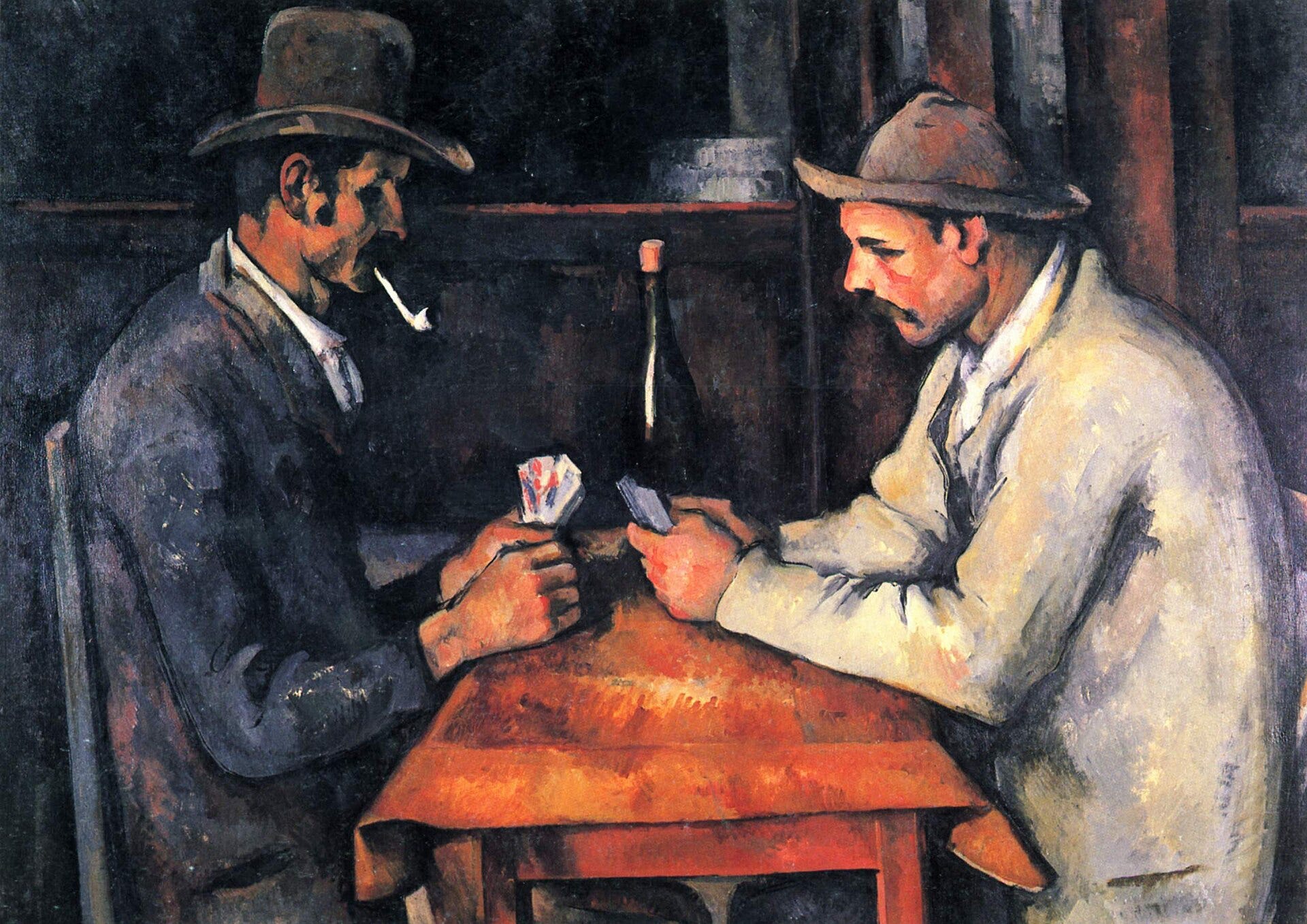
Paul Cezanne painted The Card Players five times in the early 1890s. Two men at a table, cards in hand, saying nothing. One of those five versions later sold for more than two hundred and fifty million dollars.
I remember reading the sale price attached to this painting and assuming it had to be a typo. It was not, and understanding why takes knowing what Cezanne was actually doing at that table.
Painter: Paul Cezanne, French painter, 1839 to 1906.
Date: Painted in five versions between roughly 1890 and 1895.
Where to see it: The Metropolitan Museum of Art, the Musee d'Orsay, the Courtauld Gallery, the Barnes Foundation, and one version in a private collection in Qatar.
Three More Stories Worth Your Time
The ones I would send you to next.
Cezanne's Life Before Fame
Cezanne was born in Aix en Provence in 1839, the son of a banker who wanted him to study law. He grew up alongside the future novelist Emile Zola.
That childhood friendship lasted for decades before eventually falling apart over Zola's fiction. He moved to Paris to pursue painting against his father's wishes.
He spent years being rejected by the official Salon, the state approved exhibition that controlled which artists got taken seriously in France. Early critics mocked his rough, heavily built up brushwork.
He exhibited briefly alongside the Impressionists in the 1870s but never fully belonged to the group. Their focus on capturing fleeting light interested him less than his own goal.
Finding permanent structure underneath everything he painted, which is exactly the project The Card Players series represents.
Five Paintings, Not One
Cezanne did not paint The Card Players once. Between roughly 1890 and 1895, he painted five separate versions of the scene, varying the number of players, the composition, and the size of the canvas.
Today those five paintings live scattered across the world. One hangs at the Metropolitan Museum of Art in New York. Another is at the Musee d'Orsay in Paris.
A third belongs to the Courtauld Gallery in London, and a fourth to the Barnes Foundation in Philadelphia.
The fifth is the one that made headlines. It left the private art market entirely in 2011, when it was purchased by the royal family of Qatar.
The five paintings are not identical copies of each other. The largest version, now at the Barnes Foundation in Philadelphia, includes extra figures, a standing spectator among them, gathered around the table.
It measures well over a meter across. Cezanne pared the scene down as the series progressed.
In the final three versions, including the ones now at the Met, the Musee d'Orsay, the Courtauld, and Qatar, he removed the spectators entirely and kept only two players locked in concentration.
That editing process tells you something about how Cezanne actually worked. He was not repeating himself out of habit.
He was testing how much he could remove from a scene before it stopped functioning, then removing exactly that much and no more.
The Peasants Cezanne Actually Painted
The men at the table were not professional models or society figures. They were peasants Cezanne saw regularly around his father's estate, the Jas de Bouffan, on the edge of Aix en Provence.
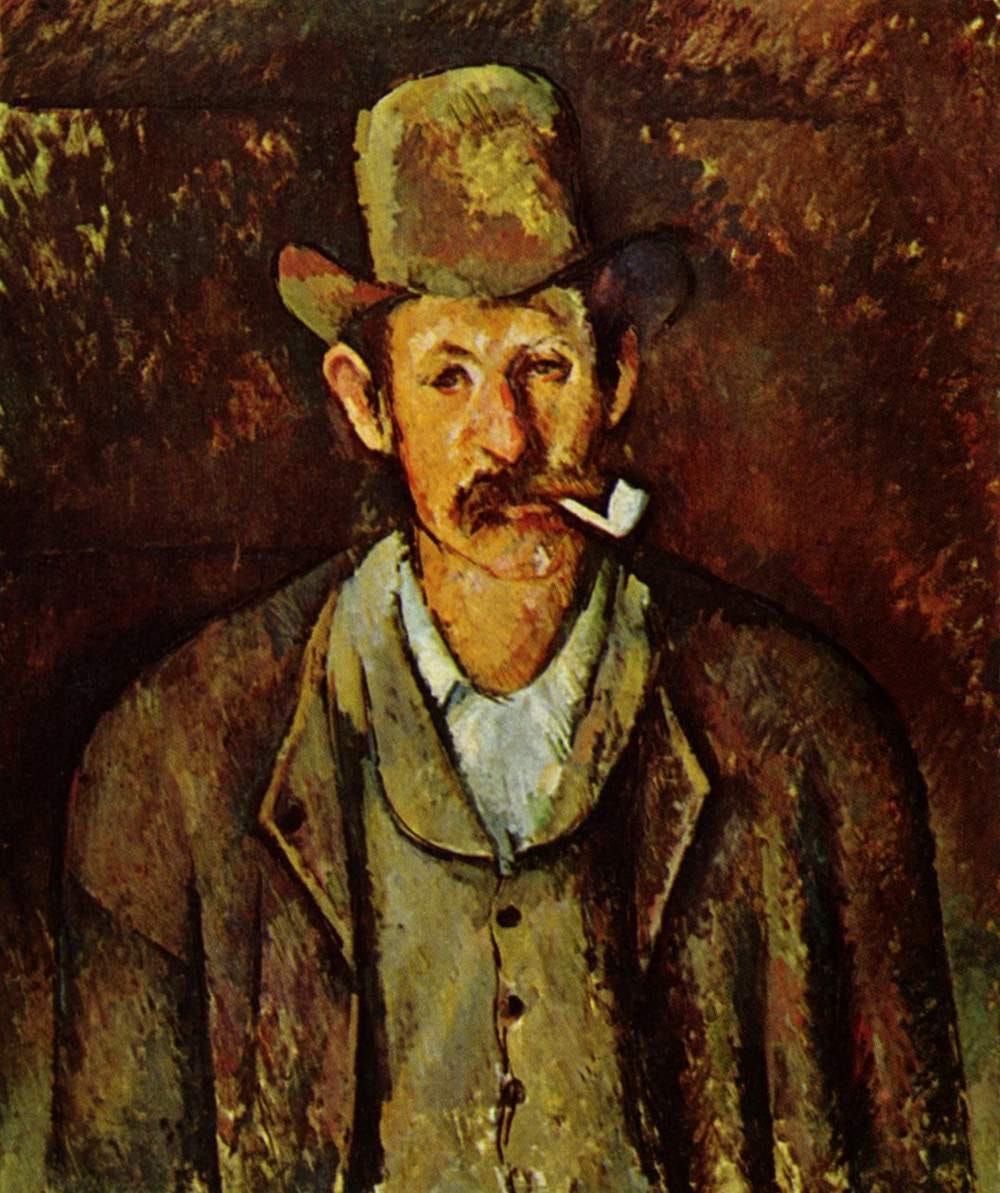
The man smoking a pipe in several versions has been identified as pere Alexandre, the gardener who worked the property.
Cezanne painted him and the other card players in individual sketches first, then assembled the full composition on canvas afterward.
There is no drama in their expressions, no glance exchanged, no visible reaction to the cards in hand.
Cezanne stripped out every gesture a lesser painter would have leaned on to make the scene feel alive.
The Quiet Genius of the Composition
Look at the table and one detail organizes the entire painting. A single wine bottle sits at the center, catching the light, splitting the canvas into two nearly symmetrical halves.
Everything on either side balances against everything else, the tilt of a hat, the angle of an arm, the fold of a coat.
Technical study of the canvas shows Cezanne reworked the outlines of the figures, the table, and the chairs repeatedly, adjusting the relationships between shapes until the whole arrangement locked into place.
This is not a snapshot of a card game. It is closer to architecture, built from human figures instead of stone.
Why Cezanne Kept Returning to the Same Scene
Cezanne spent his career trying to solve a specific technical problem: how to paint solid, three dimensional form using only flat color on a flat canvas.
His solution was to build figures out of small, deliberate patches of color, treating a sleeve or a shoulder almost like a cylinder or a cone rather than a soft, continuous surface.
Painting the same two or three men repeatedly gave him a stable subject to keep testing that idea against.
That approach, breaking the visible world down into basic geometric forms, is the exact idea Picasso and Braque picked up a decade later when they invented Cubism.
Cezanne was not trying to paint a card game. He was trying to figure out how solid objects actually work on a flat surface.
The Record Sale That Made Headlines
In February 2011, news broke that the royal family of Qatar had purchased one version of The Card Players in a private sale reported at more than two hundred and fifty million dollars.
At the time, that made it the most expensive painting ever sold, ahead of works by artists far more associated with blockbuster auction prices.
Prominent dealers, including William Acquavella and Larry Gagosian, were reportedly involved in the bidding and outbid at figures rumored close to two hundred and twenty million dollars.
The sale happened privately, away from any auction house, which is part of why exact terms were never fully confirmed. The number that leaked was enough to make front pages regardless.
Newer sales have since passed that number. Leonardo da Vinci's Salvator Mundi sold at auction in 2017 for well over four hundred million dollars, pushing Cezanne's painting down the list of record holders.
It remains, even so, one of the highest prices ever confirmed for a work that never touched an actual auction block.
Most record breaking paintings come loaded with obvious drama, a beheading, a shipwreck, a screaming face. This one has none of that.
Two men sit still, saying nothing, doing something millions of ordinary people did every evening in cafes across France.
I think that stillness is exactly what collectors are actually paying for. Cezanne proved that total calm, rendered with enough structural intelligence, could carry as much weight as any dramatic history scene.
That was a genuinely new idea in the 1890s, and it reshaped what serious painters believed a subject needed to justify itself.
The price also reflects simple scarcity. Only five of these paintings exist, four of them locked permanently inside major public museums that will never sell.
Once Qatar's version left the market, there was effectively no way for another buyer to ever own one again.
Cezanne's Bigger Legacy
Cezanne worked in relative obscurity for most of his career, largely ignored by the Paris art establishment and mocked in early reviews. Recognition came late, mostly in the final decade of his life.
By the time Picasso and Matisse were building their own careers, both openly credited Cezanne as the source of everything they were doing.
Both artists at various points referred to him as something close to the father of modern painting, the bridge between Impressionism and everything that followed.
That legacy is why Cezanne belongs firmly among the greatest painters of all time, and why his auction record now sits comfortably alongside the most expensive paintings ever sold.
Proof that a quiet card game outranked centuries of dramatic religious and royal portraiture in the end.
He also belongs on any list of artists you need to know before anyone else from the late nineteenth century, since almost every major movement that followed him, Cubism, Fauvism, and eventually full abstraction, traces back to the geometric logic he worked out at that card table.
For the full arc of his career, read Paul Cezanne: The Complete Story, and for the movement his late work fed straight into, see What Is Post Impressionism.
More Stories Worth Falling Into
A few more paintings and painters worth a proper look.
Frequently Asked Questions
How many versions of The Card Players did Cezanne paint?
Five, painted between roughly 1890 and 1895, varying in size and in the number of figures shown at the table, from a large early version with onlookers to smaller later versions focused on just two players.
Where can you see the different versions today?
At the Metropolitan Museum of Art in New York, the Musee d'Orsay in Paris, the Courtauld Gallery in London, and the Barnes Foundation in Philadelphia. The fifth is privately held by the royal family of Qatar.
How much did the Qatar version sell for?
Reports from 2011 put the price at more than two hundred and fifty million dollars, making it the most expensive painting sale reported up to that point, later surpassed by other sales.
Who are the men in the paintings?
Local peasants Cezanne saw around his family estate near Aix en Provence. The pipe smoking figure in several versions has been identified as pere Alexandre, the estate's gardener.
Why is the composition considered so important?
Cezanne built the scene around strict symmetry, using a central wine bottle to balance the two halves of the canvas, and reworked the figures repeatedly to perfect the relationships between shapes.
How did Cezanne influence Cubism?
He treated human figures and objects as basic geometric forms, cylinders, spheres, and cones, an approach Picasso and Braque later expanded directly into the Cubist movement.
Why does an ordinary card game make for such a valuable painting?
The subject's stillness demonstrated that structural mastery and quiet concentration could carry as much artistic weight as dramatic historical scenes, a genuinely new idea at the time it was painted.
When did Cezanne gain recognition as a major painter?
Mostly late in his life and after his death in 1906. Painters like Picasso and Matisse later credited him directly as a foundational influence on modern art.