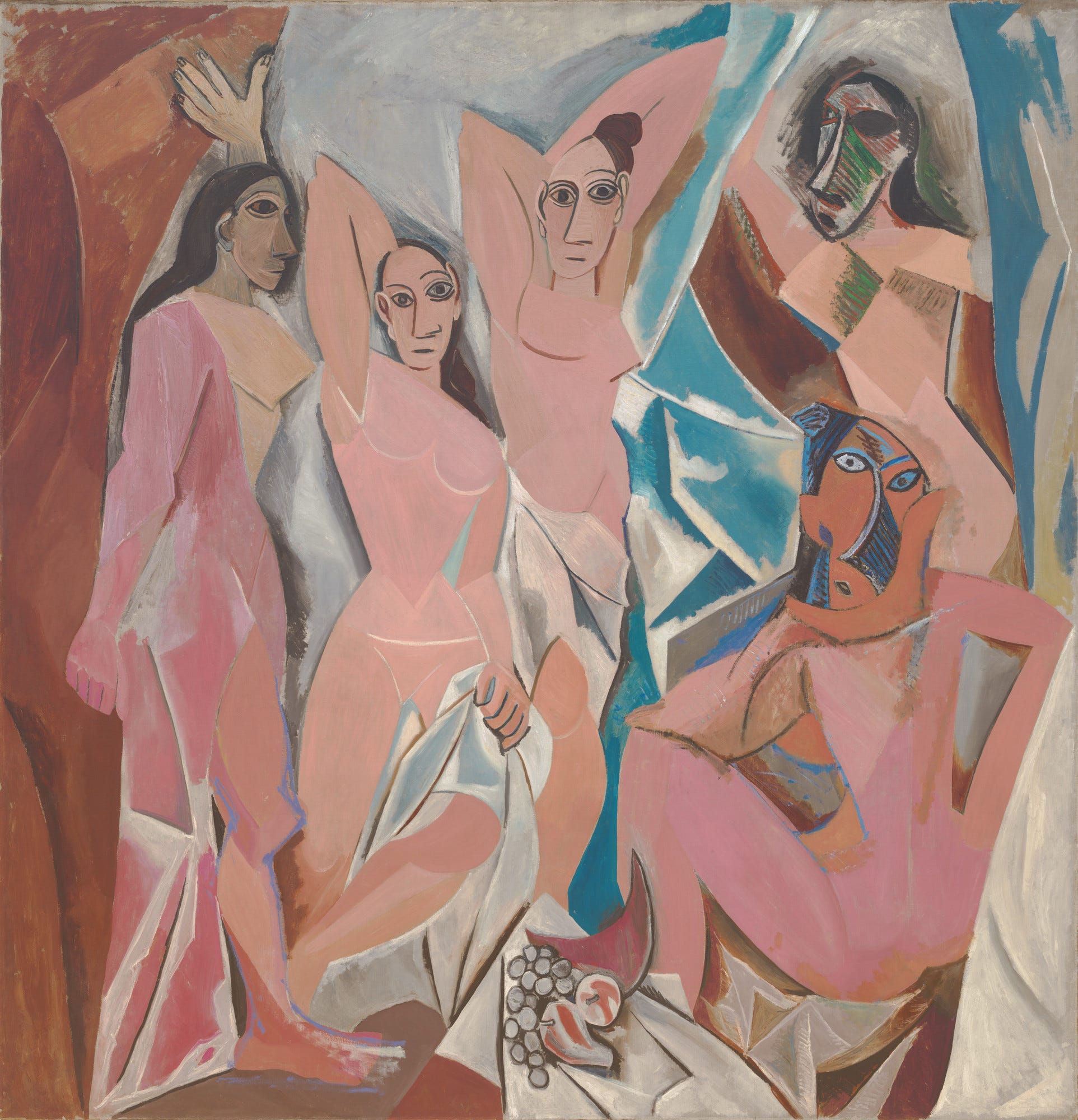
Les Demoiselles d'Avignon is Pablo Picasso's 1907 painting of five nude women in a brothel, painted with fractured, mask like faces that broke completely with Renaissance perspective. Art historians treat it as the starting point of Cubism, a movement Picasso and Georges Braque built together.
What I find most telling about this painting is that it took a full decade for the art world to catch up to what Picasso had already painted alone in a locked studio.
Date: 1907, exhibited publicly for the first time only in 1916.
Medium: Oil on canvas, about 2.4 by 2.3 meters.
Location: Museum of Modern Art, New York, acquired in 1937.
More Stories Like This
If this shock painting pulled you in, these stories sit close to the same world of Picasso and the break with tradition.
Not Avignon in France, But a Street in Barcelona
Despite the French sounding title, Les Demoiselles d'Avignon is set on Barcelona's carrer d'Avinyo, a street in the city's red light district that Picasso knew from his own teenage years nearby. The five women are prostitutes. Picasso originally sketched two men into the scene, a sailor and a medical student, before cutting both entirely.
Picasso lived near that district as a teenager, when his father taught at Barcelona's fine arts school, and biographers have traced several of his early sketchbooks back to streets within a few minutes' walk of the carrer d'Avinyo.
He was not inventing a generic scene from imagination alone. He was painting a real kind of room in a real part of the city he had walked through as a young artist.
Cezanne, Masks, and the Break with Perspective
Picasso built the painting's break with tradition from two separate sources. He studied how Paul Cezanne flattened the human body into geometric planes, and he borrowed the carved, mask like features of African and Iberian sculpture he had seen at Paris's Trocadero museum, reworking the two right hand faces in a distinct, later campaign.
A large Cezanne retrospective opened in Paris in the autumn of 1907, the same year Picasso was finishing the canvas, and historians treat that show as a direct trigger for how aggressively he flattened the bodies in the final version. What strikes me is the timing. Picasso was not working in a vacuum, he was reacting to a show that was still up while he finished the painting.
Technical study of the canvas shows the two figures on the right were reworked after Picasso had already painted the rest of the composition. The three women on the left keep an earlier, flatter style closer to Iberian relief carving alone. Two different moments of work sit on the same canvas.
The Friends Who Recoiled
When Picasso finally uncovered the hidden canvas for his own circle, the reaction was closer to alarm than admiration. Georges Braque, soon to become his closest collaborator, reportedly compared the experience to watching someone eat rope or drink gasoline, and even Henri Matisse reacted with confusion rather than praise.
Even the dealer who had backed Picasso for years, Wilhelm Uhde, reportedly struggled with the canvas at first sight, and no dealer offered to show it publicly for nearly a decade after Picasso finished it. To me, that decade of silence says more than any review could. Even people who believed in Picasso needed time to catch up with this one.
I think Braque's rope and gasoline line tells you more about the painting than most formal analysis does. Shock, not admiration, is the honest first reaction to a lot of real breakthroughs.
More Than a Hundred Sketches Before the Final Canvas
More than a hundred surviving sketches trace how the painting evolved from a busy narrative scene into the stripped down group of five women shown today. One abandoned study included a medical student holding a skull, a memento mori warning against the brothel, that Picasso cut entirely from the final composition.
Some of these studies survive only as loose sheets scattered across museum and private collections today, which is part of why reconstructing the painting's full evolution took art historians decades of comparing scattered archives.
Surviving sketchbooks and individual studies trace the painting's evolution step by step, an unusually documented process for a canvas Picasso kept hidden from almost everyone while he worked.
A Critic's Borrowed Insult Gave Cubism Its Name
Picasso did not exhibit the canvas publicly until 1916, nine years after finishing it, using the years in between to push its fractured forms further alongside Georges Braque. A critic's borrowed insult, aimed at cube like shapes in one of Braque's landscapes, gave the resulting movement its name: Cubism.
Braque and Picasso worked so closely in the years right after that some paintings from the period are difficult for specialists to tell apart without documentation, a closeness rare between two major artists at the height of their careers.
Henri Matisse reportedly described Braque's landscape paintings, shown in 1908, as being made of little cubes. Critic Louis Vauxcelles picked up the phrase in a review and put it into print, and the label stuck to the movement Picasso and Braque built directly out of the fractured space Les Demoiselles first opened up.
More From Cool Stories About Art
From a Fashion Designer's Library to MoMA
Picasso sold the painting in 1924 to Jacques Doucet, a French fashion designer who used his fortune to assemble one of the era's most serious contemporary art collections, and it hung in Doucet's private library for over a decade. Picasso called it Le Bordel d'Avignon while painting it; a friend gave it the softer title that stuck only when he first showed it publicly in 1916.
Doucet reportedly paid a modest sum for the canvas compared to what Picasso's work would later command, since in 1924 Les Demoiselles was still viewed by most collectors as a strange, difficult early experiment rather than a landmark.
The detail I keep coming back to is that Picasso never accepted the polite title. He called it a brothel outright, and history sanded that down for him.
Poet Andre Salmon, the friend who showed the painting publicly for the first time in 1916, chose the softer title Les Demoiselles d'Avignon instead. The canvas reached the Museum of Modern Art only after Doucet's death, sold by his estate in the late 1930s.
A Canvas Built at Public Scale
At close to 2.4 by 2.3 meters, Les Demoiselles d'Avignon is built at a scale usually reserved for public commissions, not for a private studio experiment nobody outside Picasso's circle had asked to see. Visitors standing close to it in New York today still have to step back to take in all five figures at once.
That scale is one reason reproductions in books and on screens undersell the painting. Standing in front of the real canvas at MoMA, the fractured bodies fill enough of the field of vision that the effect is closer to confrontation than observation.
Most of Picasso's Blue and Rose Period canvases, painted only a few years earlier, were roughly half this size, which makes the jump in ambition even harder to miss once you know the numbers.
Few private studio paintings of the period were built at that scale. Picasso worked at a size usually reserved for commissioned work, for a picture he had no plan to sell or exhibit anytime soon.
FAQ
Is Avignon in Les Demoiselles d'Avignon the French city?
No. The title refers to the carrer d'Avinyo, a street in Barcelona's red light district, not the city of Avignon in France.
Who are the women in Les Demoiselles d'Avignon?
They are prostitutes in a brothel. Picasso originally sketched two male figures into the scene, a sailor and a medical student, before removing both from the final composition.
Why do two of the faces look like masks?
Picasso had seen African and Iberian masks at the Trocadero ethnographic museum in Paris, and he borrowed their carved, angular features for the two women on the right of the canvas.
Why is Les Demoiselles d'Avignon considered the start of Cubism?
It broke with single point perspective more completely than any painting before it, splitting bodies into flat, angular planes. Picasso and Georges Braque built on that break together over the following years.
When was Les Demoiselles d'Avignon first shown to the public?
Not until 1916, nine years after Picasso finished it. The Museum of Modern Art in New York acquired the painting in 1937.
Did Picasso choose the title Les Demoiselles d'Avignon himself?
No. Picasso called it Le Bordel d'Avignon while he worked on it. Poet Andre Salmon gave it the softer title in 1916, and that is the name that stuck.