Why Are the Cherubs in Raphael's Sistine Madonna So Famous?

Two bored looking cherubs at the bottom of a Raphael altarpiece became more famous than the painting itself. Here is where they came from.

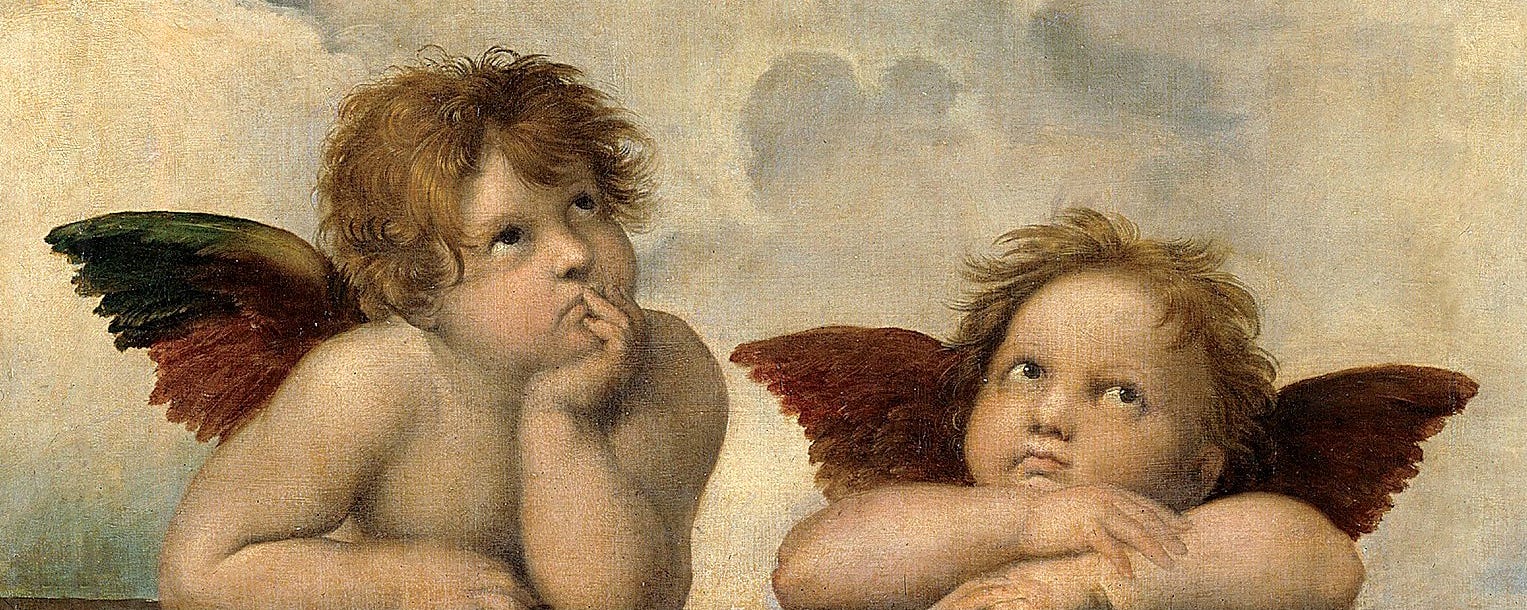
Raphael painted two bored looking cherubs resting their chins on a ledge at the bottom of his 1512 altarpiece. They have been reproduced on more postcards, mugs, and wrapping paper than almost any other detail in art history.

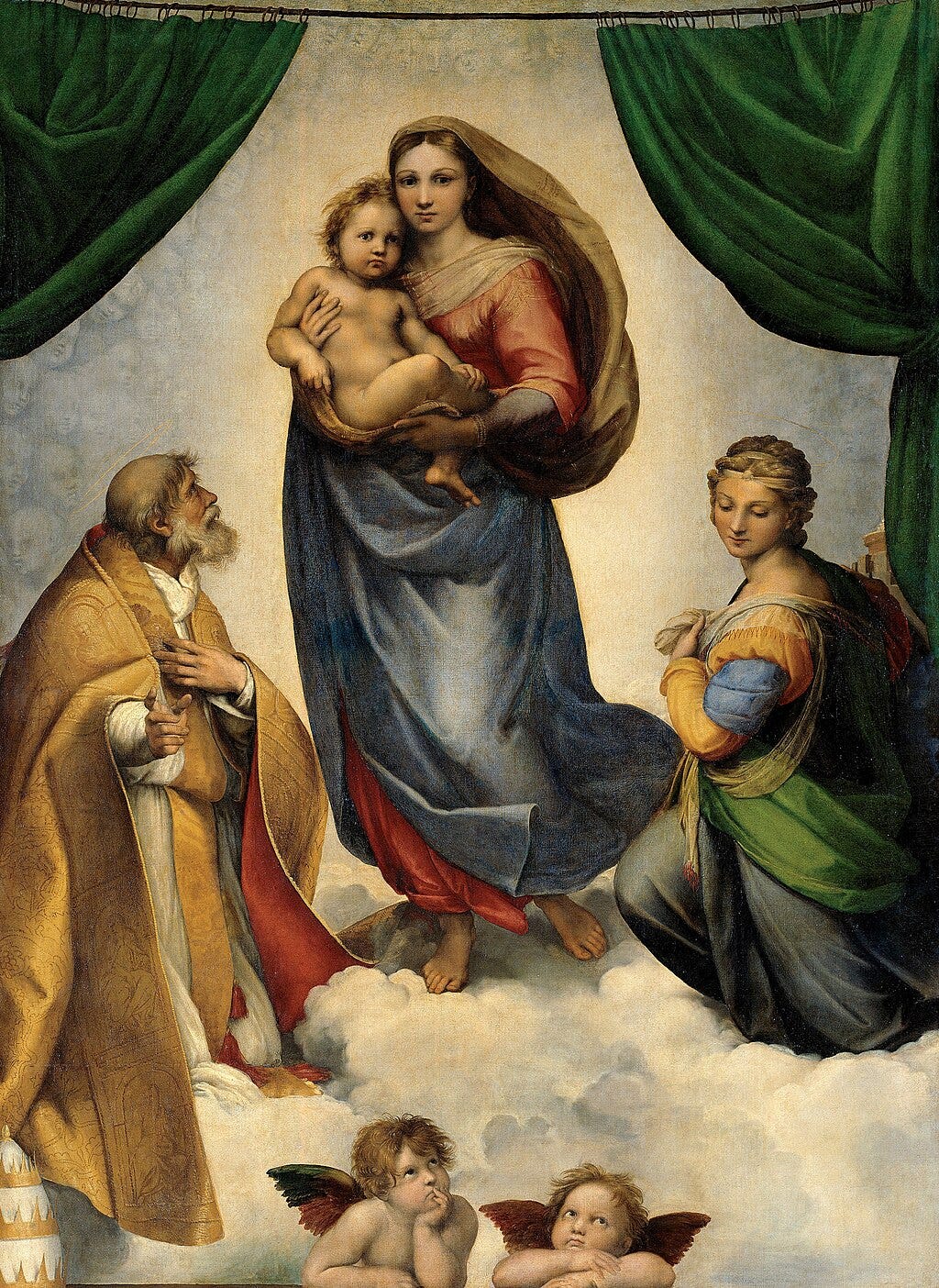
Sistine Madonna painting
Raphael, The Sistine Madonna, 1512.

The rest of the painting shows the Virgin and Child descending on clouds, flanked by two kneeling saints. Almost none of that shows up on the merchandise. Just the two cherubs at the bottom, looking upward with their chins on their arms.

  • Date: 1512 to 1513.

  • Medium and size: Oil on canvas, 265 by 196 centimeters.

  • Location: Gemäldegalerie Alter Meister, Dresden.


No boring lectures, ever. Join 170,000 readers learning art the fun way, free.


More Renaissance Portraits Worth a Second Look

Raphael was working in a crowded field. These three hold their own against him.


An Altarpiece Built Like a Vision

Raphael's Sistine Madonna breaks from standard altarpiece design. Instead of Mary enthroned, green curtains part like a stage curtain and she walks forward on clouds, barefoot, carrying the infant Christ toward the viewer. Painted around 1512 for a Piacenza monastery, it reads less like a devotional image and more like a vision caught mid motion.

Green curtains part at the top corners, as if someone has just pulled them open to reveal what is happening behind. Mary walks forward on clouds, barefoot, holding the Christ child.

Most altarpieces of the period show Mary seated on a solid throne. Raphael has her in motion instead, stepping out of a vision rather than posing for one.

Who Is Kneeling on Either Side

Two saints flank the vision in the Sistine Madonna. Saint Sixtus II kneels on the left, his face widely thought to echo Pope Julius II, who commissioned the altarpiece. Saint Barbara kneels on the right, her eyes cast downward, linking the miracle above to whoever stands in front of the canvas.

To the left, Saint Sixtus II kneels with a papal tiara resting beside him, his face widely thought to echo Pope Julius II, who commissioned the painting for a monastery in Piacenza.

To the right, Saint Barbara kneels and looks down and out of the frame, her gaze acting as a bridge between the vision above and whoever is standing in front of the painting.

Raphael Madonna in the Meadow
Raphael, Madonna in the Meadow, 1506.

Learn art the fun way. Join 170,000 readers getting one painting and its story every week.


The Two Cherubs Almost Nobody Notices Are Part of a Bigger Painting

The two winged children were never meant to stand alone. Raphael placed them at the base of the composition, looking up at the vision above, the only figures in the scene who share the viewer's own vantage point on the floor of the church.

The two winged children leaning on the ledge at the bottom were not painted as a standalone image. They sit at the base of the composition, looking up at the vision happening above them, the only figures in the scene who share the viewer's own vantage point.

Their fame outgrew the painting itself. By the twentieth century, printers and gift shops had lifted them out entirely, and most people who recognize the cherubs have never seen the Madonna they were painted underneath.

To me, that is the real irony of the whole thing. The two figures Raphael placed there to lead the eye upward are the only part most people ever actually look at.

Sistine Madonna cherubs detail
The Sistine Madonna, cherubs detail.

Why the Cherubs Lean and Look Bored, Not Amazed

The two winged children at the bottom are not biblical cherubim, a term theology reserves for a different, more fearsome order of angel usually shown with multiple wings. Raphael painted putti, a decorative figure borrowed from classical and Renaissance ornament, and gave them the pose of spectators leaning on a ledge rather than worshippers kneeling in the vision.

Genre painters of the period often placed a figure leaning on a windowsill or a stone balustrade, gazing out at the viewer, a stock device meant to draw the eye into a scene. Raphael borrowed that same posture for the two putti, propping their chins on their folded arms at the base of the composition.

Early writers on the Sistine Madonna barely mentioned them. The detachment that reads today as boredom was, in 1512, simply a compositional hinge, a way of framing the miracle above without competing with it.

I read their expression the same way now. What looks like teenage boredom on a postcard was really just Raphael managing where your eye goes next.

A Popular Story About a Bakery Window

A widely repeated legend says Raphael modeled the two cherubs on real children he saw pressing their faces against a bakery window in Rome, watching pastries they could not buy. No contemporary document supports the story, which makes it a charming myth rather than a documented source for the painting.

A popular story claims Raphael based the two cherubs on real children he saw pressing their faces against a bakery window, watching pastries they could not afford. It is a nice story, repeated often, but there is no solid documentation behind it, so it is worth treating as folklore rather than fact.

Raphael Alba Madonna painting
Raphael, The Alba Madonna, 1510.

From a Monastery in Piacenza to Dresden

Raphael painted the Sistine Madonna for the Benedictine monastery of San Sisto in Piacenza around 1512. It stayed on the monastery altar for more than two centuries. In 1754, the monks sold it to Augustus III of Saxony, and the altarpiece left Italy for Dresden, where it has remained with one long exception.

Raphael painted the altarpiece for the Benedictine monastery of San Sisto in Piacenza. It stayed there for over two centuries before the monks sold it in 1754 to Augustus III, Elector of Saxony, who brought it to Dresden.

Soviet troops moved it to Moscow after the Second World War. It returned to Dresden in 1955, where it has remained since.

What strikes me is how much this painting has survived just to end up reproduced as two bored children on a mug.

Madonna of the Goldfinch painting
Raphael, Madonna of the Goldfinch, 1506.

See art differently. 170,000 people read these free stories. Come find out why.


More Stories Behind Famous Paintings

A painting can hide behind its most famous detail. These do too.


Painted on Canvas, Not Panel

Raphael painted the Sistine Madonna on canvas rather than the wood panel he normally used, a rare choice for him in 1512. The switch made the finished altarpiece easier to roll and ship, a detail that mattered two centuries later when the painting crossed the Alps from Italy to Saxony.

Raphael finished the Sistine Madonna in 1512, and unusually for him he used canvas rather than wood panel, a choice that made the finished altarpiece easier to roll and transport out of Italy centuries later.

At 265 by 196 centimeters, it is one of Raphael's largest single figure compositions. The green curtains pulled back on either side make the scene look like a vision briefly parting the fabric of a stage, not a fixed architectural niche.

Sold to Dresden for a Fortune

In 1754, Augustus III of Saxony paid the Benedictine monks of San Sisto a reported twenty thousand scudi for the Sistine Madonna, one of the highest sums recorded for a single painting at the time. The sale emptied the monastery of its most valuable possession and made Dresden its new home.

In 1754, Augustus III, Elector of Saxony and King of Poland, bought the painting directly from the Benedictine monks of San Sisto in Piacenza for a reported twenty thousand scudi, a price that became a byword in Dresden for princely extravagance.

The sale stripped the monastery of the single most valuable object it owned. The painting then traveled north over the Alps to Dresden, where Augustus made it the centerpiece of his new picture gallery.

Hidden From Bombs, Taken to Moscow

The Sistine Madonna survived the Allied bombing of Dresden in February 1945 because it had already been moved to safety. Soviet troops carried it to Moscow that same year, where it stayed at the Pushkin Museum until 1955, when it was returned to Dresden as a gesture between East Germany and the USSR.

During the Second World War, the painting was moved out of Dresden for safekeeping and survived the Allied bombing of the city in February 1945 that destroyed much of the historic center.

Soviet troops took it to Moscow after the war, where it stayed until 1955, when it was returned to East Germany as a gesture of goodwill. It hangs today in the Gemaldegalerie Alte Meister in Dresden, back in the city that bought it in the first place. The two cherubs at the bottom of the canvas were barely mentioned by early writers on the painting, and only became famous on their own once the nineteenth century print trade started selling them separately from the Madonna above.

Frequently Asked Questions

  • When did Raphael paint the Sistine Madonna?

    Around 1512 to 1513.

  • Why are the two cherubs so much more famous than the painting itself?

    Printers and gift shops lifted the bottom detail out of the composition for decades, so most people recognize the cherubs without ever having seen the full altarpiece.

  • Is the bakery window story about the cherubs true?

    There is no solid documentation behind it. It is a popular story, not a confirmed fact.

  • Where is the Sistine Madonna kept today?

    At the Gemäldegalerie Alter Meister in Dresden, aside from a decade after World War Two when it was held in Moscow.

  • Who are the two saints kneeling beside the Madonna?

    Saint Sixtus II, on the left, and Saint Barbara, on the right.

  • Are the two figures technically cherubs?

    Not exactly. Art historians call them putti, the winged infant figures common in Renaissance decoration. Biblical cherubim are a different order of angel, traditionally described with multiple wings.


Ten minutes, one masterpiece. That is the deal. 170,000 readers already took it, free.