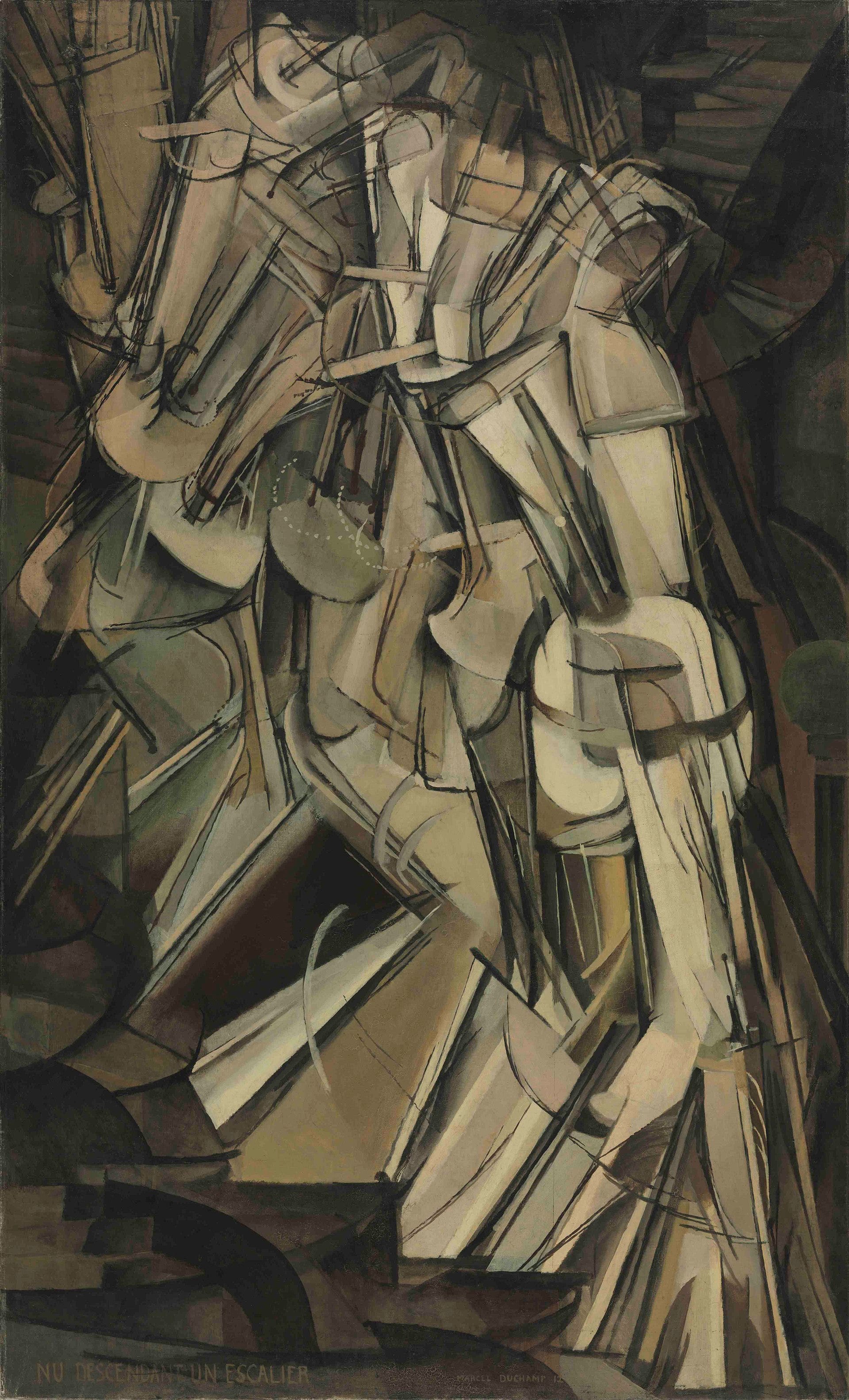
Why Did Duchamp's Nude Descending a Staircase Cause a Scandal?

Duchamp's own brothers asked him to pull this painting from a Paris show in 1912. A year later, it made him the most mocked artist in New York, then the most famous.

Marcel Duchamp's Nude Descending a Staircase No. 2 got laughed out of the 1913 Armory Show, then sold for 324 dollars. The buyer loved it so much he had Duchamp paint him an exact copy to keep.

Nude Descending a Staircase No 2
Marcel Duchamp, Nude Descending a Staircase, No. 2, 1912.

The painting had already been rejected once, by Duchamp's own brothers, before it ever reached America.

  • Date: Painted in 1912, shown publicly in New York in February 1913

  • Medium: Oil on canvas, about 147 by 89 centimeters

  • Location: Philadelphia Museum of Art, Louise and Walter Arensberg Collection


Learn art the fun way. Join 170,000 readers getting one painting and its story every week.


More Artists Who Broke the Rules

Duchamp was not the only painter who got laughed at first and remembered later. These three went just as far.


Rejected by His Own Brothers

In 1912, Duchamp submitted the painting to the Salon des Indépendants in Paris. The hanging committee included his own brothers, Jacques Villon and Raymond Duchamp Villon, both established Cubist painters. They asked him to withdraw it, and he did, without arguing.

The committee felt the painting leaned too far into the Futurist obsession with speed and motion, something their own circle of Cubists wanted no part of.

Duchamp pulled the picture rather than fight for it. He later said the episode taught him to stop caring what any group of artists thought about his work.

The Salon des Indépendants had no jury in principle, open to any artist who paid the entry fee. The request from his own brothers was a private family intervention, not an official rejection, which is part of why Duchamp found it so hard to forgive.

What strikes me is that the rejection came from his own brothers, not from a stranger on a jury. That kind of no is harder to walk away from.

He had painted an earlier, more conventional version in 1911, called Nude Descending a Staircase, No. 1. It showed a similar figure on a spiral staircase but stayed closer to a recognizable body. A year later he repainted the same idea as No. 2, pushing it into pure overlapping planes.

Armory Show 1913 cubist room
The Cubist Room at the 1913 Armory Show, New York.

An Explosion in a Shingle Factory

The 1913 Armory Show introduced European modernism to American audiences at a scale nobody had seen before. Nude Descending a Staircase became the single most mocked work in the entire exhibition, and one critic said it looked like an explosion in a shingle factory.

Newspapers ran cartoons mocking it for weeks, including one titled Rude Descending a Staircase, which showed subway riders stumbling down a staircase instead of a nude.

Visitors lined up specifically to laugh at the painting, then stayed to argue about it with strangers. The mockery pulled bigger crowds toward the Cubist room than any other painting in the show.

To me the mockery reads as proof the picture worked. Nobody lines up to laugh at something that leaves them cold.

The Armory Show drew several hundred thousand visitors across its run in New York, Chicago, and Boston, making it the most attended exhibition of modern art the country had seen up to that point.

Rude Descending a Staircase cartoon
J. F. Griswold, Rude Descending a Staircase, a 1913 parody cartoon.

Ten minutes, one masterpiece. That is the deal. 170,000 readers already took it, free.


What Duchamp Was Actually Doing

Duchamp was studying chronophotography, the sequential motion studies made by photographers like Eadweard Muybridge and Étienne Jules Marey. He wanted to paint time itself rather than a single instant, compressing an entire descent, frame by frame, into one canvas.

Muybridge and Marey captured bodies walking or falling in a strip of separate frames, decades before film cameras existed. Duchamp borrowed that logic directly, turning a moving body into overlapping wood colored planes.

The result reads less like a portrait of a person than a diagram of a motion, closer to an engineering drawing than a nude in the traditional sense.

Duchamp later described his goal simply as the problem of motion in painting, a phrase he used to explain both the 1911 and the 1912 versions of the same idea.

Muybridge motion study
Eadweard Muybridge, motion study of a woman walking, circa 1887.

The Scandal That Made Him Famous

The painting sold at the Armory Show for 324 dollars to a San Francisco art dealer named Frederic Torrey. Its notoriety made Duchamp famous across America before he had ever set foot there, years before he moved to New York in 1915.

Duchamp received 240 dollars of that sale, the rest going to the gallery handling the transaction.

He moved to New York in 1915 and became a central figure of the city's Dada scene, later turning a urinal into a sculpture called Fountain and spending the rest of his career questioning what a work of art even needs to be.

Marcel Duchamp portrait
Marcel Duchamp, photographed in his studio.

Theodore Roosevelt Weighed In

Former president Theodore Roosevelt saw the painting at the Armory Show and mocked it in print, comparing it to a Navajo rug he owned that he called more decorative and just as easy to rename. He suggested the alternate title A Naked Man Going Down Stairs.

The joke backfired. Roosevelt's mockery, printed in newspapers nationwide, only pulled more visitors toward the Cubist room to see what the fuss was about.


See art differently. 170,000 people read these free stories. Come find out why.


The Copy Duchamp Painted of His Own Painting

Louise and Walter Arensberg wanted Nude Descending a Staircase, No. 2, but its owner Frederic Torrey would not sell it. In 1916, they asked Duchamp to make them a copy instead, and he built one from ink, colored pencil, and paint layered over a large photograph of the original.

He titled the result Nude Descending a Staircase, No. 3, and signed it as a work of its own rather than hiding the fact that it was a copy.

This was not an act of deception. Duchamp was open about what No. 3 was, and the Arensbergs knew exactly what they were buying.

Decades later, the Arensberg collection ended up holding all three versions of the painting, No. 1, No. 2, and No. 3, together under one roof at the Philadelphia Museum of Art. Their collection became the core of the museum's modern wing after Louise Arensberg's death in 1954.

It Kept Reappearing for a Century

Photographer Gjon Mili restaged the pose with stroboscopic flash photography in 1942. Cartoonist Bill Watterson gave the same idea to Calvin in a 1993 Calvin and Hobbes strip, and Joan Miró painted his own answer in 1937, a nude climbing rather than descending.

A joke about a scandalous nude on some stairs turned into one of the most copied images in modern art, referenced in photography, comic strips, and paintings across six decades. I think that afterlife says as much about the picture's power as the original scandal did.

Mili's 1942 photograph ran in Life magazine and used a strobe light to capture a dancer at several points in a single exposure, echoing the same layered motion Duchamp had painted three decades earlier.

More Stories Worth Reading

A few more paintings that reward a second, closer look.


Frequently Asked Questions

  • What does Nude Descending a Staircase actually show?

    A single abstracted figure captured in multiple overlapping positions as it moves down a staircase, painted as a chain of mechanical, wood colored planes rather than a recognizable body.

  • Why did other Cubist painters reject it first?

    In 1912, the hanging committee at the Salon des Indépendants in Paris, which included Duchamp's own brothers, asked him to withdraw the painting or change its title. They felt it mixed too much Futurist movement into their version of Cubism. Duchamp pulled it without argument.

  • How did American audiences react at the Armory Show?

    With ridicule. Newspapers mocked it, cartoonists parodied it, and former president Theodore Roosevelt compared it unfavorably to a Navajo rug he owned. It still became the most talked about work in the entire exhibition.

  • What inspired the fractured, mechanical style?

    Chronophotography. Duchamp studied the sequential motion studies of photographers like Eadweard Muybridge and Étienne Jules Marey, combined with the Italian Futurists' fascination with speed and movement.

  • Did Duchamp really paint a copy of his own painting?

    Yes. Louise and Walter Arensberg wanted the original from dealer Frederic Torrey, who would not sell it. In 1916, Duchamp made them a copy instead, titled No. 3, built from ink, colored pencil, and paint layered over a photograph of the original. All three versions now hang together at the Philadelphia Museum of Art.

  • Where is the painting today?

    In the Philadelphia Museum of Art, as part of the Louise and Walter Arensberg Collection.


No boring lectures, ever. Join 170,000 readers learning art the fun way, free.