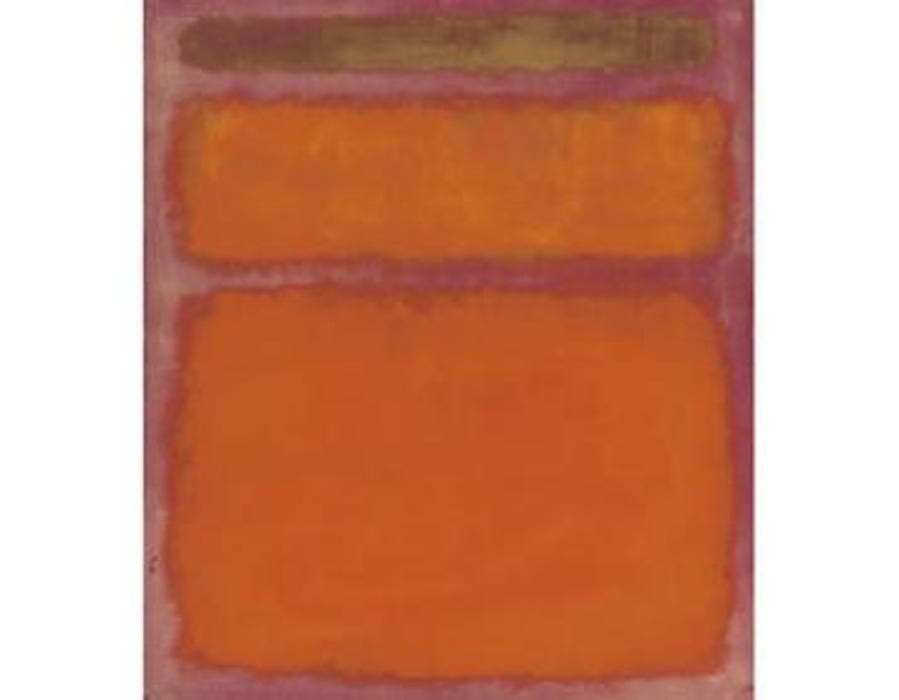
People cry in front of Mark Rothko paintings often enough that guards at major museums recognize the pattern. Rothko himself said that when viewers broke down crying in front of his pictures, it proved he was communicating the basic human emotions he was after.
His paintings are, on the surface, simple. Large rectangles of color stacked on a colored ground, with soft, blurred edges. He spent decades refining that formula specifically to produce an emotional reaction he compared to religious experience.
Born: Marcus Rothkowitz, September 25, 1903, Dvinsk, Russian Empire
Known for: Color Field painting, the Seagram Murals, the Rothko Chapel
Died: February 25, 1970, New York
More Stories From The Archive
Rothko is not the only painter who built an entire body of work around one feeling. A few more stories from the archive go looking for it in very different places.
What Rothko Actually Said About Tears
I used to think this was a joke people made about modern art, the crying in front of a rectangle thing. It is not a joke. It happens constantly, and Rothko built his entire late career around making sure it would.
Rothko was explicit that his subject was never color for its own sake. He said he was interested in expressing basic human emotions, tragedy, ecstasy, doom, and that if people wept in front of his work, they were having the same religious experience he had while painting it.
He famously said a painting is not a picture of an experience, it is the experience. That distinction matters. He did not want to depict sadness the way a 19th century painter might, with a grieving figure or a funeral scene. He wanted the canvas itself to produce the feeling directly.
The Man Behind Marcus Rothkowitz
Rothko was born Marcus Rothkowitz on September 25, 1903, in Dvinsk, then part of the Russian Empire and now Daugavpils in Latvia. His family emigrated to Portland, Oregon, when he was ten.
He did not start as an abstract painter. His early work included figures, city scenes, and subway paintings, closer to social realism than the color fields he became known for. The shift toward pure color took him roughly two decades to arrive at.
By the late 1940s, he had stripped his paintings down to two or three soft rectangles of color floating on a colored field, a format he would spend the rest of his career refining rather than abandoning for something new.
The Titles That Refuse to Help You
Rothko mostly avoided descriptive titles. Many of his paintings are simply numbered, or named for the colors they contain, Orange, Red, Yellow, No. 61, Black on Maroon. He wanted no title, no story, and no subject to give the viewer an easy shortcut past the color itself.
That refusal was deliberate. A title like Grief or Sunrise would tell you what to feel before you had felt anything. A number tells you nothing, which forces the response to come from the painting rather than from the label next to it.
It also means two people can stand in front of the same untitled canvas and walk away with completely different reactions, and neither of them is wrong. Rothko built that ambiguity into the work on purpose.
How He Built These Fields of Color
Rothko applied paint in thin, diluted layers, sometimes dozens of them, letting each one partially show through the next. That is why his colors seem to glow rather than sit flat on the canvas, they are built from translucent layers stacked over time, not a single coat of pigment.
The edges of his rectangles are deliberately soft and uneven, never taped off or ruled straight. That softness keeps the shapes from reading as hard geometry. They feel more like something breathing than something drawn.
He also insisted his paintings be hung low and viewed up close, often just a few feet away, so the color field fills the viewer's entire field of vision instead of being seen as a discrete object on a wall.
The Restaurant Commission He Refused
In 1958, Rothko accepted a lucrative commission to paint murals for the Four Seasons restaurant inside New York's new Seagram Building.
He worked on the project for more than two years and produced nearly 40 paintings, far darker in palette than his earlier work, heavy on maroon, dark red, and black.
In 1960, after visiting the finished restaurant, Rothko withdrew from the commission entirely. He was reportedly disgusted at the idea of his paintings hanging as decoration for wealthy diners eating expensive meals.
He refunded the commission and eventually donated the completed paintings to museums instead, including the Tate in London, which now holds a large group of the Seagram murals in a dedicated room.
The Chapel He Never Saw Finished
John and Dominique de Menil commissioned Rothko to create a series of paintings for a nondenominational chapel in Houston, built specifically to hold his work. The building has an octagonal floor plan, with fourteen dark, meditative canvases arranged around the walls.
Rothko wanted visitors to approach the paintings with the same fear and trembling a depiction of the Last Judgment might inspire in a church. He was not painting decoration. He was building an environment meant to trigger a specific, overwhelming state.
The Rothko Chapel opened in February 1971. Rothko never saw it finished. He died the year before it opened.
A Record Sale That Missed the Point
In May 2012, Rothko's 1961 painting Orange, Red, Yellow sold at Christie's in New York for 86.9 million dollars, at the time the highest price ever paid for a post war painting at public auction.
The buyer paid nearly double the low estimate for a canvas Rothko had refused to let hang in a restaurant a few years earlier because he did not want it treated as expensive decoration.
That contradiction, a painter who walked away from money to protect the emotional seriousness of his work, later becoming a symbol of extreme market value, is not lost on people who study his career. It is a genuinely strange afterlife for paintings built to resist being treated as objects.
The Science of Why Big Color Fields Hit This Hard
Part of the effect is scale. Rothko's canvases are large, often taller than a person, so standing close to one removes the frame from your peripheral vision. You stop looking at a painting and start being surrounded by color.
Large, slowly shifting fields of color trigger a different kind of perception than a detailed image does. There is no story to decode, no figure to identify, nothing for your analytical brain to grab onto. That absence pushes the response toward something more physical and immediate.
The philosopher Federico Campagna has described Rothko's paintings as instruments, tools that let a viewer glimpse something beyond language, beyond the usual work of interpreting an image.
That framing matches what museum staff actually observe, visitors standing silently in front of a single canvas for far longer than they can explain.
If you are curious how differently artists have handled overwhelming, hard to name emotion, the saddest paintings in art history looks at painters who went the opposite direction, using specific figures and scenes instead of pure color.
Not Everyone Cries, and That Is Fine
It is worth saying plainly that plenty of people stand in front of a Rothko and feel nothing in particular. That does not mean the painting failed or that the viewer is missing something everyone else has access to.
The paintings work on a slow, cumulative kind of attention. A quick glance while walking past a gallery wall is not the experience Rothko designed. The paintings need you to stop, get close, and give them a few uninterrupted minutes before anything happens.
His Final Years and Death
Rothko's health declined sharply in his final years, both physically and mentally. He was diagnosed with an aortic aneurysm in 1968 and was advised to stop working on paintings larger than a certain size, advice he mostly ignored.
His marriage was ending, his health was failing, and the darker palette of his final works, deep maroons, blacks, and grays, tracked closely with his declining state of mind.
On February 25, 1970, Rothko was found dead in his New York studio. He had taken his own life at 66 years old, months before the Rothko Chapel he had spent years designing finally opened to the public.
Why This Still Works on People Who Say They Don't Get Abstract Art
A lot of people walk into a Rothko room expecting to feel nothing and skip straight to the next gallery. Then they stop, usually without meaning to, and stand there longer than they planned.
That reaction does not require any background in art history. Rothko was not interested in being understood intellectually first. He wanted the color to reach you before your brain had time to ask what it means.
Whether or not you cry, that gap between seeing and understanding is exactly where Rothko wanted you standing. It is the entire reason the rectangles are soft, the canvases are enormous, and the paintings hang so close to the floor.
For more artists who built entire careers around a single, uncompromising idea, the greatest painters of all time and 10 artists you need to know are good next stops.
More Secrets to Unlock
FAQ
Why do people cry looking at Mark Rothko paintings?
Museum staff report it happening often enough to recognize the pattern. Rothko built his mature paintings, large color fields with soft edges, hung low and viewed up close, specifically to produce a direct emotional reaction rather than an intellectual one.
What was Rothko trying to express with his color field paintings?
He said he was after basic human emotions, tragedy, ecstasy, and doom, and compared the experience of making the work to a religious one. He wanted the painting to be the experience, not a picture of one.
Why are so many Rothko paintings untitled or just numbered?
Rothko avoided descriptive titles on purpose. A title like Grief or Sunrise would tell a viewer what to feel before they had felt anything, so he used numbers or color names instead, leaving the response open.
Why did Rothko walk away from the Four Seasons restaurant commission?
He completed nearly 40 paintings for the restaurant in the Seagram Building, then withdrew in 1960 after visiting the finished space.
He was reportedly disgusted at the idea of his work hanging as decoration for wealthy diners. He refunded the commission and donated the paintings to museums including the Tate.
What is the Rothko Chapel?
It is a nondenominational chapel in Houston, commissioned by John and Dominique de Menil, built around fourteen dark, meditative Rothko canvases arranged in an octagonal room. It opened in February 1971.
How did Mark Rothko die?
He was found dead in his New York studio on February 25, 1970. He had taken his own life at 66, months before the Rothko Chapel he had spent years planning finally opened to the public.