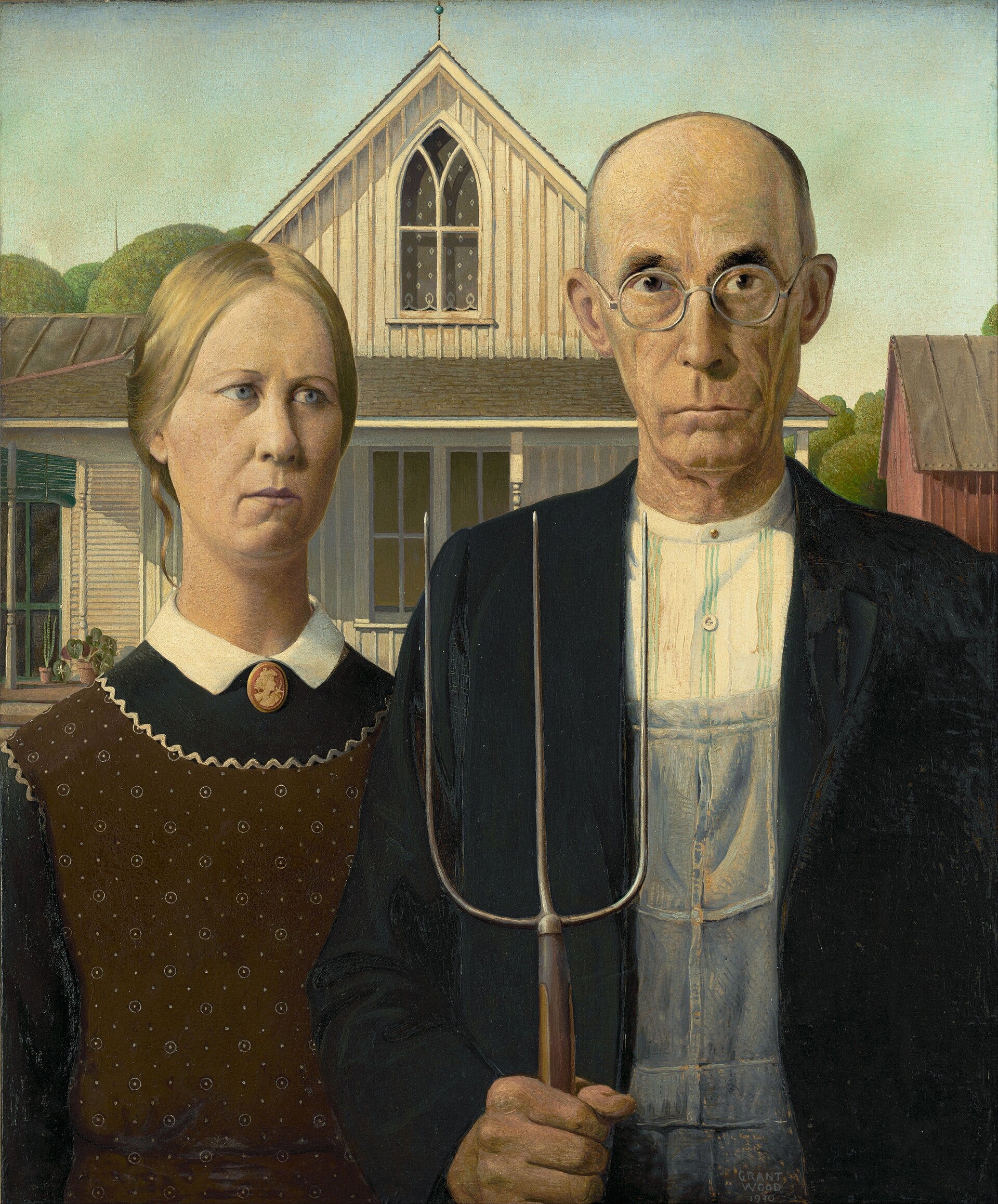
Why Is American Gothic So Famous?

American Gothic became famous because viewers assumed the two figures were a married couple, when Grant Wood said they were a farmer and his unmarried daughter, modeled by his dentist and his sister. Iowans first read the painting as an insult.

The title comes from the Carpenter Gothic window on the house behind them.

The thing people get wrong most often is the relationship between the two figures. Everyone assumes marriage, and Wood himself said it was a father and daughter. I find that mix up more interesting than the painting's supposed satire, because it shows how much viewers project onto a blank expression.

A small white wood framed farmhouse with a pointed upper window in Eldon, Iowa
The Dibble House in Eldon, Iowa, the real building behind the two figures in American Gothic.

Learn art the fun way. Free stories every week, no boring lectures.


The core of it

American Gothic is famous because almost everyone misreads it, and that confusion has kept people arguing about it for nearly a century.

Grant Wood painted a farmer and his adult daughter in 1930, in front of a small house he had spotted in Eldon, Iowa, while driving through the town on a summer afternoon.

Viewers assumed satire, then a married couple, then a symbol of stern American values, and the painting absorbed every one of those readings without ever confirming any of them. Nearly a hundred years later, people still argue about which reading is correct.

The Two People Are Not Married

Wood was clear that the pair are a farmer and his daughter, not husband and wife, though he rarely explained the painting in detail beyond that basic correction.

Most viewers still read them as a married couple at first glance, largely because of how close they stand and how serious their expressions are.

That mistaken assumption has followed the painting since its first public showing and still shows up in casual descriptions of the work today, even in captions that should know better.

A Dentist And A Sister, Not Farmers

Neither model actually worked the land. The man was Byron McKeeby, Wood's own dentist in Cedar Rapids, Iowa.

The woman was Nan Wood Graham, the artist's younger sister, who posed for many of Wood's paintings over the years and later wrote about the experience herself.

Wood dressed them in clothes he described as pulled from an old family photo album, to fit the mood he wanted rather than real farm work. Neither model spent much time posing, since Wood worked quickly from sketches and photographs.

A close view of the pointed Gothic style window on the upper floor of a wood framed house
The pointed Carpenter Gothic window that gave Grant Wood's painting its title.

Related Reads On American Art And Portraits


The Window That Named The Painting

The house behind the two figures is real, a small building in Eldon, Iowa, in a style known as Carpenter Gothic.

That style borrows pointed, church like windows and applies them to ordinary wood framed houses, a common detail across small Midwestern towns built in the late nineteenth century.

Wood spotted the window first, sketched the house on an index card, then built the rest of the painting, and its title, around that single architectural detail.

Satire Or Tribute

When American Gothic was first shown publicly in 1930, many urban viewers read it as a satire of narrow, small town life.

Wood insisted the opposite, that he intended a respectful, if severe, portrait of the rural Midwest and the work ethic he grew up around.

He never fully resolved the disagreement in public, and the painting has carried both readings at once ever since, without settling into either one. That refusal to explain is part of why critics still write new essays about it.

Open farmland under a wide sky in rural Iowa
The Iowa countryside Grant Wood said he meant to honor, not mock, with the painting.

Cool Stories About Art is a free newsletter. The stories behind the paintings, straight to your inbox.


Why Iowa Was Furious

Farmers and residents in Iowa were reportedly angry when the painting first circulated in newspapers, feeling mocked by its stiff, humorless figures.

One farm wife reportedly threatened to bite off part of Wood's ear over the depiction, a story that has become part of the painting's folklore.

Wood spent time afterward defending the work as sincere, not mocking, though the resentment among some Iowans took a while to fade. He pointed out that both models were Iowans themselves, not outsiders mocking the state from a distance.

From Local Controversy To National Symbol

The painting won a bronze medal and three hundred dollars when the Art Institute of Chicago acquired it in 1930, the year it was completed, after Wood submitted it to a juried exhibition almost as an afterthought.

Over the following decades it shifted from a regional curiosity into shorthand for American identity itself, used in advertising, political cartoons, and film.

Few American paintings have been reused this often across such different contexts, from magazine covers to protest posters, television parodies, and even museum gift shop merchandise.

Common Myths About American Gothic

One myth claims the pitchfork was meant as a threat. Wood more likely used it to echo the pointed lines of the window above the figures, tying the man's tool to the house's architecture.

Another myth says the woman is the farmer's wife. Wood specifically described her as his daughter, even though the painting itself offers no confirmation either way.

A third myth treats the painting as a straightforward joke. Wood's own statements suggest something closer to affection mixed with a very dry sense of humor, aimed at people he considered his own community.


Read another story


The American Gothic house in Eldon, Iowa
The Eldon, Iowa house behind the painting still stands today.

Frequently Asked Questions About American Gothic

  • Why is American Gothic so famous?
    It became famous partly through confusion: viewers read the two figures as a married couple, then as satire, when Grant Wood intended a farmer and his daughter. That ambiguity has kept the painting relevant far longer than a clear statement might have.

  • Are the people in American Gothic married?
    No. Grant Wood said they represent a farmer and his unmarried daughter, though many viewers still assume they are husband and wife.

  • Who posed for American Gothic?
    Wood's dentist, Byron McKeeby, posed as the farmer, and Wood's sister, Nan Wood Graham, posed as the daughter, both agreeing to sit for the artist they already knew well.

  • Why is it called American Gothic?
    The title comes from the Carpenter Gothic style window on the real house behind the figures, in Eldon, Iowa.

  • Is the house in American Gothic real?
    Yes. It is a small house in Eldon, Iowa, that Wood saw and sketched before building the rest of the painting around it.

  • Did Grant Wood intend American Gothic as satire?
    He said no, that he meant it as a sincere, if stern, portrait of rural Midwestern life, though many first viewers read it as mockery. He grew up in rural Iowa himself, which he pointed to as evidence of his intent.

  • How did Iowans react to American Gothic?
    Many were angry at first, feeling the painting mocked rural people, and Wood spent time afterward defending his intentions in public.

  • Where is American Gothic displayed now?
    It has been held by the Art Institute of Chicago since 1930, the year the museum first acquired it, and it remains one of the most visited works in the building.


Join 170,000 readers learning art the fun way. Free stories every week, no boring lectures.