Why Is Courbet's A Burial at Ornans So Famous?

A village funeral painted at the scale of history, with no saints and no heroes. This is the canvas that gave Realism its name.

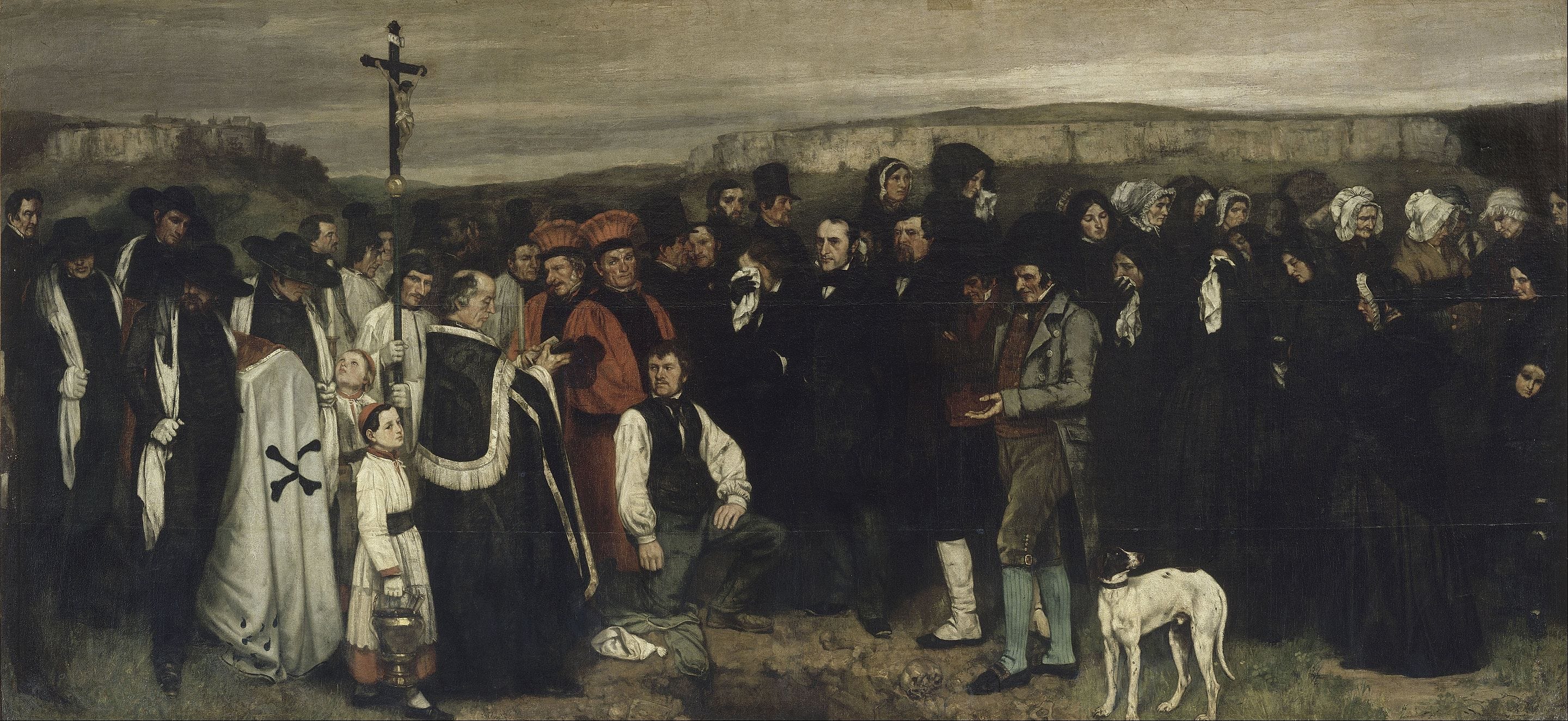
A Burial at Ornans became famous because Courbet gave an ordinary village funeral the scale of history painting, using real neighbors instead of ideal faces. When a jury later rejected the canvas for its size, he built his own pavilion to show it anyway.

Crowd of mourners around an open grave
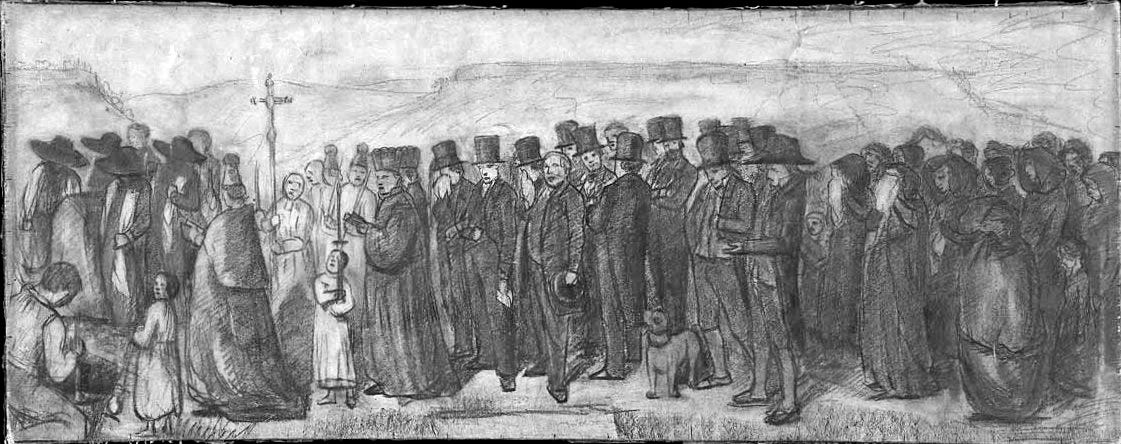
Gustave Courbet, A Burial at Ornans, 1849.

This one canvas turned a private family funeral in a small French town into one of the most argued about paintings of the 19th century.

Nothing in it is meant to look beautiful. That was exactly the plan.

  • Date: Painted in 1849 and 1850, shown at the Paris Salon of 1850 to 1851.

  • Medium: Oil on canvas, about 315 by 660 centimeters, over ten meters wide.

  • Location: Musée d'Orsay, Paris.


Learn art the fun way. Join 170,000 readers getting one painting and its story every week.


More Courbet and the Realists Around Him

If the scale of a village funeral surprised you, these stories follow other painters who forced their own era to look twice.


A Funeral for an Uncle, Not a Miracle

Courbet based the painting on the actual burial of his great uncle in Ornans, and refused every trace of religious comfort: no saints, no angels, no light breaking through the clouds, only a gray sky over an open grave and a village standing around it in silence.

Ornans sits in the Franche Comté region of eastern France, the town where Courbet was born and kept returning to paint people he actually knew.

The funeral shown is not a generic scene invented for effect. It is the burial of his own relative, staged with neighbors standing in for themselves rather than actors.

Two laborers breaking stones by a road
Gustave Courbet, The Stone Breakers, 1849.

Forty Life Size Neighbors, Not Actors

Roughly fifty townspeople from Ornans stand in the canvas at life size, each recognizable rather than idealized: Courbet's father and sisters, the local priest and mayor, gravediggers, and friends who actually stood at that grave, painted with the same blunt gray light he gave the sky.

Because the faces were recognizable, some of the real sitters were reportedly unhappy with how bluntly Courbet painted them, gray skin and all.

The Painter's Studio, finished five years later, returns to the same idea. Real people from Courbet's own life gather around him instead of invented figures filling out a composition.

Painter at his easel surrounded by figures
Gustave Courbet, The Painter's Studio, 1855.

Why the Salon Called the Faces Ugly

At the Paris Salon of 1850 to 1851, critics attacked A Burial at Ornans for its size, calling the faces ugly and the composition flat, because painting provincial nobodies at the scale of history painting broke an unwritten rule about which subjects deserved a monumental canvas.

Courbet's original French title was simply Un enterrement à Ornans, a flat, almost administrative label rather than a dramatic or religious one.

That plainness was itself part of the provocation. Grand history paintings carried grand titles. Courbet gave his the kind of title you would expect on a parish record.

The Painting That Named a Movement

A Burial at Ornans hung beside The Stone Breakers at the same Salon, and together the two paintings made Courbet the reluctant leader of Realism, a term critics coined to describe his refusal to paint anything grander than what he had actually seen.

He accepted the attention but resisted the label. To him, Realism was less a manifesto than a refusal to paint anything he had not seen with his own eyes.

Champfleury, a novelist and close friend of Courbet, defended the painting in print soon after the Salon, giving Realism a public vocabulary beyond Courbet's own blunt statements to journalists.

I find that friendship, more than any manifesto, is what actually carried Realism from one scandalized Salon into a movement with a name.

Bearded man in a dark coat
Étienne Carjat, Portrait of Gustave Courbet, 1861.

See art differently. 170,000 people read these free stories. Come find out why.


The Pavilion Courbet Built to Show It Anyway

When the jury for the 1855 Exposition Universelle rejected A Burial at Ornans for being too large, Courbet paid to build his own wooden exhibition hall next door, the Pavilion of Realism, and charged admission to see forty of his own paintings, effectively staging one of the first solo shows an artist ever organized for himself.

The gesture was unheard of. Painters exhibited inside the official Salon system, or they did not exhibit in Paris at all.

Courbet's pavilion lost money. Few visitors paid to see it, and critics mocked his self promotion.

But the idea stuck. Building your own venue and answering to no jury became a template historians later connect to the independent shows the Impressionists organized a generation afterward.

I think the pavilion is the real hinge of this story, not the shock of the funeral scene itself, but the fact that Courbet turned a jury's rejection into his own venue.

Courbet greeting a patron on a road
Gustave Courbet, Bonjour Monsieur Courbet, 1854.

Not an Attack on the Church, Courbet Said

Later readings often frame A Burial at Ornans as an attack on religion or the bourgeoisie, but Courbet pushed back on that himself, describing it simply as the burial of a man in Ornans and leaving the political reading to critics and historians rather than claiming it as his own intention.

The priest, the mayor, and the black clothing worn by the mourners have all been read as symbols of a fading rural order.

Courbet never confirmed any of it in his own letters. He described the picture in plain terms, as a funeral he had seen and then painted.

Bought by France Only After He Died

The French state left A Burial at Ornans out of its own collections for three decades, buying it only in 1881, four years after Courbet died in exile in Switzerland in 1877, and the canvas later moved to the newly opened Musée d'Orsay in 1986, where it hangs today.

Supporters made the case for keeping the painting in France once Courbet's estate was settled after his death.

It joined the rest of the nineteenth century collection when the Musée d'Orsay opened in a former train station in 1986.

Keep Reading About Art History

A few more stories worth your next ten minutes, including how one of Courbet's later paintings turned into a scandal of its own.


No boring lectures, ever. Join 170,000 readers learning art the fun way, free.


Frequently Asked Questions

  • What does A Burial at Ornans actually show?

    The funeral of Courbet's own relative in his hometown of Ornans, with about 50 real townspeople standing around the grave.

  • Why was the painting so controversial?

    Courbet gave an ordinary rural funeral the scale and seriousness of history painting, with no idealized faces. Critics saw that as an insult to the tradition.

  • How big is A Burial at Ornans?

    About 315 by 660 centimeters, over ten meters wide, one of the largest paintings of its kind at the time.

  • Where can I see A Burial at Ornans today?

    At the Musée d'Orsay in Paris, in the same rooms as many other Realist and Impressionist paintings.

  • When did A Burial at Ornans enter a public museum?

    The French state bought it in 1881, four years after Courbet's death. It moved to the Musée d'Orsay when that museum opened in 1986.

  • What was the Pavilion of Realism?

    The private exhibition hall Courbet built and funded himself in 1855, after the Exposition Universelle jury rejected A Burial at Ornans and his other large canvases for their size.


Ten minutes, one masterpiece. That is the deal. 170,000 readers already took it, free.