Why Is Flaming June by Leighton So Famous?

It nearly failed to sell for $140 in the 1960s. Today it might be the most photographed Victorian painting alive.

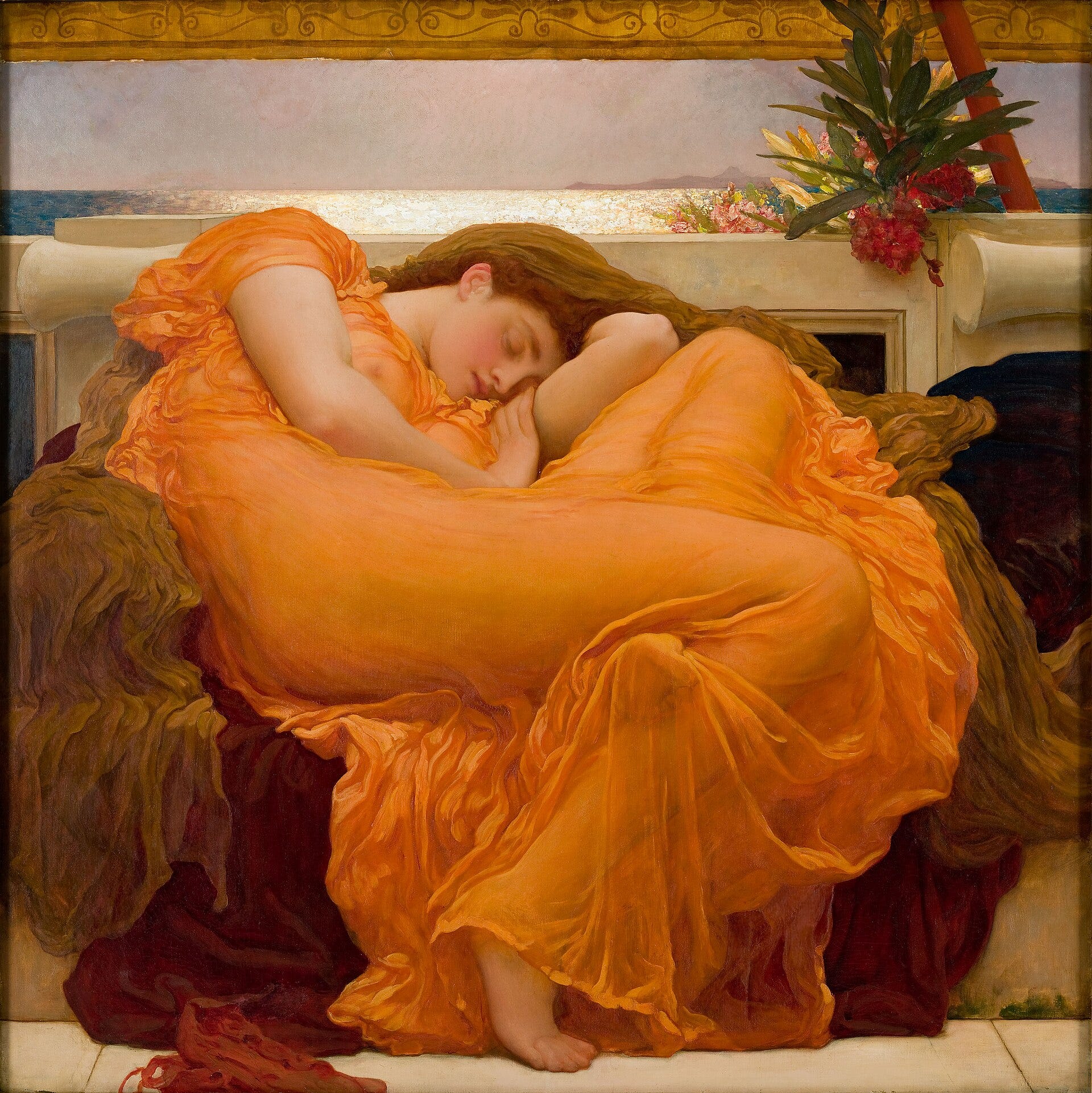
Flaming June is famous because it survived a story that should have ended it. Frederic Leighton painted this sleeping woman in 1895, the year before he died, and it vanished for decades before nearly being sold for 140 dollars in the 1960s.

Flaming June sleeping woman in orange dress
Frederic Leighton, Flaming June, 1895.

It disappeared from view in the 1930s and turned up boxed over a chimney in a London house before it nearly failed to sell at auction.

  • Painted: 1895, the year before Leighton's death

  • Nearly sold for: 140 dollars at a 1960s London auction, unsold

  • Now in: Museo de Arte de Ponce, Puerto Rico


Learn art the fun way. Join 170,000 readers getting one painting and its story every week.


More Faces Worth a Second Look

If Flaming June pulled you in, these dig into other faces worth knowing:


What Flaming June Actually Shows

A woman sleeps on a marble bench, curled into herself, wrapped in a dress the color of a lit match. The fabric is so thin you can see the shape of her leg through it, and Leighton painted every fold like he was rendering wet silk rather than paint.

Behind her, the sea catches the last of a sunset, so the whole canvas glows from within. In the top right corner, easy to miss on a first look, sits a small branch of oleander.

The canvas itself is a perfect square, about forty seven inches on each side. That format was unusual for a Victorian exhibition piece, and it forces your eye to circle around her rather than read the painting left to right the way you would a landscape.

Leighton did not set out to paint a full picture at all. The pose started as a decorative motif for the marble bath in an earlier work of his called Summer Slumber, and he liked the design enough that he built an entire canvas around it.

Leighton painting of a seated woman alone titled Solitude
Frederic Leighton, Solitude, circa 1890.

Leighton Was Racing His Own Death While He Painted Her

Frederic Leighton self portrait
Frederic Leighton, Self Portrait, 1880.

By the time Leighton began Flaming June, his body had already started failing him. His health broke down in 1894, he had been suffering attacks of angina since the previous autumn, and he stepped down as president of the Royal Academy that June because he could no longer carry the job.

He kept painting anyway. Flaming June, finished in 1895, is often described as showing no sign of that decline, no shake in the hand, no dimming of ambition.

Leighton died of angina pectoris on January 25, 1896, one day after officially becoming Baron Leighton, one of the shortest peerages in British history. His last words, by most accounts, were my love to the Academy.

He worked in his studio for the last time on January 22, three days before he died, still making drawings from a model that morning. I find that detail more moving than anything in the painting itself.

A man who knew he was dying spent his final working hours doing the one thing he had built his whole life around.

For the rest of his career, from history painting to running the Royal Academy, Frederic Leighton: The Complete Story covers the full arc.

A Pose Borrowed From a Tomb

Flaming June's curled, twisted position did not come out of nowhere.

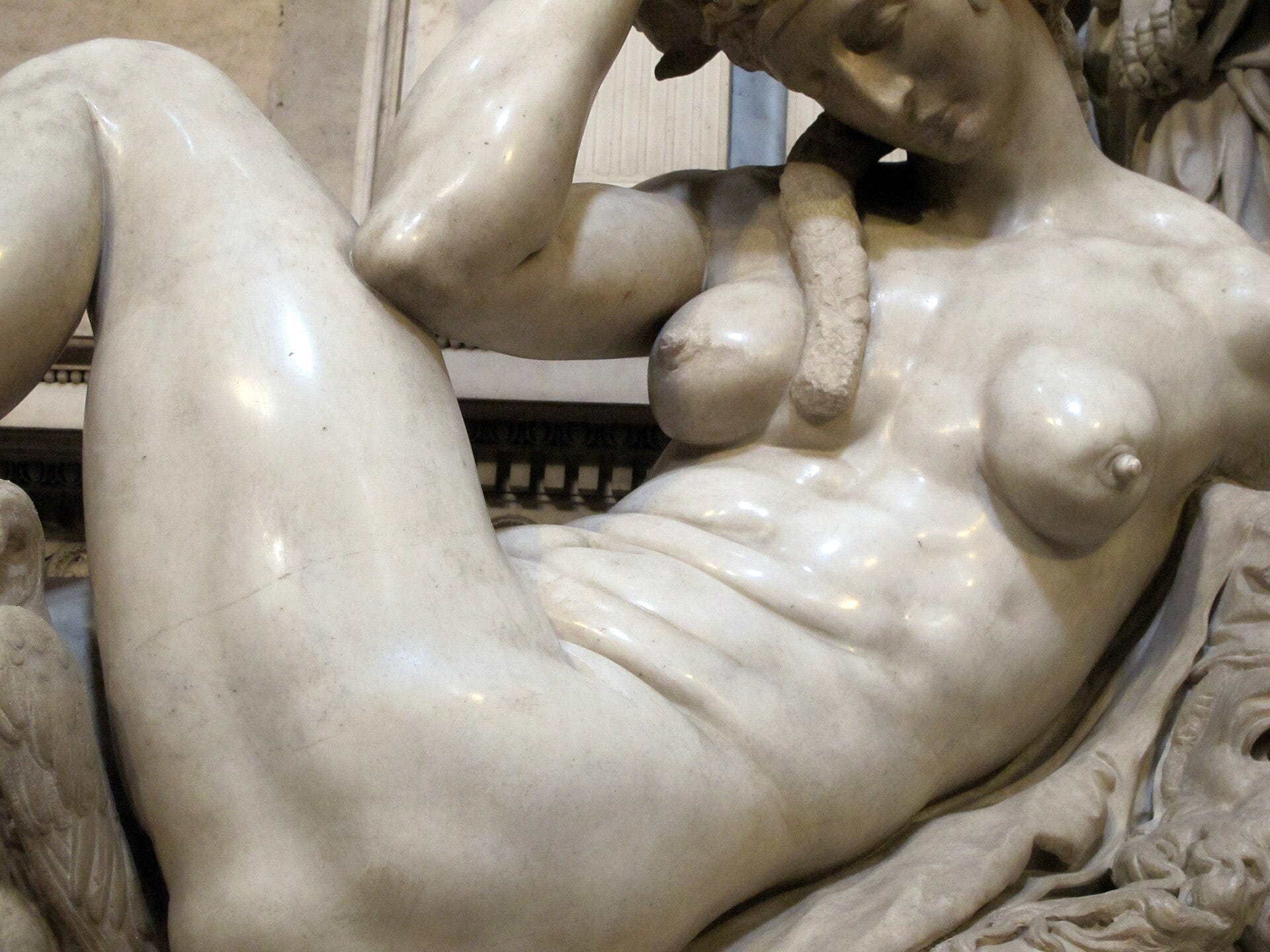
The art historian Andrew Graham Dixon has pointed out that the pose is loosely modeled on Michelangelo's sculpture of Night, in the Medici Tombs in Florence, a figure Leighton considered one of the greatest achievements in Western art.

Getting there took work. Leighton struggled for months with the angle of the sleeping woman's right arm, and his surviving sketches show at least four different attempts before he landed on the final version.

Four of those studies were nude. Only one was draped, and Leighton judged it the least convincing of the group, proof to him that painting from a real, unclothed model was the only way to get the anatomy right, even if the finished woman would be dressed head to toe.

Leighton had already explored a similarly contained, coiled body years earlier, in The Fisherman and the Syren, based on a ballad by Goethe.

Leighton painting The Fisherman and the Syren embracing figures
Frederic Leighton, The Fisherman and the Syren, circa 1856 to 1858.

This kind of academic classicism, borrowing poses and gravity from ancient sculpture and Renaissance masters, was Leighton's whole method. He was one of the last great defenders of that tradition before Modernism came along and made it look old fashioned almost overnight.

That same reliance on borrowed poses runs through most academic painting of the era, artists working the human body over and over until it stopped being a specific person and became pure form.

Frederic Leighton painting The Bath of Psyche, a standing classical female figure
Frederic Leighton, The Bath of Psyche, 1890.

The Oleander Hidden in the Corner

That small branch in the top right is oleander, and every part of the plant is toxic. Eating even a few leaves can stop a human heart.

Leighton was too precise a painter to include a detail like that by accident. Most readings connect the flower to the painting's central tension, a woman sleeping peacefully while a symbol of death sits just above her head, close enough to touch.

Victorian poetry leaned on that same pairing constantly, sleep as death's quiet cousin. Whether June is simply dreaming or something closer to dying is left open, and Leighton never explained himself, which is probably why the question still gets argued over more than a century later.

How Flaming June Nearly Disappeared for Good

The painting's first owner was not a collector but a magazine. The Graphic bought it in 1895 to produce a high quality print that it gave away as a Christmas gift that same year, which is part of why the image spread so widely before the original canvas vanished from sight.

When Leighton died in January 1896, the painting sat in the magazine's office window as his funeral procession passed below. It was loaned to the Ashmolean Museum in Oxford in the early 1900s, and after that, the trail runs cold.

Nobody seems to know exactly where Flaming June spent the next several decades. Victorian painting had fallen completely out of fashion by the 1930s, dismissed by critics and collectors alike as sentimental and overworked, and a painting can vanish fast once nobody wants to claim it.

The Near Miss in a London Chimney

The painting resurfaced in the early 1960s in a house in Battersea, found boxed in over a chimney during renovations.

It made its way to a gallery on the Kings Road, where, as the story goes, a teenage Andrew Lloyd Webber wanted to buy it for fifty pounds and his grandmother refused, calling it Victorian junk.

That story has been repeated by major museums and newspapers for years, though some art historians now question whether the timeline even allows for Lloyd Webber to have seen the painting when the story claims he did.

Either way, it is a good measure of how worthless Victorian painting looked to most people at that exact moment.

Flaming June went to auction not long after and failed to sell. Its reserve price was set at just 140 dollars, worth a little over 1,100 dollars today, and even that modest number could not find a buyer.

Luis Ferré Brings Her Home to Puerto Rico

Luis A. Ferré, a Puerto Rican industrialist who would be elected governor of Puerto Rico five years later, was touring Europe buying art for a museum he had just founded.

Accounts differ on the exact price and city, somewhere under a thousand dollars in Amsterdam by one record, roughly two thousand pounds from a London gallery by another, but every version agrees it cost next to nothing.

Ferré was reportedly warned against buying it. Victorian painting was still considered a poor investment in the 1960s and 1970s, decades before the market rediscovered painters like Leighton.

He bought it anyway and installed it in the Museo de Arte de Ponce, the museum he built to bring major European art to Puerto Rico. It became the anchor of the museum's British collection and, eventually, its single most recognized object.


One painting. One story. Every week. Free, with 170,000 readers who never sat through an art history lecture.


More Artists to Discover

A few more names and paintings worth your time:


No boring lectures, ever. Join 170,000 readers learning art the fun way, free.


FAQ

  • Who painted Flaming June? Frederic, Lord Leighton, an English painter and president of the Royal Academy, painted it in 1895, the year before he died.

  • What does the woman in Flaming June symbolize? There is no single agreed answer. Most readings connect her to sleep, rest, and the classical tradition of reclining figures, with the nearby oleander branch pulling the mood toward death as well.

  • Why is there a plant in the corner of Flaming June? The plant is oleander, which is toxic in every part. Art historians generally read it as a symbol tied to the closeness of sleep and death, though Leighton never explained the choice himself.

  • Where is Flaming June located today? The painting lives at the Museo de Arte de Ponce in Ponce, Puerto Rico, where it has been the museum's signature work since the 1960s.

  • How much is Flaming June worth? It has never been sold since Luis Ferré acquired it for the Museo de Arte de Ponce, so there is no confirmed market value, though insurance estimates tied to recent museum loans have placed it in the tens of millions of dollars.

  • Is the Andrew Lloyd Webber story about Flaming June true? It is widely repeated, including by major museums, but some art historians dispute whether the timeline actually allows for it. Treat it as a popular legend rather than a confirmed fact.

  • Why did Flaming June disappear for decades? Victorian painting fell out of critical favor after Leighton's death, and the canvas passed out of public view sometime after being loaned to the Ashmolean Museum in the early 1900s. It resurfaced by chance in a London house in the early 1960s.

  • What other paintings did Frederic Leighton make? Leighton painted for decades before Flaming June, including large scale classical and historical scenes such as processions and mythological subjects, though none reached the recognition Flaming June has today.


Ten minutes, one masterpiece. That is the deal. 170,000 readers already took it, free.