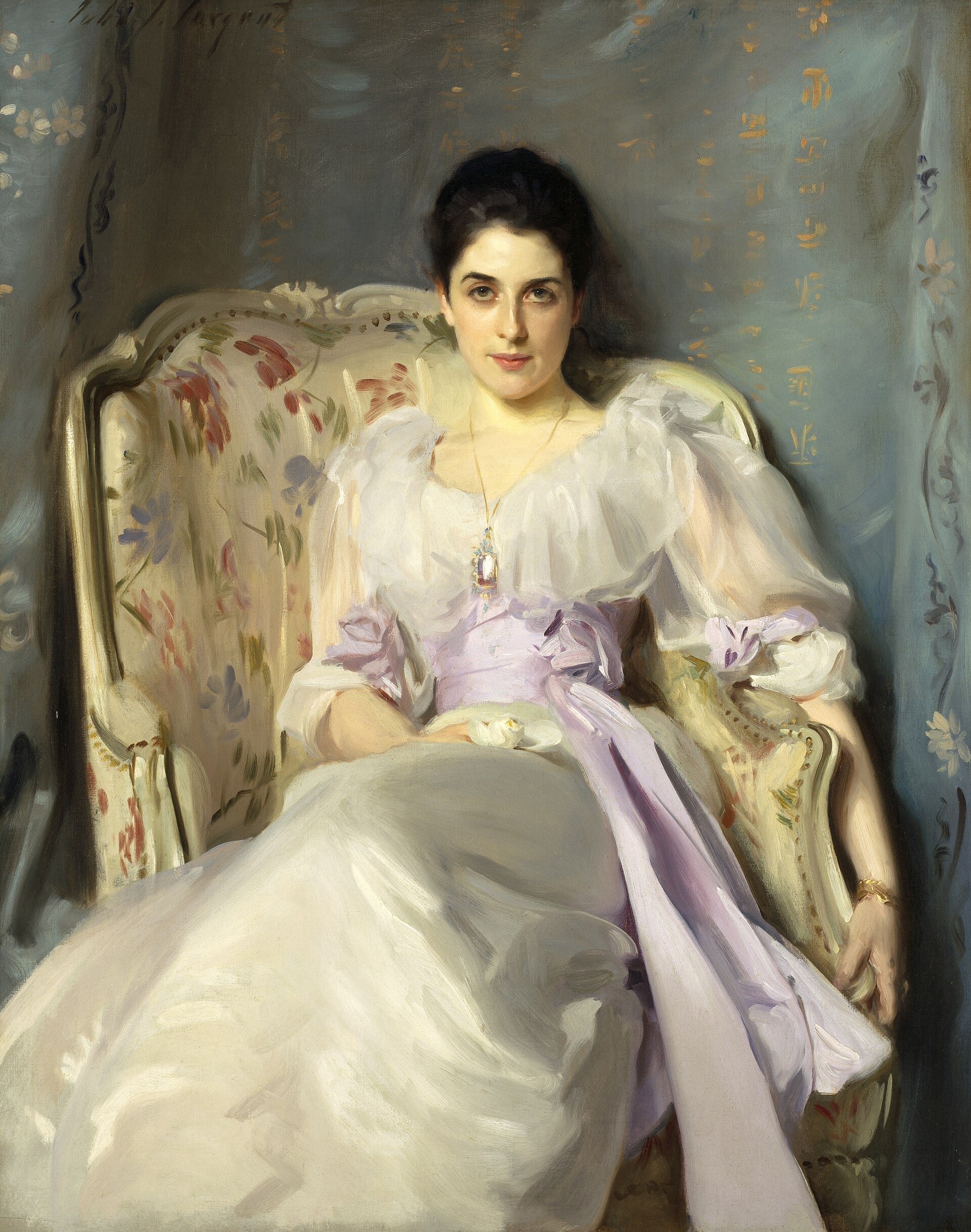
John Singer Sargent painted a woman who looks like she is about to speak, not pose. He finished it in six sittings in 1892, and it turned an unknown baronet's wife into the most talked about face in London.
The Royal Academy crowd could not stop talking about her direct gaze, and it changed Sargent's career overnight.
Painter: John Singer Sargent, working in London after leaving Paris in 1886.
Date: Painted in 1892, first exhibited at the Royal Academy in 1893.
Where to See It: Scottish National Gallery, Edinburgh.
Three More Portraits Worth Knowing
The ones I would send you to next.
Who Was Lady Agnew of Lochnaw?
Her name at birth was Gertrude Vernon. She was born in 1864, the daughter of the Honorable Gowran Vernon and the granddaughter of Robert Vernon, the first Baron Lyveden.
That placed her comfortably inside the English gentry without making her a household name. Robert Vernon had been an influential collector of British painting, donating a large body of work to the National Gallery in London decades earlier.
In 1889, she married Sir Andrew Noel Agnew, the ninth Baronet of Lochnaw Castle in Wigtownshire, Scotland. She was twenty five, recently married, and completely unknown outside her own social circle when Sargent painted her three years later.
That last detail matters. Lady Agnew was not a duchess or a famous beauty of the London stage. She was an ordinary aristocratic wife, and the portrait is precisely what turned her into someone people recognized on sight.
Her later life had its own quiet drama. She suffered ill health for a long stretch of years and died in London in April 1932, at sixty seven, decades after the portrait made her briefly one of the most discussed women in England.
Why Sargent Painted Her
Sir Andrew Agnew commissioned the portrait in 1892, most likely as a straightforward domestic commission, the kind wealthy husbands routinely paid for at the time.
Sargent's going rate for a three quarter length portrait that year was around five hundred pounds, a serious sum but nowhere near what he would later command.
Sargent himself was in an interesting position in 1892. Six years earlier, a very different portrait, of the Parisian socialite Virginie Gautreau, had scandalized the Paris Salon of 1884 because of its low cut black dress and provocative pose.
The backlash was severe enough that it effectively pushed Sargent out of France. He moved to London in 1886 and spent his first years there rebuilding a client list, one respectable sitting at a time.
If Sargent is new to you, I covered him briefly alongside other major names in 10 artists you need to know.
Sargent had trained in Paris under the portraitist Carolus Duran, who taught his students to work directly on the canvas in a single confident pass rather than building up a picture through careful underpainting.
That training is exactly what shows up in Lady Agnew's face and hands, and it is part of why his portraits from this period look so immediate compared to the more labored society portraits other painters were still producing.
By 1892 he had steady work in London but not yet the runaway reputation that would define the rest of his career. Nobody expected a routine family commission to become the picture of the year.
The Technique That Makes It Work
Sargent painted the whole portrait in six sittings, which was fast even for him. He seated Lady Agnew in an eighteenth century French bergere chair, dressed her in a plain white gown with a mauve silk sash.
Blue Chinese silk hangs behind her as the only real backdrop. Art historian Richard Ormond has described how Sargent used the curving back of the bergere as a kind of supporting frame around the sitter.
He called it a distinctive, languid elegance in the pose. The chair is not just furniture in this painting, it is doing compositional work.
The brushwork is loose almost everywhere except her face and hands, which are rendered with total precision. That contrast is a big part of why the painting still feels alive instead of varnished and frozen.
Even the frame got Sargent's attention. In an 1893 letter to Sir Andrew, he mentioned hunting down an old frame he thought might suit the picture, expensive at around twenty pounds.
The portrait still hangs today in that antique French rococo frame. According to Sargent biographers Richard Ormond and Elaine Kilmurray, Lady Agnew was convalescing from influenza during the sittings.
I actually think this detail improves the painting rather than explaining it away. A woman recovering from illness, sitting for hours, still managing that quizzical half smile, reads as more interesting than a healthy socialite performing charm on command.
The Reception at the Time
The portrait went on public view at the Royal Academy's Summer Exhibition in 1893. The reaction was immediate and loud, which was unusual for a portrait of someone nobody had heard of before that spring.
The Times reviewed it on 29 April 1893 and called it not only a triumph of technique but the finest example of portraiture, in the literal sense of the word, seen there for a long time.
The reviewer went further and used the word masterpiece, which newspapers of that period did not throw around casually.
The exhibition made Lady Agnew a minor celebrity in her own right. People went to the Royal Academy specifically to see her portrait, and society pages started mentioning her by name.
What Happened to Sargent's Career Next
The success of Lady Agnew's portrait likely helped Sargent get elected an associate of the Royal Academy the following January, a formal recognition that mattered enormously in the London art world of the 1890s.
From that point through the 1900s, Sargent became the portrait painter for anyone in London with the money to commission one. He painted politicians, industrialists, and aristocrats for the next two decades.
His fees climbed steeply from the five hundred pounds Sir Andrew Agnew had paid in 1892. By the early 1900s he was painting figures as prominent as American president Theodore Roosevelt.
If you want to see how Sargent stacks up against the rest of art history's most famous names, I wrote about that in the greatest painters of all time, and he belongs firmly in that conversation for portraiture alone.
What is easy to miss is that Sargent grew to resent the very career this painting launched. He spent his final years trying to escape portrait commissions entirely to focus on landscapes and murals instead.
He once compared portrait painting to something close to a trade he was ashamed of. Success at painting Lady Agnew bought him money and fame, and eventually he wanted out of the profession that made him famous.
Where the Painting Is Today
Lady Agnew of Lochnaw hangs in the Scottish National Gallery in Edinburgh, in its original antique French rococo frame. The museum bought it in 1925 through the Cowan Smith Bequest Fund.
Before it settled permanently in Edinburgh, the painting had already traveled. It was shown at Copley Hall in Boston in 1899 and again at the Carnegie Institute in Pittsburgh in 1924.
The sale itself has a slightly sad backstory. Lady Agnew's finances did not age as well as her portrait did.
The National Galleries of Scotland has noted that the cost of sustaining her social position eventually forced her to sell the painting that made her famous in the first place.
Before selling to Edinburgh, she reportedly tried to sell the portrait to the Frick Collection in New York in 1922. Helen Clay Frick turned the offer down.
Three years later, Lady Agnew sold it to the Scottish National Gallery for four thousand pounds, worth roughly two hundred ten thousand pounds today, and asked that the title be changed from the plain Lady Agnew to Lady Agnew of Lochnaw.
The Detail Most Articles Skip
Most quick summaries of this painting mention the direct gaze and the loose brushwork and stop there. What they usually leave out is how close the portrait came to leaving Britain entirely.
First through the failed Frick sale, and how differently art history might read this painting if it had ended up in New York instead of Edinburgh.
They also tend to skip the influenza detail, probably because saying she was sick does not sound as glamorous as saying she broke Victorian portrait conventions on purpose.
I think the illness angle is the more honest explanation for why the pose feels so natural. She was not performing relaxation. She was too tired to sit up straight, and Sargent, wisely, decided not to correct that.
The other thing that rarely gets mentioned is the price arc. Sir Andrew paid around five hundred pounds for a family commission in 1892.
By 1925, financial pressure forced his widow to sell that same canvas for four thousand pounds, a figure that says as much about the cost of keeping up appearances in aristocratic circles as it does about the painting's rising reputation.
If you enjoy stories about a single painting changing an artist's fortunes overnight, the most stolen paintings in history has a similar arc, where a single object ends up mattering far more than anyone expected when it was made.
More Women Artists Worth Discovering
A few more places to go from here.
FAQ
Who is the woman in Lady Agnew of Lochnaw?
She is Gertrude Vernon, who married Sir Andrew Noel Agnew, ninth Baronet of Lochnaw Castle in Wigtownshire, Scotland, in 1889. Sargent painted her in 1892, three years into her marriage.
When was Lady Agnew of Lochnaw painted?
Sargent painted it in 1892 and it was first exhibited publicly at the Royal Academy in London in 1893.
Where is Lady Agnew of Lochnaw located today?
It hangs in the Scottish National Gallery in Edinburgh, which purchased it from Lady Agnew herself in 1925.
Why is Lady Agnew of Lochnaw considered so important?
It broke with the stiff, formal conventions of Victorian portraiture through its direct gaze and loose brushwork, and its success at the Royal Academy in 1893 launched Sargent's career as London's leading society portrait painter.
How long did John Singer Sargent take to paint it?
He completed the portrait in six sittings, which was considered fast even by his own standards.
What is Lady Agnew wearing in the portrait?
She wears a plain white gown with a mauve silk sash, seated in an eighteenth century French bergere chair against a backdrop of blue Chinese silk.
Was Lady Agnew really sick when she sat for the painting?
According to Sargent biographers Richard Ormond and Elaine Kilmurray, she was convalescing from influenza during the sittings, which may explain the relaxed languor of her pose.
How much is Lady Agnew of Lochnaw worth today?
There is no recent market valuation since it is a permanent museum holding, but Lady Agnew sold it to the Scottish National Gallery in 1925 for four thousand pounds, equivalent to roughly two hundred ten thousand pounds today.