Why Is Las Meninas So Famous? The Full Story

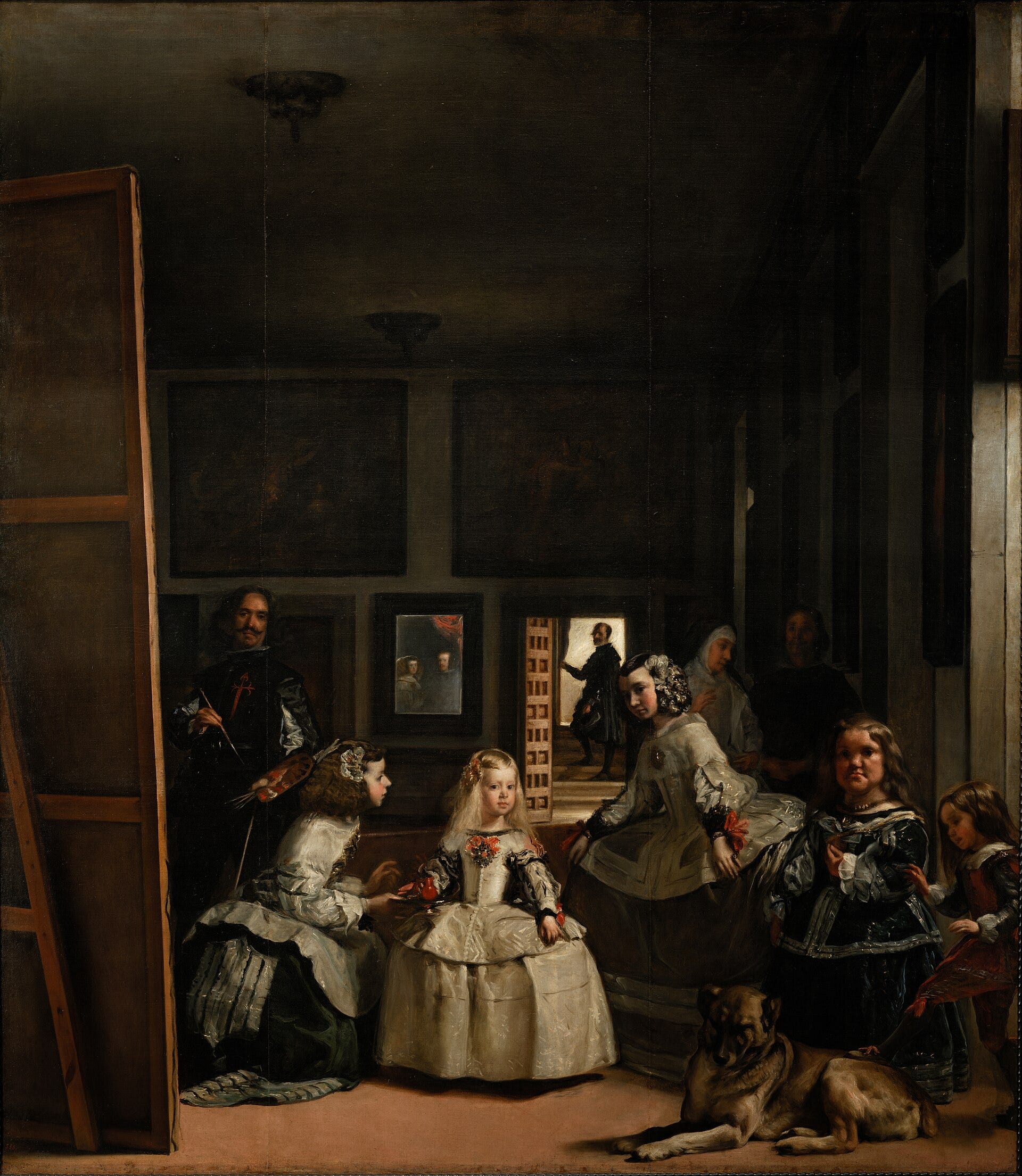
Las Meninas is famous because Velazquez placed himself inside the scene, painting a huge canvas while looking straight at the viewer. The king and queen appear only as a small reflection in a mirror, so the viewer stands exactly where they once stood.

Scholars have debated its meaning for centuries.

I think the reason Las Meninas keeps winning arguments is simple: it never lets you settle into being a spectator. Most portraits ask you to look. This one makes you occupy a spot, the spot of the king and queen, and it never tells you what to do with that. Four centuries of critics have tried to pin it down and none of them agree, which is usually the surest sign a painting earned its fame honestly.

Las Meninas by Diego Velazquez, full court scene with the Infanta Margarita at the center
Las Meninas, 1656, oil on canvas, Museo del Prado, Madrid.

Learn art the fun way. Free stories every week, no boring lectures.


A Court Portrait That Breaks Its Own Rules

In 1656, Diego Velazquez was the official painter to King Philip IV of Spain, with a career built on formal court portraits.

Las Meninas was supposed to be another one, a record of the five year old Infanta Margarita Teresa surrounded by her maids of honor.

Instead Velazquez turned the whole room into a puzzle, and that puzzle is why the painting still gets talked about four centuries later.

Close detail of the small mirror on the back wall of Las Meninas showing the reflected king and queen
The mirror reflection of King Philip IV and Queen Mariana, the detail scholars still debate.

The Mirror Trick That Changes Everything

On the back wall, barely visible in the gloom, hangs a small mirror.

Inside it are the reflected faces of King Philip IV and Queen Mariana, the two people the painting seems to be about.

They are not standing in the room with everyone else. They are standing where you are, which means the viewer has quietly been placed on the throne.

Detail of Diego Velazquez standing at his easel inside Las Meninas, looking out at the viewer
Velazquez painted himself at the easel, brush raised, staring back at whoever stands in front of the canvas.

Velazquez Paints Himself Painting

To the left, Velazquez shows himself at a canvas so large it could only be Las Meninas itself, brush raised, looking straight out at whoever stands in front of the painting.

No royal portraitist before him had put himself so prominently inside a royal scene, doing his job, staring back at his own audience.

It reads less like a portrait and more like a claim: the painting is not simply a record of the people in the room, it is proof that the painter made the room possible.


If Las Meninas Pulled You In, Try These


The Infanta at the Center, Everyone Else in Orbit

Margarita Teresa stands lit and central, flanked by her meninas, the maids of honor who give the painting its name.

Around her: two court dwarfs, Maria Barbola and Nicolasito Pertusato, a chaperone whispering to a bodyguard, and in the far doorway a chamberlain caught mid step on the stairs.

Every figure is doing something specific and slightly unclear, which is part of why viewers keep coming back to work out what actually happened in that room.

Three Centuries of Arguing About What It Means

Historians have never agreed on the exact moment Las Meninas captures.

Is Velazquez painting the king and queen, who stand where the viewer now stands? Or is he painting Margarita and her entourage, caught watching her parents pose?

The art historian Jonathan Brown called it Velazquez's culminating work, and generations of scholars have tried to settle its geometry without ever fully agreeing.


Cool Stories About Art is a free newsletter. The stories behind the paintings, straight to your inbox.


The Philosopher Who Turned It Into a Chapter

In 1966, the French philosopher Michel Foucault opened his book The Order of Things with a long reading of Las Meninas, using it to describe how representation itself works.

His chapter turned a Spanish court portrait into required reading in philosophy departments, far outside any art history classroom.

Pablo Picasso made his own extended series of paintings reworking the composition in 1957, now held together in a dedicated room at the Museu Picasso in Barcelona.

Exterior of the Prado Museum in Madrid
Las Meninas hangs in its own room at the Prado Museum in Madrid.

From the Alcazar to the Prado

Las Meninas hung in the private chambers of the Alcazar palace in Madrid, close to Philip IV, who reportedly visited it often while Velazquez worked.

It survived a major fire that destroyed much of the Alcazar in 1734, and was later moved to the Prado Museum, where it remains today.

The Prado gives it its own room, angled so visitors can stand exactly where Velazquez placed the king and queen, four centuries after he painted them there.

Why It Still Wins the Argument

Most 17th century court portraits recorded status and stayed quiet about it.

Las Meninas keeps asking the viewer a question it never answers: who is actually being painted here, and where do you fit in the scene?

No restorer, photograph, or digital reconstruction has ever fully closed that gap.

That open question, argued over by philosophers, copied by Picasso and Dali, and hung today where millions pass through the Prado each year, is the plainest reason the painting never stopped being famous.


Discover more art stories


Las Meninas Questions People Also Ask

  • Is Las Meninas really about the king and queen?
    Not entirely. On the surface, Velazquez is painting the young Infanta Margarita Teresa and her household inside the royal workshop. The king and queen only appear as a small reflection in the mirror on the back wall, standing exactly where the viewer now stands, which is why historians still argue about who the true subject of the painting actually is.

  • Where can I see Las Meninas today?
    The painting hangs in the Prado Museum in Madrid, where it has its own dedicated room. It arrived there in the 19th century after the Prado opened, following its earlier home in the royal Alcazar palace, and it remains one of the most visited single paintings in Spain.

  • How big is Las Meninas?
    It measures roughly 3.2 meters by 2.76 meters, close to life size. That scale matters, because standing in front of the actual canvas puts you almost inside the room Velazquez painted, at the same height as the figures looking back at you.

  • Who is the dwarf and the dog in the painting?
    The two figures in the foreground are Maria Barbola, a dwarf who served the royal household, and Nicolasito Pertusato, another court dwarf shown nudging a sleeping mastiff with his foot. Dwarfs held real positions at the Spanish court and appear in several of Velazquez's other paintings, not just this one.

  • Why does Velazquez paint himself in the picture?
    By placing himself at the easel, brush raised and eyes on the viewer, Velazquez makes the act of painting part of the subject rather than something hidden behind the canvas. It is widely read as a statement about the status of painters at the Spanish court, where Velazquez spent years trying to be recognized as more than a craftsman.

  • What is the man in the doorway doing?
    That is Jose Nieto Velazquez, the queen's chamberlain, caught pausing on a staircase in the far doorway, backlit and half in shadow. His exact role in the scene, whether entering, leaving, or simply framing the composition, is still debated by historians.

  • Did Michel Foucault really write about Las Meninas?
    Yes. His 1966 book The Order of Things opens with a long chapter analyzing the painting's structure of looking, using it to explore how representation itself functions. That chapter is one of the main reasons Las Meninas is studied in philosophy courses as well as art history.

  • Is Las Meninas the most analyzed painting in history?
    It is one of the most written about paintings in Western art, with centuries of conflicting interpretations that have never fully settled. Picasso alone made an entire series reworking it, and it remains a fixture in art history, philosophy, and even mathematics courses on perspective.


Join 170,000 readers learning art the fun way. Free stories every week, no boring lectures.