
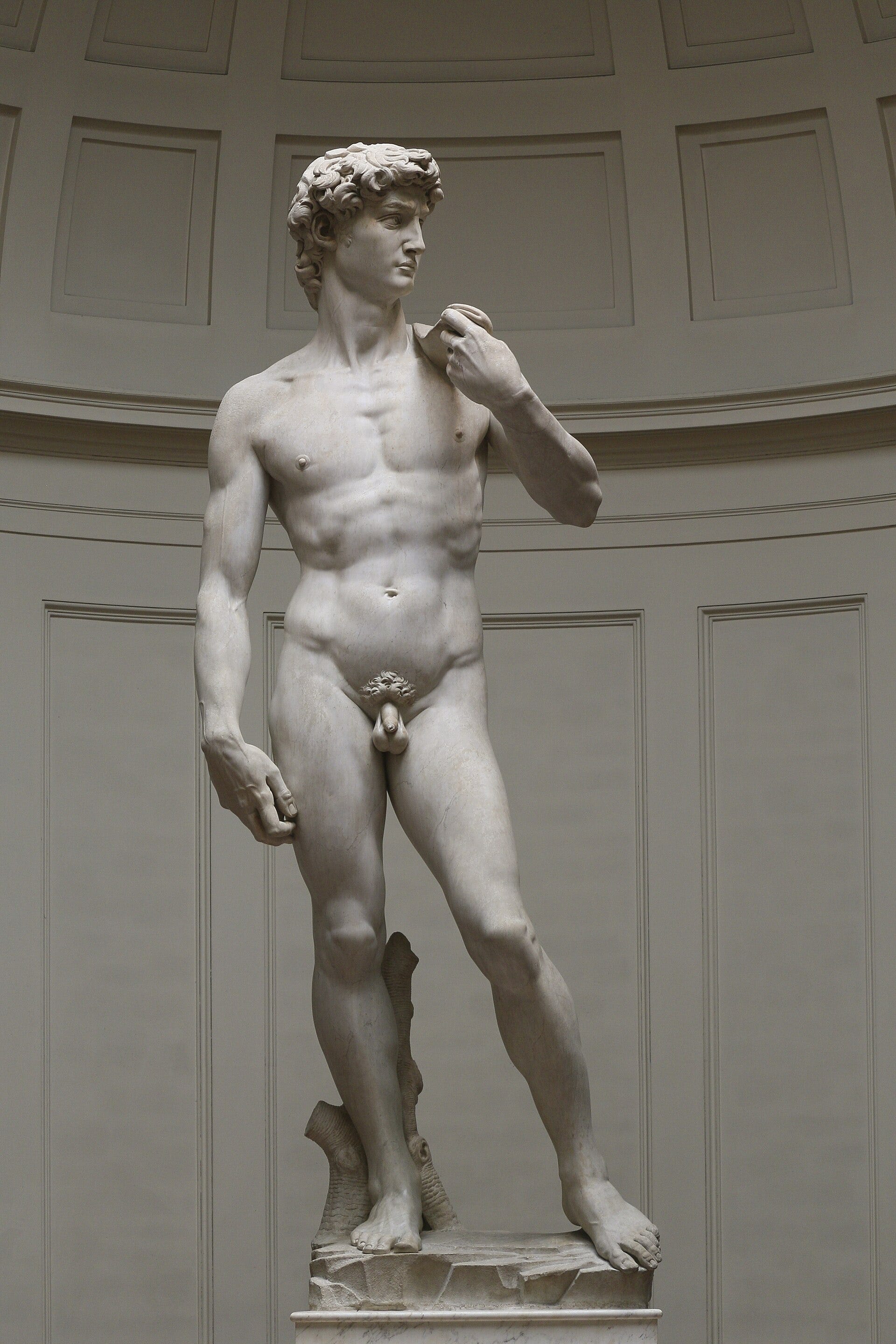
Michelangelo's David owes its fame to a choice Florence made in 1504. Carved for a spot high on the cathedral roofline, the statue went instead to the door of the city's government, as the emblem of Florence.
Michelangelo was twenty-six when he began it in 1501, on a marble block two sculptors had given up on. The rescued block, the tense moment the figure shows and the dramas that followed it did the rest.
Cool Stories About Art is a newsletter to learn art the fun way.
Join 200,000+ readers and get:
10 new art stories / month
The entire archive of content (140+ articles)
Comment, ask questions, and chat with other readers
In the Bible, David is the young shepherd who kills the giant Goliath with a single stone from his sling, and Florence loved the subject. Michelangelo's version stands 5.17 meters tall, about 17 feet, nearly three times the height of a man.
The original now stands in the Accademia, a museum in the center of Florence, which counted 2,013,974 visitors in 2023, a record.
Those crowds come to see a statue that nobody in Florence set out to make a symbol. Its marble was a leftover, and its story begins nearly forty years before Michelangelo touched it.
The cathedral of Florence, with its great brick dome, was looked after by a board called the Opera del Duomo. In 1464 the Opera wanted a series of large biblical figures for the buttresses high along its roofline, and it hired the sculptor Agostino di Duccio to carve a David for one of them.
Agostino roughed out little more than the legs and left. Twelve years later a second sculptor, Antonio Rossellino, took over the block and backed out almost at once, complaining of the poor quality of the stone.
After that the half-carved slab lay outdoors for about twenty-five years. In 1501 an official took stock of it and wrote of "a certain man of marble, named David, badly blocked out and laid on its back in the courtyard," roughly cut, in other words, and lying flat.
Two names before his
That same year the cathedral board turned back to the abandoned David, and Michelangelo was not the only artist whose name came up. Before he signed anything, two other men had a connection to the block, and one of them was the painter of The Last Supper.
What You'll Discover
Who wanted it kept under cover.
What happened the night it moved.
What David is about to do.
What broke its arm and its foot.