Why Is Nighthawks So Famous?

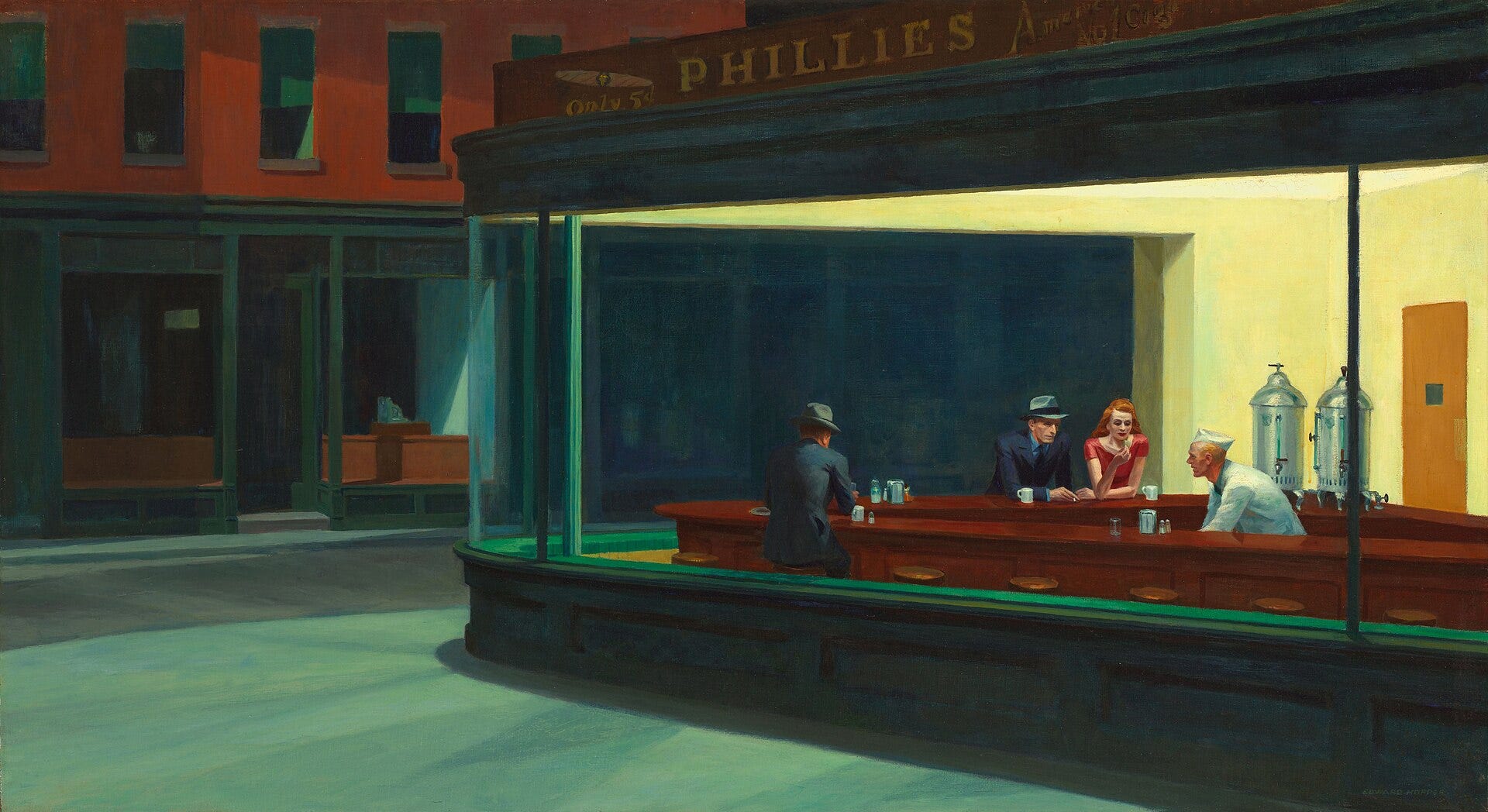
Nighthawks became famous because Hopper built a diner with no visible door, sealing four strangers behind glass for the viewer to watch. He said he had not consciously painted loneliness, only a big city at night.

Finished weeks after Pearl Harbor in 1941, it has hung at the Art Institute of Chicago since 1942.

What strikes me about this painting is how little actually happens in it. Four people, a counter, some coffee cups, and somehow it became the picture every American film about isolation borrows from. Hopper never explained it much, and I think that silence is exactly why it still works.

A lit corner diner with large glass windows on an empty city street at night
A New York diner storefront of the kind that inspired Hopper's Greenwich Village setting.

Learn art the fun way. Free stories every week, no boring lectures.


Quick take

Nighthawks is famous because it turned an ordinary late night diner into a portrait of urban isolation, using a composition with no visible entrance.

Edward Hopper finished it in 1941, just weeks after the attack on Pearl Harbor, and the painting has stayed in the American imagination ever since.

It has lived at the Art Institute of Chicago since 1942, and remains one of the most reproduced and parodied paintings from the United States. Few American paintings show up this often outside of art museums.

A Diner With No Door

Look closely and there is no visible entrance into the diner. The glass wraps around the corner with no handle, no hinge, no way in.

That single choice traps the four figures inside a lit box, sealed off from the empty street outside, even though nothing physically blocks them.

Viewers become outsiders looking in, unable to join the scene even if they wanted to, which is part of why the mood feels so airtight. Hopper also stripped away most street clutter, so nothing distracts from that sealed feeling.

Hopper's Own Words On Loneliness

Hopper himself often resisted the reading that Nighthawks was about loneliness. He said he had not painted it consciously, that he was probably unconsciously painting the loneliness of a large city.

That phrase, an unconscious rendering of urban isolation, has followed the painting ever since, quoted in nearly every serious essay written about the work. His wife Jo Hopper, who often modeled for him, kept detailed notes on the painting's progress.

Whether intentional or not, the mood is unmistakable to almost everyone who sees it, regardless of what the artist claimed about his own process.

A street corner in Greenwich Village, New York, near where Hopper lived and worked
Greenwich Village, the neighborhood Hopper loosely drew on for the diner's setting.

Related Reads On Edward Hopper And American Art


The Real Diner Behind The Scene

Hopper based the setting loosely on a diner near his own apartment in Greenwich Village, on Greenwich Avenue in New York.

He did not copy the location exactly. Like most of his work, it is an invented composite built from real city corners he knew well, assembled from years of walking the same New York streets.

That mix of real observation and invention is typical of how Hopper worked throughout his career, blending specific places into scenes that feel universal. He often sketched storefronts and street corners for years before folding them into a single finished composition. It is a pattern that runs through his full story as a painter, long before this particular diner made him famous.

An empty nighttime street corner with streetlights and no visible pedestrians
The empty street outside the diner carries as much of the painting's mood as the figures inside.

Painted In The Shadow Of Pearl Harbor

Hopper completed Nighthawks in January 1942, only weeks after the bombing of Pearl Harbor pulled the United States into the Second World War.

Cities across the country were adjusting to blackout rules and a new sense of unease. Empty streets were suddenly a familiar sight rather than an artistic choice, and coastal cities in particular took the threat seriously.

The painting reads today as a quiet response to that moment, even though Hopper rarely discussed politics directly in his work or his letters. Later writers connected the mood of the painting to the general anxiety of a country entering a war.

The stone exterior facade of the Art Institute of Chicago, home to Nighthawks since 1942
The Art Institute of Chicago, where Nighthawks has hung since the museum bought it in 1942.

Cool Stories About Art is a free newsletter. The stories behind the paintings, straight to your inbox.


At The Art Institute Of Chicago Since 1942

The museum purchased Nighthawks the same year Hopper finished it, for three thousand dollars, a modest sum by today's standards and a small fraction of what the work would fetch if it ever went to auction.

It has remained in the Art Institute of Chicago's collection ever since, and is now one of the museum's most visited works.

Millions of visitors have stood in front of that diner counter since it first went on display, many recognizing it before they even read the label. It regularly ranks among the museum's most photographed works.

The Most Parodied American Painting

Nighthawks has been reworked more than almost any other American painting, appearing in advertising, film, comics, and countless art parodies.

Artists have swapped in celebrities, cartoon characters, and even themselves at the counter, while keeping the same glowing diner and empty street.

That endless reuse is its own kind of tribute, a composition simple enough to borrow and specific enough to still be recognized instantly, even stripped of color. Very few paintings survive that much reworking without losing their identity.

Common Myths About Nighthawks

One myth is that Nighthawks shows a real, identifiable diner that still exists somewhere in New York. It does not, the building is an invention built from memory.

Another myth claims Hopper painted himself and his wife as the couple at the counter. There is no confirmed evidence for that reading beyond speculation.

A third myth treats the painting as a direct illustration of Pearl Harbor. Hopper never described it that way, even though the timing lines up closely, and he generally avoided explaining his paintings in specific historical terms.


More worth your time


Frequently Asked Questions About Nighthawks

  • Why is Nighthawks so famous?
    It compresses urban loneliness into one diner scene with no visible door, painted by Edward Hopper just after Pearl Harbor in 1941. Decades of reuse in film and advertising have only reinforced how recognizable it is.

  • Is there a door in Nighthawks?
    No. The diner's glass wraps around the corner with no visible entrance, which is part of what makes the scene feel sealed off.

  • What did Edward Hopper say about the meaning of Nighthawks?
    He said he had not consciously painted loneliness, and that he was probably unconsciously painting the loneliness of a big city.

  • Is the diner in Nighthawks a real place?
    It is loosely based on a diner near Hopper's Greenwich Village apartment on Greenwich Avenue, though the exact building is an invention.

  • When was Nighthawks painted?
    Hopper finished it in January 1942, weeks after the attack on Pearl Harbor.

  • Where is Nighthawks displayed today?
    It has been part of the Art Institute of Chicago's collection since 1942, the year the museum bought it.

  • How much did the Art Institute of Chicago pay for Nighthawks?
    The museum purchased it for three thousand dollars in 1942, shortly after Hopper completed it.

  • Why has Nighthawks been parodied so often?
    Its simple, instantly recognizable composition, a lit diner and an empty street, is easy to rework while staying immediately identifiable, which makes it a favorite target for advertising and film homage.


Join 170,000 readers learning art the fun way. Free stories every week, no boring lectures.