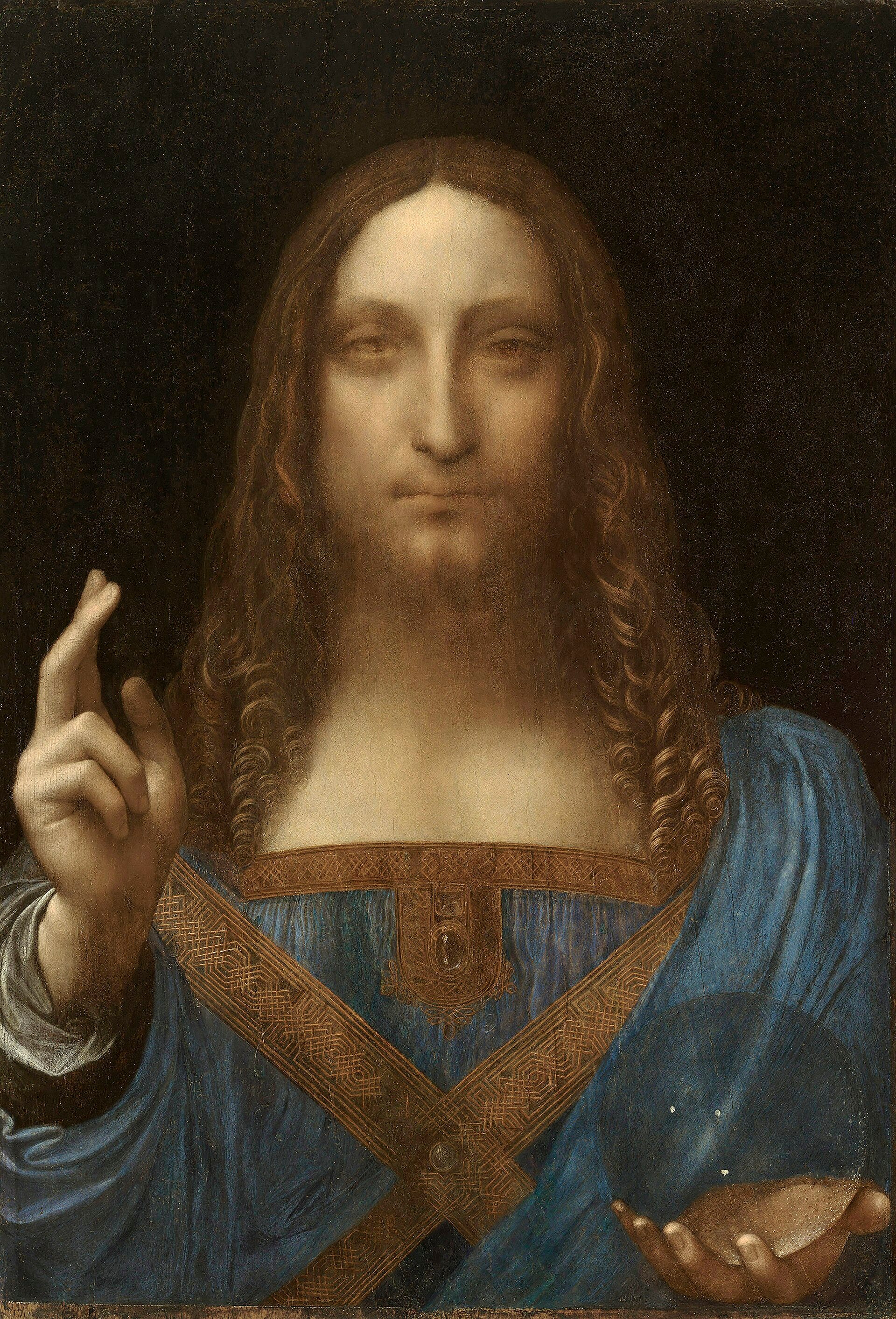
Salvator Mundi sold at Christie's in New York in 2017 for 450.3 million dollars, the highest price ever paid for a painting at auction. Its attribution to Leonardo da Vinci is disputed, but its rarity, its restoration story, and its marketing as the last available Leonardo drove the record.
What strikes me about this painting is that the price says more about scarcity than about the brushwork itself.
Date: Painted around 1500, sold in 2017.
Medium: Oil on walnut panel.
Price: 450.3 million dollars at Christie's, New York.
More Renaissance stories worth reading
If a record breaking, disputed Leonardo caught your attention, these go further.
The Painting: Christ Holding the World
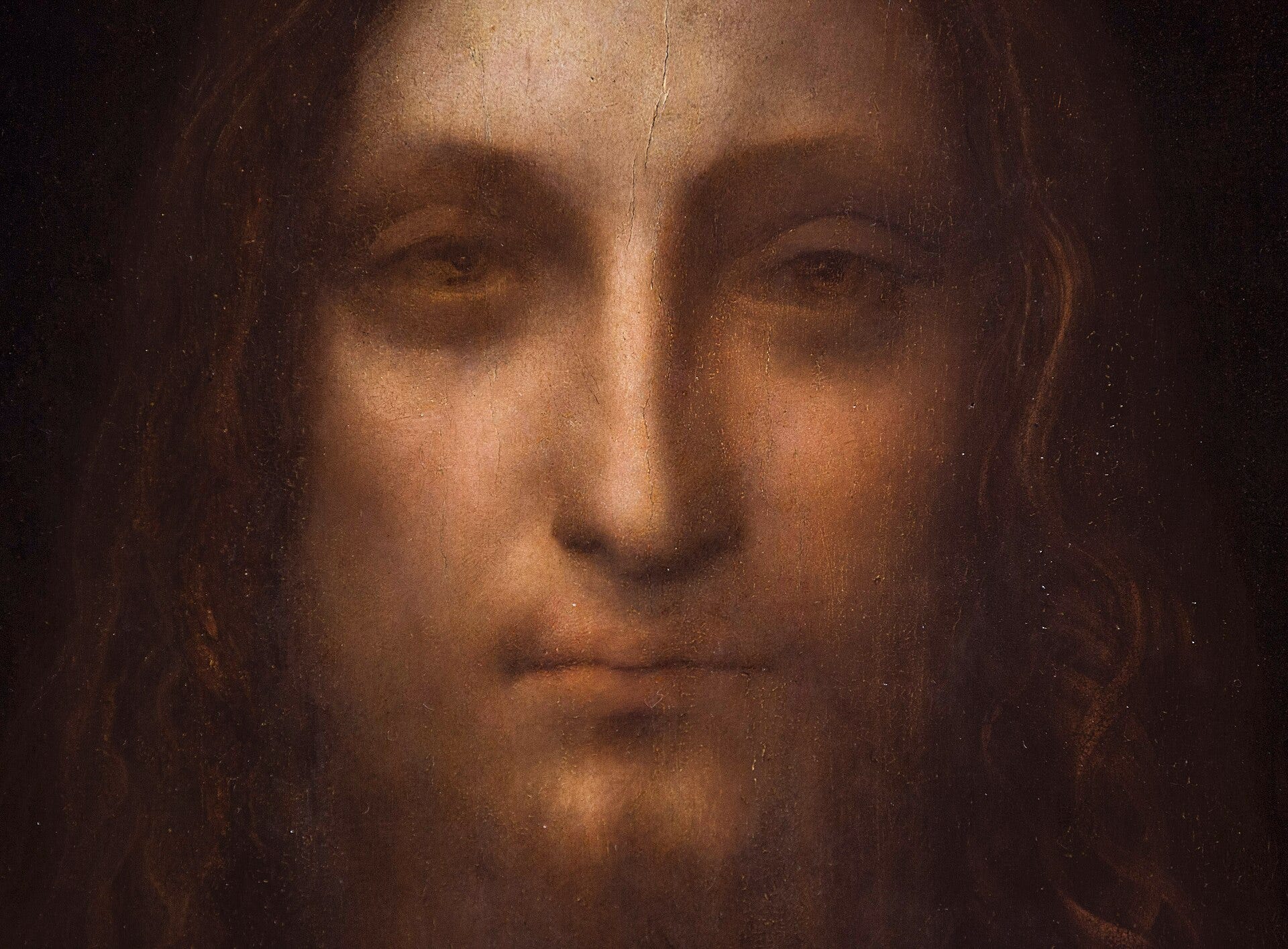
Salvator Mundi shows Christ facing forward, one hand raised in blessing, the other holding a crystal orb representing the world. The composition follows a long tradition of Salvator Mundi paintings by other artists, but the quality of the hands and the sfumato in the face are what drew attention back to Leonardo himself.
Christ's curls fall in tight symmetrical waves, a detail scholars compare to Leonardo's own late drawings of flowing water and hair, subjects he studied obsessively side by side in his notebooks.
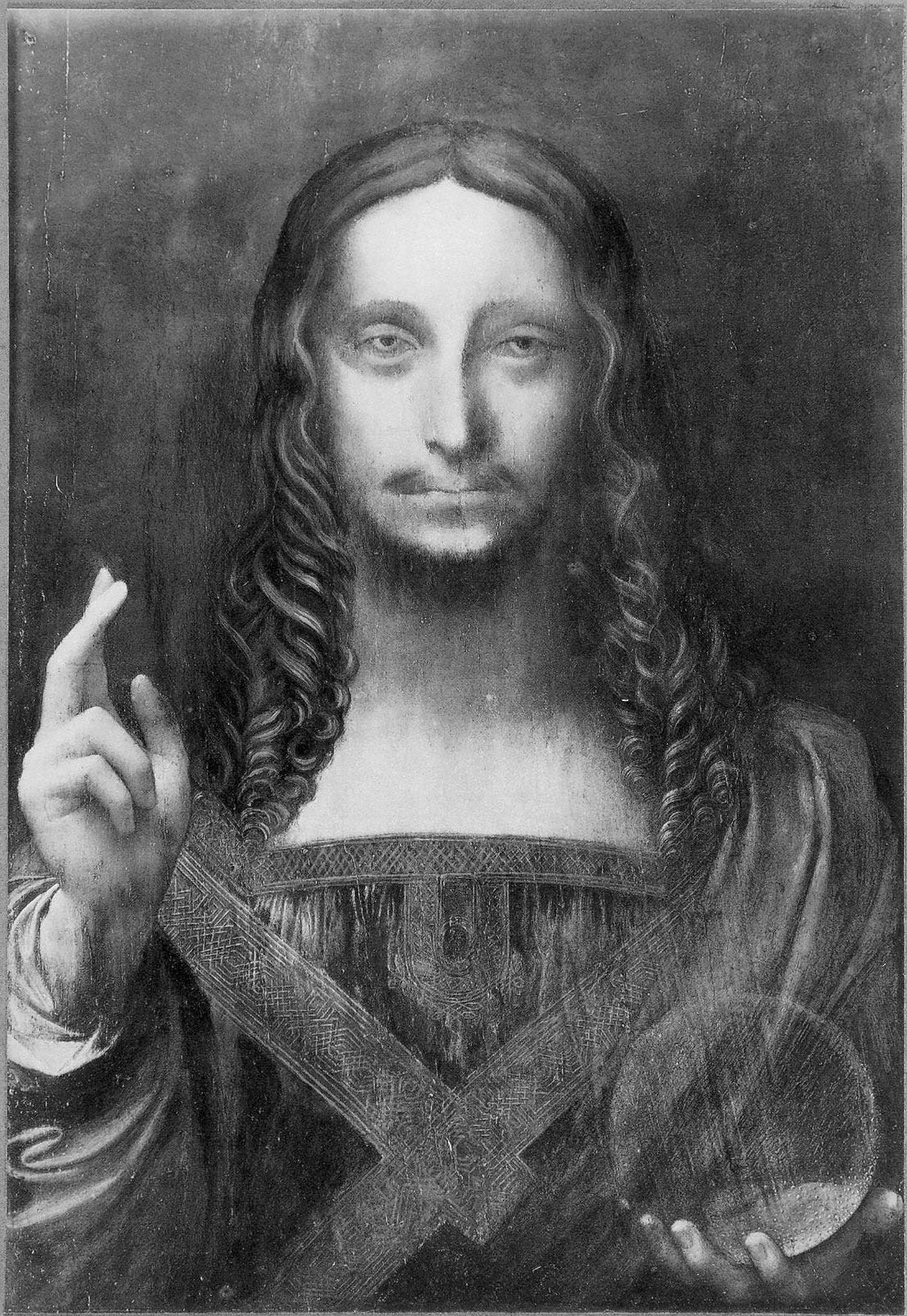
Infrared imaging of the panel has also revealed pentimenti, small changes Leonardo made to the thumb's position as he worked, the kind of adjustment usually associated with an artist inventing a composition rather than copying one.
Leonardo's presumed self portrait, drawn late in his life, shows the same interest in careful modeling through light and shadow that specialists point to in the panel's face.
From 45 Pounds to the Record Sale
The panel was heavily overpainted and damaged for centuries, selling at auction in 1958 for just 45 pounds as a copy by a follower of Leonardo. Provenance records trace it back to King Charles I of England in the 1600s, and a 1900 buyer misattributed it to Bernardino Luini, a mistake that held for decades until restorer Dianne Modestini began stripping away the overpaint starting in 2007.
I find the jump from 45 pounds to nine figures the single strangest fact in the entire art market. Nothing else moved this far this fast.
Modestini has written and spoken publicly about the restoration in unusual detail for a conservator, including how much of the final surface reflects her own reconstruction rather than paint Leonardo's own hand laid down five centuries earlier.
The 1958 sale catalogue did not even list Leonardo's name in the main heading, a detail auction historians still cite as a reminder of how far attributions can swing across a single lifetime.
A small group of dealers bought the panel in 2005 and had it restored over several years. In 2011, it appeared in the National Gallery's Leonardo exhibition in London, a moment that pushed its attribution and its value into public view. Several specialists still dispute that it is fully autograph.
Why One Painting Can Break Records
Only around twenty paintings are universally accepted as autograph works by Leonardo, and nearly all of them already hang in museums. The Mona Lisa will never be sold, which is part of why Salvator Mundi was marketed as the last Leonardo anyone could actually buy, pushing two phone bidders into a prolonged war at Christie's.
Two telephone bidders pushed the price far past presale estimates that had put the painting at around 100 million dollars, a gap that stunned even seasoned auction watchers in the room that night. What strikes me is that gap between the estimate and the final price. That is not two bidders pricing a painting, that is two bidders pricing each other.
Christie's marketed the sale with an unusually large advertising campaign for an Old Master painting, including a world tour of the panel through Hong Kong, London, San Francisco and New York before the auction itself.
Christie's staged the sale as a historic event. The bidding war ended at 450.3 million dollars including fees, a figure no other painting has matched since.
A Quiet Sale Before the Record One
Russian collector Dmitry Rybolovlev bought Salvator Mundi privately in 2013 for around 127.5 million dollars, through Swiss dealer Yves Bouvier. Four years later, he sold the same painting at Christie's for 450.3 million dollars, a nearly fourfold increase that later became part of a separate legal dispute between Rybolovlev and Bouvier over how the earlier sale had been handled.
The legal dispute between Rybolovlev and Bouvier eventually widened into a string of lawsuits across several countries, tied to a wider pattern of purchases the collector said he had overpaid for through the same dealer. To me, that widening dispute says the real story here was never just about one canvas. Once lawyers get involved, the painting becomes a side character in its own sale.
More From Cool Stories About Art
Where Is Salvator Mundi Now
Since the 2017 sale, Salvator Mundi's location has largely stayed private, and it has not been shown to the public. The Louvre left it out of its own 2019 Leonardo retrospective marking 500 years since the artist's death, and a planned 2018 unveiling at the Louvre Abu Dhabi was postponed with no new date ever given.
Lady with an Ermine, another Leonardo painting from roughly the same era, remains on public display, a contrast to Salvator Mundi's disappearance from view.
Journalists and researchers have floated several possible locations over the years, from a Saudi royal yacht to a climate controlled storage facility, none of them confirmed by the owners themselves.
Reports at the time of the Louvre show pointed to disagreements over how the museum would present the attribution, and the painting's current owners did not lend it.
A Crystal Orb That Breaks Its Own Optics
Christ holds a solid crystal orb meant to represent the heavens, but several scientists and art historians have pointed out that a real sphere of that size would visibly bend and invert light passing through it. The orb in the painting shows almost none of that distortion, a detail read either as evidence against Leonardo's careful study of optics, or as a deliberate simplification.
The orb detail is the one that keeps me skeptical. Leonardo studied optics obsessively elsewhere in his work, which makes this omission harder to wave away.
Leonardo's notebooks elsewhere show detailed studies of refraction and reflected light, which is exactly why the orb's flat, undistorted surface stands out to specialists who know the rest of his scientific work.
Some defenders counter that Leonardo may have simplified the orb deliberately, favoring symbolic clarity over strict optical accuracy in a devotional image meant to be read at a glance rather than studied like a scientific diagram.
A Modest Panel for a Record Price
The panel measures about 66 by 45 centimeters, smaller than many people expect given the price it eventually commanded. Walnut was a common support for Italian panel paintings of this period, chosen for its fine, stable grain rather than any symbolic connection to the subject.
Walnut panels of this size were common workshop stock in Renaissance Milan and Florence, which is part of why some skeptics argue a well trained assistant could have produced comparable work on the same kind of support.
Standing in front of a panel that size, most visitors describe it as an intimate, quiet object rather than the kind of grand statement its price tag suggests, closer in feel to a private devotional image than a public monument.
FAQ
Who painted Salvator Mundi?
The painting is attributed to Leonardo da Vinci, though several specialists dispute that attribution and argue it may be largely the work of an assistant or a later restorer.
How much did Salvator Mundi sell for?
Christie's sold it in November 2017 for 450.3 million dollars including fees, the highest price ever paid for a painting at auction.
Who bought Salvator Mundi?
Prince Badr bin Abdullah placed the winning bid, reportedly on behalf of Saudi Crown Prince Mohammed bin Salman.
Where is Salvator Mundi now?
Its location has largely been kept private since the 2017 sale. It has not been shown publicly, which keeps the attribution debate alive.
Why is Salvator Mundi so rare?
Only around twenty paintings are universally accepted as autograph works by Leonardo, and almost all of them already sit in museums. A Leonardo in private hands is exceptional.
Why do some experts doubt the Leonardo attribution?
Critics point to inconsistencies like the crystal orb's missing optical distortion, and to the centuries of overpaint and restoration that make it hard to know how much of the surface is original Leonardo work.