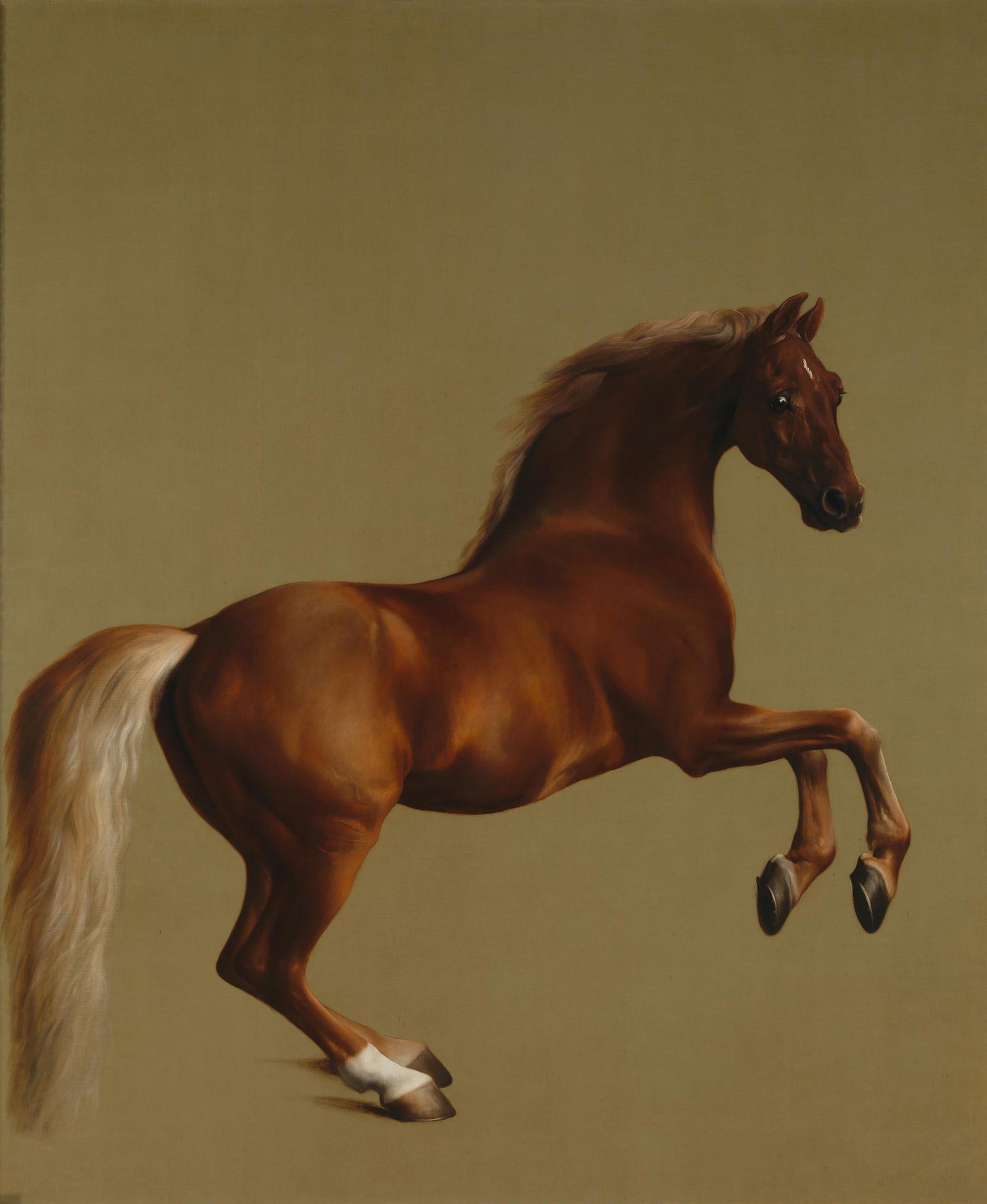
George Stubbs painted a rearing Arabian racehorse in 1762 against a completely empty background. No rider, no landscape, nothing but the horse's own muscle and motion. Whistlejacket is one of the largest and most studied horse portraits ever made.
Nearly life size, the horse rises up on its hind legs, ears back, one front hoof pawing at the air. Stubbs gives it nothing to stand in front of, no stable, no field, no owner in the saddle.
Date: 1762.
Medium and size: Oil on canvas, 292 by 246.4 centimeters.
Location: National Gallery, London.
More Painters Who Broke With Tradition
Stubbs was not the only artist willing to strip a subject down to almost nothing. These stories cover others who did the same.
A Real Racehorse With a Real Name
Whistlejacket was not an invented or idealized horse. He was a real Arabian bred stallion, owned by the second Marquess of Rockingham, and already a winning racehorse at York in 1759 before Stubbs painted him in 1762. The portrait records a specific champion, not a generic ideal of a horse.
Whistlejacket was an actual Arabian bred racehorse, owned by the second Marquess of Rockingham, one of the most prominent racehorse breeders of his day.
The horse had already won real races before Stubbs painted him, which makes the portrait less a fantasy and more a record of a specific, celebrated animal.
No Rider, No Landscape, No Explanation
Many descriptions call Whistlejacket unfinished because it has no rider and no background. I do not think that holds up: Stubbs painted a shadow beneath the horse's rear hooves, a detail historians point to as proof the picture was completed exactly as intended, empty background and all.
Equestrian portraits from this period almost always included a rider, a landscape, or some marker of status. Stubbs gives Whistlejacket none of that, just a plain background the color of old parchment.
Historians have never fully agreed on why. Some think a portrait of King George III on the horse's back was planned and never finished. Others think Stubbs and Rockingham simply preferred the horse alone.
A Painter Who Studied Horses Like a Surgeon
Before painting a single commission, Stubbs spent about eighteen months dissecting horse carcasses in a rented Lincolnshire farmhouse, suspending and studying each layer of muscle himself. That anatomical training is why Whistlejacket's rearing pose reads as physically correct rather than decorative, down to how the muscles shift under the skin.
Before Whistlejacket, Stubbs spent about eighteen months dissecting horses to understand exactly how muscle, bone, and tendon worked underneath the skin. He published the results in 1766 as The Anatomy of the Horse.
That research shows up directly in the painting, in how convincingly the muscles shift as the horse rears.
What strikes me about that discipline is how invisible it is meant to be. You are not supposed to notice the anatomy lesson, only feel that the horse is real.
One Theory About a Missing King
The leading theory holds that Rockingham first commissioned Whistlejacket to carry King George III on its back, a painting meant as political flattery. A falling out between the two men is often blamed for why the king was never added. I find the shadow evidence more convincing than either story.
The most persistent theory is that Rockingham originally commissioned the painting to include George III riding Whistlejacket, meant as a political gesture. A falling out between the two men is sometimes credited with why that figure was never added.
The Most Expensive Old Master Bought in Decades
The National Gallery in London bought Whistlejacket in 1997 for 11 million pounds, using Heritage Lottery Fund money after the Fitzwilliam family, heirs to the Rockingham estate, finally sold it. At the time, it was a record price for an old master painting bought by a British public collection.
The National Gallery in London acquired Whistlejacket in 1997 for a price that set a record at the time for an old master painting, cementing its place as one of the most valuable horse portraits in existence.
More Stories Behind Famous Paintings
A subject stripped down to almost nothing can still carry a painting. These stories show how.
Posed on a Platform, Not in a Field
Stubbs painted Whistlejacket from life, not from sketches. Grooms held the horse still inside a barn at Wentworth Woodhouse, on a raised platform built for the sitting, so daylight could fall on the animal without a rider, saddle, or landscape competing for attention.
Stubbs painted Whistlejacket from a horse posed inside a barn at Wentworth Woodhouse, the Marquess of Rockingham's Yorkshire estate, on a raised platform built specifically so the animal could be studied in full daylight without a rider or landscape around it. Grooms held the horse in position for hours at a time while Stubbs worked, a process he repeated for each of the large scale portraits he painted for Rockingham during that period.
Built on Eighteen Months of Dissection
Stubbs turned his Lincolnshire dissections into The Anatomy of the Horse, an atlas he wrote, illustrated, and engraved himself, published in 1766. Whistlejacket, painted several years earlier, already carries that same precision, proof the research came before the book rather than after it.
Before painting horses professionally, Stubbs spent about eighteen months dissecting horse carcasses in a rented farmhouse in Lincolnshire, working largely alone to understand muscle and bone beneath the coat.
That research became The Anatomy of the Horse, published in 1766 with engravings Stubbs made himself. Whistlejacket, painted a few years earlier, already shows the same precise understanding of how a rearing horse's muscles actually sit under the skin.
A Painting Almost Exported
Whistlejacket stayed at Wentworth Woodhouse for more than two centuries. When the Fitzwilliam family sold it in the 1990s, the British government placed a temporary export bar on the painting, giving the National Gallery time to raise the money and keep it from leaving the country where it was painted.
Whistlejacket stayed at Wentworth Woodhouse for more than two centuries after Stubbs finished it. When the family finally sold it in the 1990s, the British government placed a temporary export bar on the painting to give a public buyer time to raise the money.
The National Gallery in London launched a fundraising campaign, secured the sum in 1997, and has kept Whistlejacket on permanent display ever since, the rare case of an export threat ending with the painting staying in the country where it was made. The campaign drew donations from thousands of members of the public alongside major grants, an unusually broad base of support for a single old master purchase.
To me, that ending fits the painting. A horse painted with nothing to prove ended up being the one thing London refused to let leave.
A Technique Built to Last
Whistlejacket has needed remarkably little restoration since 1762. Stubbs ground and mixed his own pigments and prepared his own canvases, a habit that helped the paint layer survive more than two hundred and sixty years with very little loss, according to the National Gallery's own conservation notes.
Stubbs mixed his own pigments and prepared his own canvases, a level of control unusual for a painter who had never trained inside the Royal Academy system. He later worked with the Wedgwood pottery firm on enamel paintings fired onto ceramic plaques, chasing colors that would never fade.
Whistlejacket itself has needed remarkably little restoration since 1762, thanks partly to that technical care. The canvas stands nearly three meters tall and has survived more than two hundred and sixty years with very little paint loss. Cleaning carried out after the 1997 sale removed a layer of old varnish and dust, brightening the horse's coat without needing any structural repair to the canvas itself.
Frequently Asked Questions
When did George Stubbs paint Whistlejacket?
In 1762.
Was Whistlejacket a real horse?
Yes. He was an Arabian bred racehorse owned by the Marquess of Rockingham, who had already won races before the portrait was painted.
Why is the background completely empty?
Historians still debate it. One theory suggests a portrait of King George III riding the horse was planned but never finished.
Where can I see Whistlejacket today?
At the National Gallery in London.
Why does the horse look so anatomically accurate?
Stubbs spent years dissecting horses to study their muscles and skeleton before painting, later publishing his findings as The Anatomy of the Horse in 1766.