Why Is The Creation of Adam So Famous?

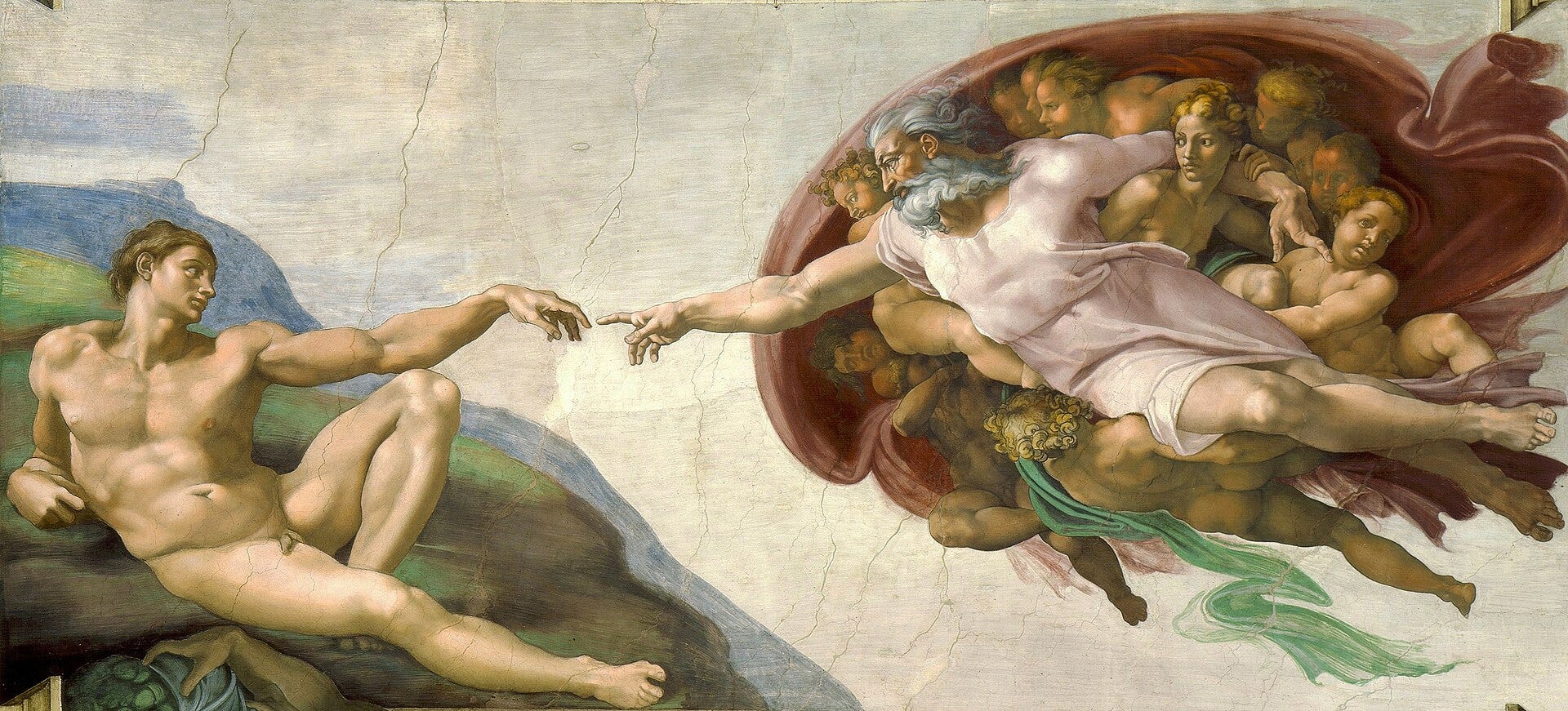
The Creation of Adam is famous because it compresses the whole idea of creation into one gesture: two hands, God's arm outstretched, Adam's hand still limp, a gap of bare air between the fingertips.

Michelangelo placed it at the center of the Sistine Chapel ceiling, where every visitor eventually looks up and finds it.

I have stood under this ceiling and watched people crane their necks looking for exactly one thing, those two hands. I get why. It is the rare artwork that explains itself in one glance, then keeps giving you more the longer you look.

God and Adam reaching toward each other
The Creation of Adam, painted by Michelangelo around 1512, on the Sistine Chapel ceiling

Learn art the fun way. Free stories every week, no boring lectures.


What Makes This Fresco So Famous

The Creation of Adam sits at the center of the Sistine Chapel ceiling, painted by Michelangelo around 1512. It shows God reaching toward Adam, their fingers separated by a small gap of open space.

That gap is the whole point of the composition. Michelangelo chose the instant before contact instead of the instant of contact itself, which is a harder thing to paint well.

The image is simple enough to recognize from a phone screen in under a second, yet complex enough that art historians still argue about small details in it.

Few paintings from any period manage both extremes at once. That combination, instant recognition plus real depth, is the short answer to why this fresco became so famous.

The Hands That Almost Touch

God's hand is tense, fingers extended, his whole arm carrying forward motion. Adam's hand hangs loose, barely lifted off his own knee.

Reading the two hands side by side tells the entire story of the scene. One figure is full of energy and intent, the other is only just waking up.

A popular claim online says the gap between the fingers represents an electrical spark passing from God to Adam. There is no historical evidence Michelangelo meant anything like electricity, a concept that did not exist in his time the way people use it today.

That reading is a modern add on, not something Michelangelo wrote down or that his contemporaries described. It is worth knowing the difference between the two hands as design, and the spark story as later invention.

The Sistine Chapel ceiling
The Creation of Adam is one of nine Genesis scenes running down the center of the ceiling

Part of a Bigger Ceiling

The Creation of Adam is one of nine central panels running down the Sistine Chapel ceiling, each one showing a scene from the book of Genesis.

Michelangelo painted the entire ceiling, roughly 40 meters long, mostly by himself, over about four years starting in 1508.

Visitors often assume Creation of Adam is a standalone painting they can walk up to. In reality it is one scene inside a much larger scheme, viewed from far below on a curved surface, tucked among dozens of other figures.

For more on his life and the rest of his major works, read the complete Michelangelo story.


More Michelangelo and Renaissance art


Michelangelo Almost Said No

Michelangelo considered himself a sculptor first. He pushed back hard when Pope Julius II asked him to paint the ceiling, and he had barely worked in fresco before that point.

He took the job anyway in 1508, and worked mostly standing on a raised scaffold that he designed himself, not lying on his back, despite what popular legend often claims.

That detail matters. It shows a sculptor solving a painting problem with an engineer's instincts, which is part of why the bodies on the ceiling look so solid and physical.

The commission stretched into a project far bigger than anyone, including Michelangelo, expected when it started.

Portrait of Michelangelo
Michelangelo worked on the ceiling from 1508 to 1512, largely by himself

The Restoration That Changed How We See It

Centuries of candle soot, old varnish, and animal glue darkened the ceiling, to the point that most people assumed Michelangelo painted in muted, heavy tones.

A cleaning project ran from 1980 to 1994, carried out by the Vatican Museums, and removed that buildup layer by layer.

The Creation of Adam came back with brighter skin tones and a much sharper line between God's hand and Adam's. Some critics at the time argued the cleaning had gone too far, a debate that still comes up among conservators today.

Most images people see now, in books and online, reflect the restored version, not how the ceiling looked for most of the twentieth century.


Cool Stories About Art is a free newsletter. The stories behind the paintings, straight to your inbox.


Endless Copies and References

The two hands reaching toward each other now show up in advertising, film, cartoons, and phone cases, usually stripped of any religious context at all.

That constant reuse is a big part of why the image feels familiar even to people who have never been to Rome or opened a book on Renaissance art.

A single detail, repeated everywhere for decades, can end up more recognized than the full fresco it came from in the first place.

If you want to see how Michelangelo compares with his biggest rival, the Leonardo vs Michelangelo breakdown lays it out point by point.

Interior of the Sistine Chapel
The Creation of Adam is part of the ceiling of the Sistine Chapel in Vatican City

You Cannot See the Original Anywhere Else

The Creation of Adam is a fresco, meaning the paint was applied directly into wet plaster on the ceiling itself, not on a canvas or wood panel.

There is no traveling version and no way to borrow it for an exhibit somewhere else. Seeing the original means going to the Sistine Chapel in Vatican City and looking up.

That permanence is part of why the image carries so much weight. It has stayed in exactly one place since Michelangelo finished it in the early 1510s.

Why It Still Works After 500 Years

Most Renaissance ceiling paintings need a guidebook to explain who is who and why it matters. This one mostly does not.

Two hands reaching toward each other, one full of intent, one just stirring, reads instantly to almost anyone, in almost any culture, without a caption.

That is rare for religious art from this period, and it is the simplest explanation for why the fresco outlasted the fashions and tastes built up around it.


More paintings, more stories


Why the Creation of Adam is famous: questions people ask

  • Who painted The Creation of Adam?
    Michelangelo, as part of the Sistine Chapel ceiling, which he worked on between 1508 and 1512. This panel is usually dated to around 1511 or 1512.

  • Why don't God and Adam's fingers touch?
    Michelangelo painted the moment just before contact rather than the moment of contact. No surviving source from Michelangelo explains his exact reasoning, so any deeper meaning is interpretation.

  • Is The Creation of Adam a painting or a fresco?
    It is a fresco. The pigment was applied into wet plaster on the ceiling, which is why it cannot be moved or displayed elsewhere.

  • Can you see The Creation of Adam outside the Vatican?
    No. It is part of the physical ceiling of the Sistine Chapel and has never left that location.

  • Is the spark of electricity idea real?
    No. The claim that the gap shows an electrical spark is a modern reading. Electricity as we use the word did not exist in Michelangelo's time.

  • Was The Creation of Adam restored?
    Yes. A cleaning project ran from 1980 to 1994 and removed centuries of soot and old varnish, revealing brighter original colors.

  • Did Michelangelo paint it lying on his back?
    No. He worked standing on a raised scaffold he designed himself, not flat on his back.

  • What does The Creation of Adam show?
    It shows the moment God gives life to Adam, the first human, following the Genesis creation account.


Join 170,000 readers learning art the fun way. Free stories every week, no boring lectures.