
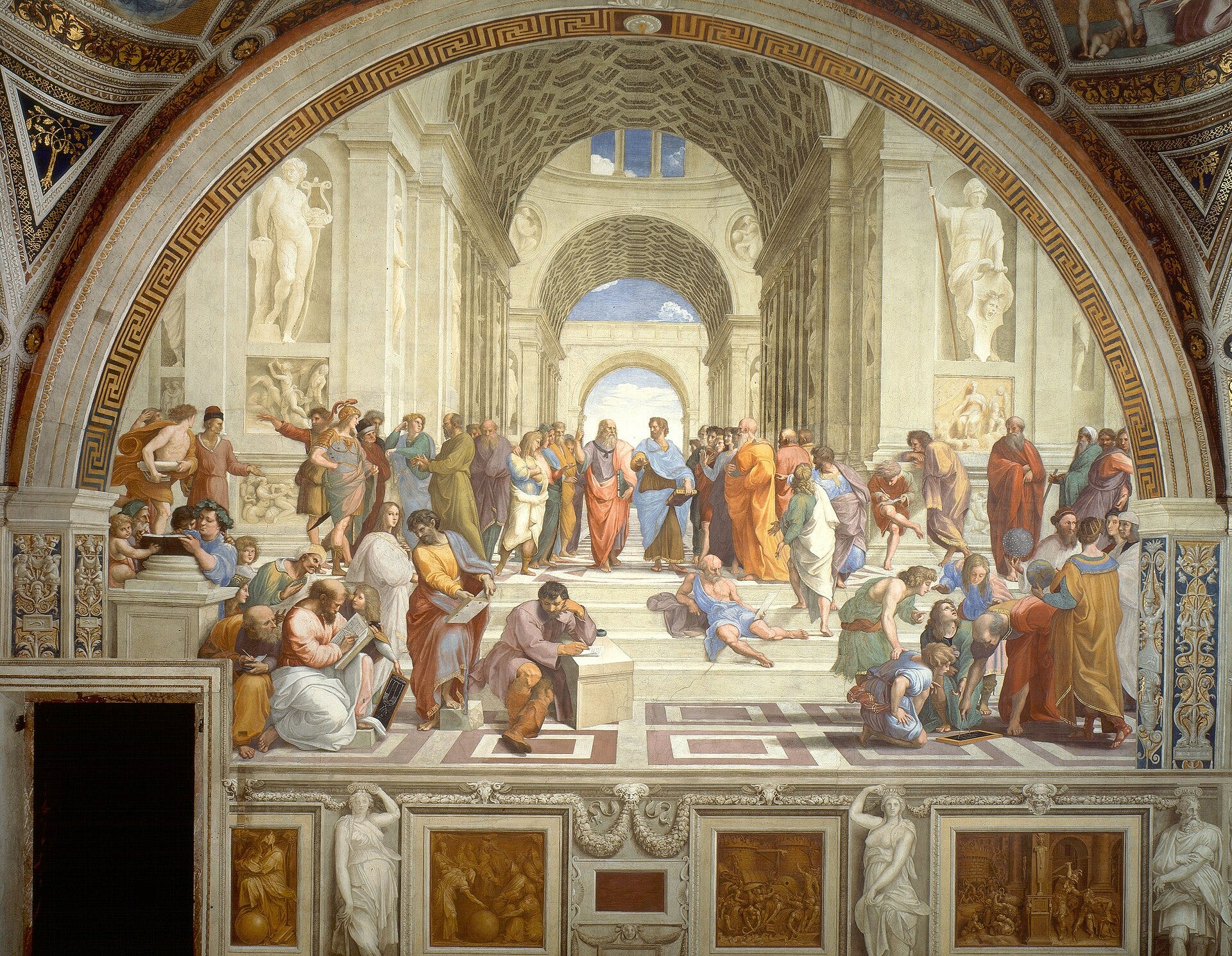
The School of Athens is famous because it puts the whole of ancient philosophy into one room and one view. Raphael painted Plato and Aristotle walking toward us under a great vaulted hall, surrounded by dozens of thinkers who lived centuries apart, on a wall of Pope Julius II's private library in the Vatican, between 1508 and 1511.
It was Raphael's first work in the Vatican, and he was in his mid-twenties. In the nearby Sistine Chapel, Michelangelo was painting the ceiling for the same pope, so for a few years the two painters worked within a short walk of each other.
Cool Stories About Art is a newsletter to learn art the fun way.
Join 200,000+ readers and get:
10 new art stories / month
The entire archive of content (1,000+ articles)
Comment, ask questions, and chat with other readers
The picture everyone admires is not the one its early describers saw. Giorgio Vasari, a painter who wrote “Lives of the Artists”, described this wall in 1550, about forty years after Raphael finished it, and he saw no school of philosophy. He saw theologians reconciling philosophy and astrology with Christian theology.
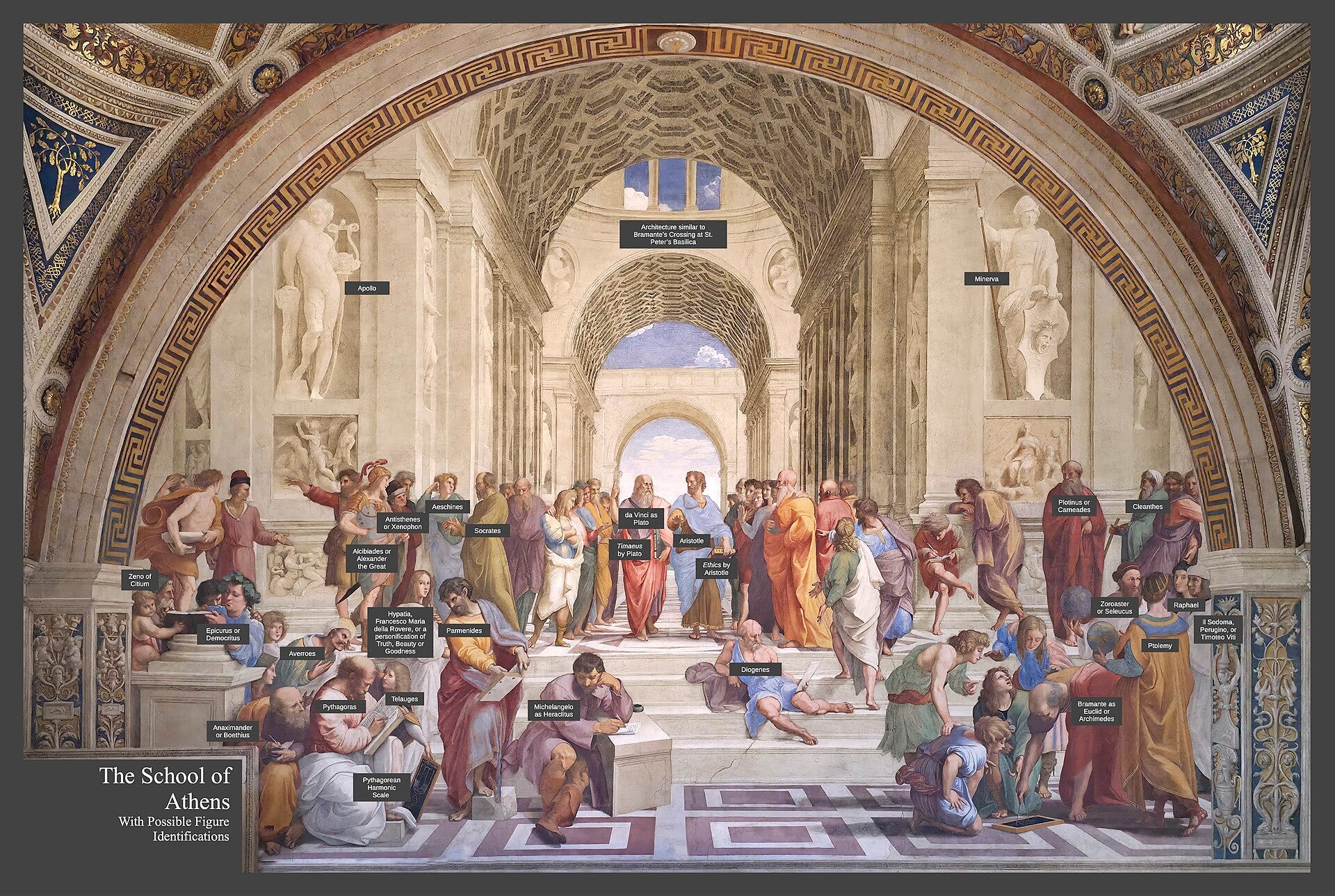
He also saw Saint Matthew copying from a tablet that an angel held in front of him. No angel appears anywhere on the wall. Raphael left no list saying who is who, and the title is not his either: the Pinacoteca Ambrosiana in Milan, which owns his full-size drawing for the wall, says the proper title is Philosophy.
The picture that now stands for ancient philosophy was first described by the best-known biographer of Renaissance artists as a scene of theologians and a saint, and most of what people now say about its faces was added after him.
Whose paintings did the pope have destroyed?
The older masters who had worked in the same rooms, if Vasari is to be believed. In his telling, the same account explains how Raphael got the wall: the job began with a letter.
Donato Bramante, the architect rebuilding Saint Peter's for Julius II, came from Urbino like Raphael and was a distant relation. He wrote to Raphael in Florence that he had won the pope over, and that the new rooms would give Raphael a chance to show his worth.
Raphael left an altarpiece unfinished and went to Rome. The palace was already full of painters. Vasari lists Piero della Francesca, who had finished a scene in one room, and a Milanese painter admired for portraits from life.
Then Raphael began work in the Stanza della Segnatura, the room that holds the School of Athens, and Julius was so pleased, Vasari wrote, that he had “all the scenes of the other masters, both the old and the new, to be thrown to the ground, so that Raffaello alone might have the glory.”
One painter's work survived: Sodoma had decorated the ceiling of the room, and Raphael decided to keep its framework and decorations.
Vasari wrote decades later, so the detail deserves caution. What the room was for is better documented. According to the Vatican Museums, Julius used it as a library and private office, and that it takes its name from the Segnatura, the highest court of the Holy See. Its frescoes give each wall one idea: theology, philosophy, law and poetry.
The Vatican describes the School of Athens as the image of rational truth, and sets it against the wall of theology. A pope who hung Greek pagans across from the Church's doctrine was saying that reason and faith could share a library. To show that, Raphael needed a place where all the thinkers could stand together.
What You'll Discover
What Plato and Aristotle hold.
Whose faces are really in the crowd.
Who Raphael added after the drawing.
How the fresco got its name.