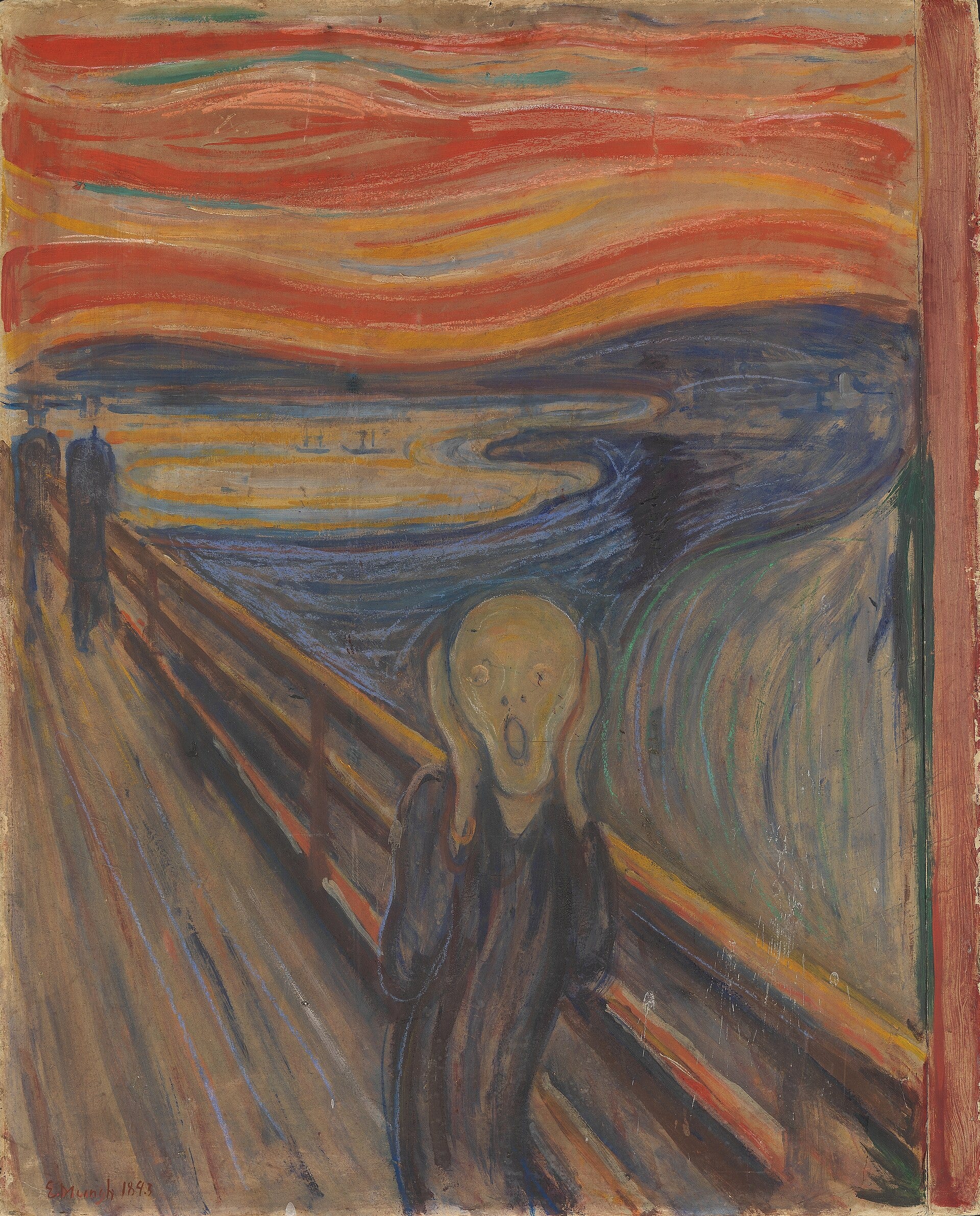
Why Is The Scream So Famous?

The Scream is famous because Edvard Munch turned a single moment of panic on a bridge near Oslo into an image everyone recognizes.

He painted four versions starting in 1893, one was stolen twice, and the 1895 pastel sold for 119.9 million dollars at auction in 2012, still one of art's highest prices.

I used to assume the figure in The Scream was the one screaming, until I read Munch's own account. He is the one hearing it, hands over his ears, which changes how I look at the painting every time now.

The Scream by Edvard Munch
The Scream, Edvard Munch, 1893, National Gallery, Norway
Photograph of Edvard Munch
Edvard Munch, Norwegian painter, 1863 to 1944

Learn art the fun way. Free stories every week, no boring lectures.


Who was Edvard Munch

Edvard Munch was born in Norway in 1863. His mother died of tuberculosis when he was five, and a sister died of the same disease when he was fourteen.

Another sister was diagnosed with a mental illness and spent time in an asylum. Munch later wrote that sickness, insanity, and death were the angels that surrounded his cradle.

He trained in Kristiania, now Oslo, then spent years moving between Norway, Germany, and France, absorbing symbolism and early expressionist ideas.

His later work helped set the stage for expressionism, a movement we explain in one minute elsewhere.

The walk that inspired it

Munch described the moment behind the painting in his diary. He was walking with two friends near Kristiania at sunset when the sky suddenly turned blood red.

He wrote that he stopped, felt exhausted, and sensed an infinite scream passing through nature. His friends walked on while he stood there, shaking with anxiety.

The location he described sat near a slaughterhouse and the asylum where his sister was committed, both places he would have known well.

The National Gallery in Oslo
The National Gallery in Oslo, former home of one version of The Scream

Four versions, not one

There is no single Scream. Munch made four versions between 1893 and 1910, two in paint and two in pastel.

The two 1893 versions are a tempera and casein on cardboard, held by the National Gallery in Oslo, and a pastel on cardboard, held by the Munch Museum.

A third version, a pastel from 1895, stayed in private hands for most of its history. The fourth, a tempera from 1910, belongs to the Munch Museum.


More on Munch, anxiety and art heists


What the title actually means

Most people assume the figure in the painting is the one screaming. That is worth correcting.

Munch's own diary entry describes hearing a scream from nature itself, not producing one. In the painting the figure has stopped on a bridge, hands pressed to its ears, as if trying to block the sound out rather than make it.

The original Norwegian title, Skrik, is ambiguous in the same way English is, but Munch's written account points toward a figure reacting to a scream, not screaming.

The 1994 theft

On February 12, 1994, the same morning the Winter Olympics opened in Lillehammer, thieves broke into the National Gallery in Oslo and took the 1893 tempera version in under a minute.

They left a note reading thanks for the poor security. Norwegian police recovered the painting undamaged three months later, in May 1994, after a sting operation involving British detectives.


Cool Stories About Art is a free newsletter. The stories behind the paintings, straight to your inbox.


The 2004 theft

A decade later, in August 2004, armed robbers stole a different version of The Scream, along with Munch's Madonna, from the Munch Museum in broad daylight.

Both paintings were missing for two years and came back damaged by moisture and light exposure. They were recovered in 2006, and the museum spent years restoring them.

It is one of several episodes we cover in our rundown of the biggest museum thefts in history.

The record auction sale

In May 2012, the 1895 pastel version, the only one still in private hands, sold at Sotheby's in New York for 119.9 million dollars.

It was the highest price ever paid for a work of art at auction at that time. The buyer was later revealed to be American financier Leon Black.

Detail of the sky in The Scream
Detail of the swirling sky in The Scream, an image of modern anxiety

Why it became an icon of modern anxiety

The Scream became shorthand for existential dread decades before that phrase was common. Its swirling sky and faceless figure translate easily across language and culture, which is part of why it gets reproduced so often.

Two thefts and a record sale kept it in the news well past its own century, adding a layer of real world drama to a painting already built around panic.

We cover Munch's full life and this painting in the complete Munch story.


Wander a little further


Why The Scream is so famous: questions people ask

  • Why is The Scream so famous?
    Edvard Munch turned a single panic attack near Oslo into an image everyone recognizes, painted it in four versions from 1893 onward, and one copy sold for 119.9 million dollars in 2012.

  • How many versions of The Scream are there?
    Four. Two from 1893, one from 1895, and one from 1910, split between the National Gallery in Oslo, the Munch Museum, and a private collector.

  • Is the figure in The Scream the one screaming?
    Munch's own diary suggests the figure is reacting to a scream heard in nature, hands pressed over its ears, rather than producing the scream itself.

  • Was The Scream stolen?
    Yes, twice. Once in 1994 from the National Gallery in Oslo, recovered after three months, and again in 2004 from the Munch Museum, recovered in 2006.

  • How much did The Scream sell for?
    The 1895 pastel version sold at Sotheby's in 2012 for 119.9 million dollars, a record for a work of art at auction at the time.

  • Where can I see The Scream today?
    Two versions are in Oslo, at the National Gallery and the Munch Museum. The 1895 pastel is in a private collection.

  • What inspired The Scream?
    Munch described walking near Kristiania at sunset when the sky turned blood red and he felt an infinite scream pass through nature.

  • Who is Edvard Munch?
    A Norwegian painter, born in 1863, whose work dealing with illness, death, and anxiety helped shape early expressionism.


Join 170,000 readers learning art the fun way. Free stories every week, no boring lectures.